Edited by A. Corti
and M. Reid
Explicit Birational Geometry of 3-folds
One of the main achievements of algebraic geometry over the
last 20 years is the work of Mori and others extending minimal
models and the Enriques-Kodaira classification to 3-folds. This
book is an integrated suite of papers centred around applications
of Mori theory to birational geometry and its contributions work
for the first time with a representative class of Fano varieties,
3-fold hypersurfaces in weighted projective space, and include an
attractive introductory treatment and a wealth of detailed
computation of special cases.
Foreword; 1. One parameter families containing three
dimensional toric Gorenstein singularities K. Altmann; 2.
Nonrational covers of CPm ・ CPn J. Kollar; 3. Essentials of the
method of maximal singularities A. V. Pukhlikov; 4. Working with
weighted complete intersections A. R. Iano-Fletcher; 5. Fano
3-fold hypersurfaces A. Corti, A. V. Pukhlikov and M. Reid; 6.
Singularities of linear systems and 3-fold birational geometry A.
Corti; 7. Twenty five years of 3-folds -an old person's view M.
Reid.
London Mathematical Society Lecture Note Series, 281
0 521 63641 8 Paperback 360pp
Hans L. Pecseli
Universitetet i Oslo
Fluctuations in Physical Systems
This book provides a simple and accessible introduction to the
statistical description and analysis of fluctuations and
diffusion. It starts by introducing the ideas underlying the
subject, develops the necessary mathematical tools, and goes on
to apply them in a variety of physical contexts. The approach of
the book is rooted in reality, starting from a consideration of
how fluctuations arise in actual physical examples. It is a
useful and attractive text for senior undergraduate and graduate
physics students, and anyone else who wants an accessible
introduction to the subject.
1. Introduction; 2. Elements of statistical analysis; 3.
Fluctuations in electric circuits; 4. The fluctuation-dissipation
theorem; 5. The Kramers-Kronig relation; 6. Brownian motion; 7.
Random walk; 8. Density fluctuations in gases; 9. A reference
model; 10. Markov processes; 11. Diffusion of particles; 12.
Thermal fluctuations in a diode; 13. Fermi-acceleration; A. The
binomial distribution; B. The Poisson distribution; C. The
gaussian distribution; D. Dirac's d-function; E. Physical
constants; F. The MKSA-units.
0 521 65192 1 Hardback 200pp
0 521 65592 7 Paperback 200pp
Donald B. Percival
and Andrew T. Walden
Wavelet Methods for Time Series Analysis
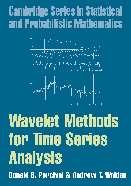 Data in the form of time series are routinely collected in
science, engineering, and other areas such as finance and
economics. This is an introduction to wavelet analysis 'from the
ground level and up' and to wavelet-based statistical analysis of
time series. It focuses on practical discrete time techniques,
with detailed descriptions of the theory and algorithms needed to
understand and implement the discrete wavelet transforms.
Numerous examples illustrate the techniques on actual time
series. The many embedded exercises - with full solutions
provided in the Appendix - allow use of the book for self-guided
study; additional exercises can be used in a classroom setting. A
Web site gives access to the time series and wavelets used in the
book, as well as information on accessing software in S-Plus and
other languages. This book will be welcomed by all students and
researchers wishing to use wavelet methods to analyse time
series.
Data in the form of time series are routinely collected in
science, engineering, and other areas such as finance and
economics. This is an introduction to wavelet analysis 'from the
ground level and up' and to wavelet-based statistical analysis of
time series. It focuses on practical discrete time techniques,
with detailed descriptions of the theory and algorithms needed to
understand and implement the discrete wavelet transforms.
Numerous examples illustrate the techniques on actual time
series. The many embedded exercises - with full solutions
provided in the Appendix - allow use of the book for self-guided
study; additional exercises can be used in a classroom setting. A
Web site gives access to the time series and wavelets used in the
book, as well as information on accessing software in S-Plus and
other languages. This book will be welcomed by all students and
researchers wishing to use wavelet methods to analyse time
series.
1. Introduction to wavelets; 2. Review of Fourier theory and
filters; 3. Orthonormal transforms of time series; 4. The
discrete wavelet transform; 5. The maximal overlap discrete
wavelet transform; 6. The discrete wavelet packet transform; 7.
Random variables and stochastic processes; 8. The wavelet
variance; 9. Analysis and synthesis of long memory processes; 10.
Wavelet-based signal estimation; 11. Wavelet analysis of finite
energy signals; Appendix. Answers to embedded exercises;
References; Author index; Subject index.
0 521 64068 7 Hardback
2000 253 x 177 mm 620pp 24 tables 119 exercises 181 figures