Piermarco Cannarsa, Universita di Roma, Tor Vergata, Carlo
Sinestrari
Semiconcave Functions and Optimal Control
Series: Progress in Nonlinear Differential
Equations and Their
Applications, Vol. 4000
350 pages , 6 1/8 x 9 , paperback
ISBN: 0-8176-4084-3, published 2004
ABOUT THIS BOOK
Semiconcavity is a natural generalization
of concavity that
retains most of the good properties known
in convex analysis, but
arises in a wider range of applications.
This text is the first
comprehensive exposition of the theory of
semiconcave functions,
and of the role they play in optimal control
and Hamilton--Jacobi
equations. The first part he general theory,
encompassing all key
results and illustrating them with significant
examples. The
latter part is devoted to applications concerning
the Bolza
problem in calculus of variations and optimal
exit time problems
for nonlinear control systems. The exposition
is essentially self-contained
since the book includes all prerequisites
from convex analysis,
nonsmooth analysis, and viscosity solutions.
A central role in
the present work is reserved for the study
of singularities.
Singularities are first investigated for
general semiconcave
functions, then sharply estimated for solutions
of Hamilton--Jacobi
equations, and finally analyzed in connection
with optimal
trajectories of control systems. Researchers
in optimal control,
the calculus of variations, and partial differential
equations
will find this book useful as a state-of-the-art
reference for
semiconcave functions. Graduate students
will profit from this
text as it provides a handy---yet rigorous---introduction
to
modern dynamic programming for nonlinear
control systems.
Klaus Ecker, Freie Universitat Berlin, Berlin, Germany
Regularity Theory for Mean Curvature Flow
Series: Progress in Nonlinear Differential
Equations and Their
Applications, Vol. 57
144 pages , 6 1/8 x 9 , 16 illus., hardcover
ISBN: 0-8176-3243-3, published 2004
ABOUT THIS BOOK
Mean curvature flow and related geometric
evolution equations are
important tools in mathematics and mathematical
physics. A major
example is Hamilton's Ricci flow program,
which has the aim of
settling Thurston's geometrization conjecture,
with recent major
progress due to Perelman. Another important
application of a
curvature flow process is the resolution
of the famous Penrose
conjecture in general relativity by Huisken
and Ilmanen.
Under mean curvature flow, surfaces usually
develop singularities
in finite time. This work presents techniques
for the study of
singularities of mean curvature flow and
is largely based on the
work of K. Brakke, although more recent developments
are
incorporated.
Key features and topics of this self-contained,
systematic
exposition:
* A detailed account of techniques (including
some of Brakke's
original ones) leading to a proof of Brakke's
main regularity
theorem
* Preliminary material begins with the concept
of mean curvature
flow, illustrated with important examples
and special solutions
including a detailed discussion of homethetic
solutions
* Local pointwise estimates on geometric
quantities for smooth
solutions of mean curvature flow are derived
in a streamlined
presentation
* Rescaling methods, monotonicity formulas,
and mean value
inequalities are presented
* Two local regularity theorems and an estimate
of the singular
set are established
* Definitions and facts for hypersurfaces
in Euclidean space,
used throughout the text, are listed in an
appendix, along with
some background on geometric measure theory
* Relations to the regularity theory for
minimal surfaces, as in
Allard's and de Giorgi's work, are outlined
* Good bibliography and index
Graduate students and researchers in nonlinear
PDEs, differential
geometry, geometric measure theory and mathematical
physics will
benefit from this work.
TABLE OF CONTENTS
Introduction * Preliminaries, Examples and
Global Behaviour *
Local Estimates for Smooth Solutions * Integral
Behaviour,
Monotonicity and Consequences * Regularity
Theory at the First
Singular Time * Appendix * A. Geometry of
Hypersurfaces * B.
Evolution Equations for Mean Curvature Flow
* C. Some Background
on Geometric Measure Theory * References
* Index
Jeffrey A. Hogan, University of Arkansas, Fayetteville, AR
Joseph D. Lakey, New Mexico State University,
Las Cruces, NM
Time Frequency and Time-Scale Methods
Adaptive Decompositions, Uncertainty Principles,
and Sampling
Series: Applied and Numerical Harmonic Analysis
400 pages , 6 1/8 x 9 , 40 illus., hardcover
ISBN: 0-8176-4276-5, published 2004
ABOUT THIS BOOK
The goal of the book is to develop a deeper
understanding of the
roles of time-frequency or Fourier and Gabor
analysis, and time-scale
or wavelet analysis, when the various tools
are properly
assembled in a larger context. While researchers
at the forefront
of developments in time-frequency scale (TFS)
analysis are well
aware of the benefits of such a unified approach,
there remains a
gap in the larger community of practitioners
concerning precisely
the strengths and limitations of Gabor analysis
versus wavelets.
The book fills this gap by presenting the
interface between time-frequency
and time-scale methods as a rich area of
work. Topics and
Features- *Self-contained core material is
presented in the first
part of the book *Second part addresses new
TFS methods and
algorithms *Presents an integrated approach
to using Fourier/Gabor
methods and wavelet methods *Real world applications
of Gabor
theory, wavelets to PDEs and wavelets to
compression *Develops
the ideas of phase space and the uncertainty
principle focusing
on the role of the metaplectic group and
the flexibility in
constructing analysis tools *Explanations
at the end of each
chapter address historical context, major
developments and new
directions. Electrical engineers and applied
mathematicians in
signal and image processing analysis and
communication theory
will find an authoritative, systematic presentation
of this
active field of modern analysis and applications.
Researchers and
professionals in wavelets and mathematical
signal analysis will
find this an up-to-date resource.
TABLE OF CONTENTS
1. Preliminaries
2. Discrete and Continuous Fourier Analysis
3. Continuous and Discrete Wavelet Analysis
4. Time-frequency Versus Time-scale
5. Fourier and Wavelets: the Best of Both
Worlds
6. Phase Space and the Metaplectic Group
7. All About Uncertainty
8. Function Spaces and Operator Theory
9. Regular and Irregular Sampling in Fourier
and Wavelet Analysis
10. Further Applications
Archimedes, Edited and translated by Reviel Netz
The Works of Archimedes
Translation and Commentary
Volume 1, The Two Books On the Sphere and
the Cylinder
February 2004 | Hardback | 386 pages 108
line diagrams | ISBN:
0-521-66160-9
Archimedes was the greatest scientist of
antiquity and one of the
greatest of all time. This book is Volume
1 of the first
authoritative translation of his works into
English. It is also
the first publication of a major ancient
Greek mathematician to
include a critical edition of the diagrams,
and the first
translation into English of Eutocius’ ancient
commentary on
Archimedes. Furthermore, it is the first
work to offer recent
evidence based on the Archimedes Palimpsest,
the major source for
Archimedes, lost between 1915 and 1998. A
commentary on the
translated text studies the cognitive practice
assumed in writing
and reading the work, and it is Reviel Netz’s
aim to recover
the original function of the text as an act
of communication.
Particular attention is paid to the aesthetic
dimension of
Archimedes’ writings. Taken as a whole,
the commentary offers a
groundbreaking approach to the study of mathematical
texts.
Contents
Introduction; On Sphere and Cylinder Book
I; On Sphere and
Cylinder Book II; Eutocius’ Commentary to
On Sphere and
Cylinder Book I; Eutocius’ Commentary to
On Sphere and Cylinder
Book II.
Desmond Higham
An Introduction to Financial Option Valuation
Mathematics, Stochastics and Computation
March 2004 | Paperback | 276 pages 120 exercises
95 figures 80
worked examples | ISBN: 0-521-54757-1
March 2004 | Hardback | 276 pages 120 exercises
95 figures 80
worked examples | ISBN: 0-521-83884-3
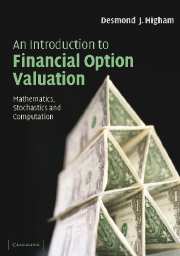 This is a lively textbook providing a solid
introduction to
financial option valuation for undergraduate
students armed with
a working knowledge of a first year calculus.
Written in a series
of short chapters, its self-contained treatment
gives equal
weight to applied mathematics, stochastics
and computational
algorithms. No prior background in probability,
statistics or
numerical analysis is required. Detailed
derivations of both the
basic asset price model and the Black?Scholes
equation are
provided along with a presentation of appropriate
computational
techniques including binomial, finite differences
and in
particular, variance reduction techniques
for the Monte Carlo
method. Each chapter comes complete with
accompanying stand-alone
MATLAB code listing to illustrate a key idea.
Furthermore, the
author has made heavy use of figures and
examples, and has
included computations based on real stock
market data. Solutions
to exercises are available from solutions@cambridge.org.
This is a lively textbook providing a solid
introduction to
financial option valuation for undergraduate
students armed with
a working knowledge of a first year calculus.
Written in a series
of short chapters, its self-contained treatment
gives equal
weight to applied mathematics, stochastics
and computational
algorithms. No prior background in probability,
statistics or
numerical analysis is required. Detailed
derivations of both the
basic asset price model and the Black?Scholes
equation are
provided along with a presentation of appropriate
computational
techniques including binomial, finite differences
and in
particular, variance reduction techniques
for the Monte Carlo
method. Each chapter comes complete with
accompanying stand-alone
MATLAB code listing to illustrate a key idea.
Furthermore, the
author has made heavy use of figures and
examples, and has
included computations based on real stock
market data. Solutions
to exercises are available from solutions@cambridge.org.
Contents
1. Introduction; 2. Option valuation preliminaries;
3. Random
variables; 4. Computer simulation; 5. Asset
price movement; 6.
Asset price model: part I; 7. Asset price
model: part II; 8.
Black?Scholes PDE and formulas; 9. More on
hedging; 10. The
Greeks; 11. More on the Black?Scholes formulas;
12. Risk
neutrality; 13. Solving a nonlinear equation;
14. Implied
volitility; 15. The Monte Carlo method; 16.
The binomial method;
17. Cash-or-nothing options; 18. American
options; 19. Exotic
options; 20. Historical volatility; 21. Monte
Carlo part II:
variance reduction by antithetic variates;
22. Monte Carlo part
III: variance reduction by control variates;
23. Finite
difference methods; 24. Finite difference
methods for the
Black?Scholes