Joseph Rudnick, George Gaspari
Elements of the Random Walk
An introduction for Advanced Students and
Researchers
January 2004 | Hardback | 345 pages 102 line
diagrams 2 half-tones
2 tables 97 exercises | ISBN: 0-521-82891-0
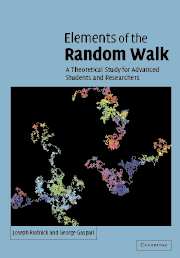 Random walks have proven to be a useful model
in understanding
processes across a wide spectrum of scientific
disciplines.
Elements of the Random Walk is an introduction
to some of the
most powerful and general techniques used
in the application of
these ideas. The mathematical construct that
runs through the
analysis of the topics covered in this book,
unifying the
mathematical treatment, is the generating
function. Although the
reader is introduced to modern analytical
tools, such as path-integrals
and field-theoretical formalism, the book
is self-contained in
that basic concepts are developed and relevant
fundamental
findings fully discussed. Mathematical background
is provided in
supplements at the end of each chapter, when
appropriate. This
self-contained text will appeal to graduate
students across
science, engineering and mathematics who
need to understand the
applications of random walk techniques, as
well as to established
researchers.
Random walks have proven to be a useful model
in understanding
processes across a wide spectrum of scientific
disciplines.
Elements of the Random Walk is an introduction
to some of the
most powerful and general techniques used
in the application of
these ideas. The mathematical construct that
runs through the
analysis of the topics covered in this book,
unifying the
mathematical treatment, is the generating
function. Although the
reader is introduced to modern analytical
tools, such as path-integrals
and field-theoretical formalism, the book
is self-contained in
that basic concepts are developed and relevant
fundamental
findings fully discussed. Mathematical background
is provided in
supplements at the end of each chapter, when
appropriate. This
self-contained text will appeal to graduate
students across
science, engineering and mathematics who
need to understand the
applications of random walk techniques, as
well as to established
researchers.
Contents
1. Introduction to techniques; 2. Generating
functions I; 3.
Generating functions II: recurrence, sites
visited and the role
of dimensionality; 4. Boundary conditions,
steady state and the
electrostatic analogy; 5. Variations on the
random walk; 6. The
shape of a random walk; 7. Path integrals
and self-avoidance; 8.
Properties of the random walk: introduction
to scaling; 9.
Scaling of walks and critical phenomena;
10. Walks and the O(n)
model: mean field theory and spin waves;
11. Scaling, fractals
and renormalization; 12. More on the renormalization
group.
Jean-Pierre Antoine, Romain Murenzi, Pierre Vandergheynst,
Syed Twareque Ali
Two-Dimensional Wavelets and their Relatives
July 2004 | Hardback | 450 pages 115 line
diagrams 19 half-tones
3 tables 137 figures | ISBN: 0-521-62406-1
Two-dimensional wavelets offer a number of
advantages over
discrete wavelet transforms when processing
rapidly varying
functions and signals. In particular, they
offer benefits for
real-time applications such as medical imaging,
fluid dynamics,
shape recognition, image enhancement and
target tracking. This
book introduces the reader to 2-D wavelets
via 1-D continuous
wavelet transforms, and includes a long list
of useful
applications. The authors then describe in
detail the underlying
mathematics before moving on to more advanced
topics such as
matrix geometry of wavelet analysis, three-dimensional
wavelets
and wavelets on a sphere. Throughout the
book, practical
applications and illustrative examples are
used extensively,
ensuring the book’s value to engineers,
physicists and
mathematicians alike.
Contents
Prologue; 1. Warm-up: the 1-D continuous
wavelet transform; 2.
The 2-D continuous wavelet transform; 3.
Some 2-D wavelets and
their performances; 4. Applications of the
2-D CWT I. Image
processing; 5. Applications of the 2-D CWT
II. Physical
applications; 6. Matrix geometry of wavelet
analysis I; 7. Matrix
geometry of wavelet analysis II; 8. Minimal
uncertainty and
Wigner transformations; 9. Higher-dimensional
wavelets; 10.
Spatio-temporal wavelets and motion estimation;
11. Beyond
wavelets; Epilogue; Appendix 1; Bibliography;
Index.
Jeff Zhuk
Integration-Ready Architecture and Design
Software Engineering with XML, Java, .NET,
Wireless, Speech, and
Knowledge Technologies
May 2004 | Paperback | 300 pages 50 line
diagrams | ISBN: 0-521-52583-7
The book offers examples of technologies
providing access to
corporate data and services not only from
corporate workstations
but also from multiple types of wired and
wireless devices and
Personal Digital Assistants. The author shares
experiences of
transforming business for e-business and
extending services to
the wireless world. Internet and wireless
service developers will
find unique recipes for creating 訴ntegration
ready・J2EE based
components. Architects, designers, coders,
and even management
will find innovative ideas and detailed examples
of building
multi-dimensional enterprise applications.
A 爽nified service・approach
is demonstrated while creating a core of
business frameworks, and
then building presentation factories of VoiceXML,
WAP, and Web
technologies providing access to corporate
data and services for
wired and wireless clients, devices, and
PDAs.
Contents
Introduction - wired and wireless worlds;
1. Enterprise
application development process; 2. J2EETM
based Frameworks; 3.
Telco system management framework; 4 WAP/WML
wireless
applications; 5. VoiceXML speech technology;
6. Data
consolidation under JNDITM umbrella; 7. Spatial
data support (GIS)
with Java technology; 8. Java client challenges
and solutions; 9.
Federation of distributed knowledge; 10.
Web service support
technologies; Summary; Appendix.
Enzo Olivieri, Maria Eulalia Vares
Large Deviations and Metastability
August 2004 | Hardback | 575 pages 50 line
diagrams | ISBN: 0-521-59163-5
This book provides a self-contained account
of the main results
in large deviation theory up to some rather
recent developments.
Particular emphasis is given to the fundamental
Freidlin-Wentzell
results on small random perturbations of
dynamical systems.
Metastability is first described on physical
grounds, following
which more rigorous apprroaches to its description
are developed.
Many relevant examples are considered from
the point of view of
the so-called pathwise approach. The first
part of the book
develops the relevant tools including the
theory of large
deviations which are then used to provide
a physically relevant
dynamical description of metastability. Written
to be accessible
to graduate students this book provides an
excellent route into
contemporary research.
Contents
1. Large deviations: basic results; 2. Small
random perturbations
of dynamical systems; 3. Large deviations
and statistical
mechanics; 4. Metastability- General description,
Curie Weiss
model. Contact process; 5. Metastability
- Models of Freidlin and
Wentzell; 6. Reversible Markov chains in
the Freidlin-Wentzell
regime; 7. Metastable behaviour for lattice
spin models at low
temperature
Mauro Dardo
Nobel Laureates and 20th Century Physics
September 2004 | Hardback | 540 pages 52 line diagrams 173
half-tones 3 tables | ISBN: 0-521-83247-0
September 2004 | Paperback| 540 pages 52 line diagrams 173 half-tones
3 tables | ISBN: 0-521-54008-9
In this richly-illustrated book the author combines history with
real science. Using an original approach he presents the major
achievements of twentieth-century physics - for example,
relativity, quantum mechanics, atomic and nuclear physics, the
invention of the transistor and the laser, superconductivity,
binary pulsars, and the Bose-Einstein condensate - each as they
emerged as the product of the genius of those physicists whose
labours, since 1901, have been crowned with a Nobel Prize. Here,
in the form of a year-by-year chronicle, biographies and
revealing personal anecdotes help bring to life the main events
of the past hundred years. The work of the most famous physicists
of the twentieth century - great names, like the Curies, Bohr,
Heisenberg, Einstein, Fermi, Feynman, Gell-Mann, Rutherford, and
Schringer - is presented, often in the words and imagery of
the prize-winners themselves.
Contents
1. Introduction; 2. Founding fathers; 3. Highlights of classical
physics; 4. The Triumphs of Modern Physics (1901・950): 4. New
foundations; 5. The quantum atom; 6. The golden years; 7. The
thirties; 8. The nuclear age; II. New Frontiers (1951・003): 9.
Wave of inventions; 10. New vistas on the cosmos; 11. The small,
the large - the complex; 12. Big physics - small physics; 13. New
trends.