Theodore Frankel
The Geometry of Physics
An Introduction, 2nd Edition
Publication is planned for March 2004 | Hardback
| 720 pages
120 line diagrams | ISBN: 0-521-83330-2
Publication is planned for March 2004 | Paperback
| 720 pages 120
line diagrams | ISBN: 0-521-53927-7
This book provides a working knowledge of
those parts of exterior
differential forms, differential geometry,
algebraic and
differential topology, Lie groups, vector
bundles and Chern forms
that are essential for a deeper understanding
of both classical
and modern physics and engineering. Included
are discussions of
analytical and fluid dynamics, electromagnetism
(in flat and
curved space), thermodynamics, the deformation
tensors of
elasticity, soap films, special and general
relativity, the Dirac
operator and spinors, and gauge fields, including
Yang-Mills, the
Aharonov-Bohm effect, Berry phase, and instanton
winding numbers,
quarks, and quark model for mesons. Before
discussing abstract
notions of differential geometry, geometric
intuition is
developed through a rather extensive introduction
to the study of
surfaces in ordinary space; consequently,
the book should be of
interest also to mathematics students. Ideal
for graduate and
advanced undergraduate students of physics,
engineering and
mathematics as a course text or for self
study.
Contents
Preface; Part I. Manifolds, Tensors and Exterior
Forms: 1.
Manifolds and vector fields; 2. Tensors and
exterior forms; 3.
Integration of differential forms; 4. The
Lie derivative; 5. The
Poincare lemma and potentials; 6. Holonomic
and non-holonomic
constraints; Part II. Geometry and Topology:
7. R3 and Minkowski
space; 8. The geometry of surfaces in R3;
9. Covariant
differentiation and curvature; 10. Geodesics;
11. Relativity,
tensors, and curvature; 12. Curvature and
topology: Synge’s
theorem; 13. Betti numbers and de Rham’s
theorem; 14. Harmonic
forms; Part III. Lie Groups, Bundles and
Chern Forms: 15. Lie
groups; 16. Vector bundles in geometry and
physics; 17. Fiber
bundles, Gauss-Bonnet, and topological quantization;
18.
Connections and associated bundles; 19. The
Dirac equation; 20.
Yang-Mills fields; 21. Betti numbers and
covering spaces; 22.
Chern forms and homotopy groups; Appendix
A. Forms in continuum
mechanics; Appendix B. Harmonic chains and
Kirchhoff’s circuit
laws; Appendix C. Symmetries, quarks, and
meson masses; Appendix
D. Representations and hyperelastic bodies;
Appendix E: Orbits
and Morse-Bott theory in compact Lie groups.
Michel Le Bellac, Fabrice Mortessagne, George Batrouni
Equilibrium and Non-Equilibrium Statistical
Thermodynamics
Publication is planned for April 2004 | Hardback
| 628 pages
154 line diagrams 10 tables | ISBN: 0-521-82143-6
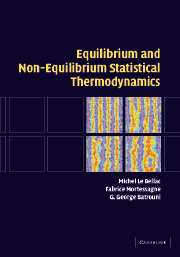 This graduate-level text gives a self-contained
exposition of
fundamental topics in modern equilibrium
and nonequilibrium
statistical thermodynamics. The text follows
a balanced approach
between the macroscopic (thermodynamic) and
microscopic (statistical)
points of view. The first half of the book
deals with equilibrium
thermodynamics and statistical mechanics.
In addition to standard
subjects, the reader will find a detailed
account of broken
symmetries, critical phenomena and the renormalization
group, as
well as an introduction to numerical methods.
The second half of
the book is devoted to nonequilibrium phenomena,
first following
a macroscopic approach, with hydrodynamics
as an important
example. Kinetic theory receives a thorough
treatment through
analysis of the Boltzmann-Lorentz model and
the Boltzmann
equation. The book concludes with general
nonequilibrium methods
such as linear response, projection method
and the Langevin and
Fokker-Planck equations, including numerical
simulations. This
advanced textbook will be of interest to
graduate students and
researchers in physics.
This graduate-level text gives a self-contained
exposition of
fundamental topics in modern equilibrium
and nonequilibrium
statistical thermodynamics. The text follows
a balanced approach
between the macroscopic (thermodynamic) and
microscopic (statistical)
points of view. The first half of the book
deals with equilibrium
thermodynamics and statistical mechanics.
In addition to standard
subjects, the reader will find a detailed
account of broken
symmetries, critical phenomena and the renormalization
group, as
well as an introduction to numerical methods.
The second half of
the book is devoted to nonequilibrium phenomena,
first following
a macroscopic approach, with hydrodynamics
as an important
example. Kinetic theory receives a thorough
treatment through
analysis of the Boltzmann-Lorentz model and
the Boltzmann
equation. The book concludes with general
nonequilibrium methods
such as linear response, projection method
and the Langevin and
Fokker-Planck equations, including numerical
simulations. This
advanced textbook will be of interest to
graduate students and
researchers in physics.
Contents
Preface; 1. Thermodynamics; 2. Statistical
entropy and Boltzmann
distribution; 3. Canonical and grand-canonical
ensembles; 4.
Critical phenomena; 5. Quantum statistics;
6. Irreversible
processes: macroscopic theory; 7. Numerical
simulations; 8.
Irreversible processes: kinetic theory; 9.
Topics in non-equilibrium
statistical mechanics; 10. Appendices.
Edited by J. C. van den Berg
Wavelets in Physics
March 2004 | Paperback | 475 pages 76 line
diagrams 42 half-tones
3 tables | ISBN: 0-521-53353-8
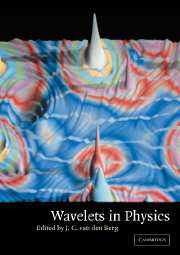 This book surveys the application of the
recently developed
technique of the wavelet transform to a wide
range of physical
fields, including astrophysics, turbulence,
meteorology, plasma
physics, atomic and solid state physics,
multifractals occurring
in physics, biophysics (in medicine and physiology)
and
mathematical physics. The wavelet transform
can analyze scale-dependent
characteristics of a signal (or image) locally,
unlike the
Fourier transform, and more flexibly than
the windowed Fourier
transform developed by Gabor fifty years
ago. The continuous
wavelet transform is used mostly for analysis,
but the discrete
wavelet transform allows very fast compression
and transmission
of data and speeds up numerical calculation,
and is applied, for
example, in the solution of partial differential
equations in
physics. This book will be of interest to
graduate students and
researchers in many fields of physics, and
to applied
mathematicians and engineers interested in
physical application.
This book surveys the application of the
recently developed
technique of the wavelet transform to a wide
range of physical
fields, including astrophysics, turbulence,
meteorology, plasma
physics, atomic and solid state physics,
multifractals occurring
in physics, biophysics (in medicine and physiology)
and
mathematical physics. The wavelet transform
can analyze scale-dependent
characteristics of a signal (or image) locally,
unlike the
Fourier transform, and more flexibly than
the windowed Fourier
transform developed by Gabor fifty years
ago. The continuous
wavelet transform is used mostly for analysis,
but the discrete
wavelet transform allows very fast compression
and transmission
of data and speeds up numerical calculation,
and is applied, for
example, in the solution of partial differential
equations in
physics. This book will be of interest to
graduate students and
researchers in many fields of physics, and
to applied
mathematicians and engineers interested in
physical application.
Contributors
J. C. van den Berg, J.-P. Antoine, A. Bijaoui,
M. Farge, N. K.-R.
Kevlahan, V. Perrier, K. Schneider, L. Hudgins,
J. H. Kaspersen,
B. Ph. van Milligen, A. Fournier, Ph. Antoine,
B. Piraux, A.
Arneodo, E. Bacry, J. F. Muzy, P. Ch. Ivanov,
A. L. Goldberger, S.
Havlin, C. -K. Peng, M. G. Rosenblum, H.
E. Stanley, Ch.-A.
Guerin, M. Holschneider
Contents
A guided tour J. C. van den Berg; 1. Wavelet
analysis, a new tool
in physics J.-P. Antoine; 2. The 2-D wavelet
transform, physical
applications J.-P. Antoine; 3. Wavelets and
astrophysical
applications A. Bijaoui; 4. Turbulence analysis,
modelling and
computing using wavelets M. Farge, N. K.-R.
Kevlahan, V. Perrier
and K. Schneider; 5. Wavelets and detection
of coherent
structures in fluid turbulence L. Hudgins
and J. H. Kaspersen; 6.
Wavelets, non-linearity and turbulence in
fusion plasmas B. Ph.
van Milligen; 7. Transfers and fluxes of
wind kinetic energy
between orthogonal wavelet components during
atmospheric blocking
A. Fournier; 8. Wavelets in atomic physics
and in solid state
physics J.-P. Antoine, Ph. Antoine and B.
Piraux; 9. The
thermodynamics of fractals revisited with
wavelets A. Arneodo, E.
Bacry and J. F. Muzy; 10. Wavelets in medicine
and physiology P.
Ch. Ivanov, A. L. Goldberger, S. Havlin,
C.-K. Peng, M. G.
Rosenblum and H. E. Stanley; 11. Wavelet
dimension and time
evolution Ch.-A. Guerin and M. Holschneider.
Abdelhak Zoubir, D. Robert Iskander
Bootstrap Techniques for Signal Processing
Publication is planned for April 2004 | Hardback
| 228 pages
41 line diagrams 34 tables | ISBN: 0-521-83127-X
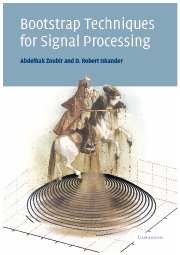 The statistical bootstrap is one of the methods
that can be used
to calculate estimates of a certain number
of unknown parameters
of a random process or a signal observed
in noise, based on a
random sample. Such situations are common
in signal processing
and the bootstrap is especially useful when
only a small sample
is available or an analytical analysis is
too cumbersome or even
impossible. This book covers the foundations
of the bootstrap,
its properties, its strengths, and its limitations.
The authors
focus on bootstrap signal detection in Gaussian
and non-Gaussian
interference as well as bootstrap model selection.
The theory
developed in the book is supported by a number
of useful
practical examples written in MATLAB. The
book is aimed at
graduate students and engineers, and includes
applications to
real-world problems in areas such as radar
and sonar, biomedical
engineering, and automotive engineering.
The statistical bootstrap is one of the methods
that can be used
to calculate estimates of a certain number
of unknown parameters
of a random process or a signal observed
in noise, based on a
random sample. Such situations are common
in signal processing
and the bootstrap is especially useful when
only a small sample
is available or an analytical analysis is
too cumbersome or even
impossible. This book covers the foundations
of the bootstrap,
its properties, its strengths, and its limitations.
The authors
focus on bootstrap signal detection in Gaussian
and non-Gaussian
interference as well as bootstrap model selection.
The theory
developed in the book is supported by a number
of useful
practical examples written in MATLAB. The
book is aimed at
graduate students and engineers, and includes
applications to
real-world problems in areas such as radar
and sonar, biomedical
engineering, and automotive engineering.
Contents
1. Introduction; 2. The bootstrap principle;
3. Signal detection
with the bootstrap; 4. Bootstrap model selection;
5. Real data
applications; Appendices.
Marc Cabanes, Michel Enguehard
Representation Theory of Finite Reductive
Groups
New Series : New Mathematical Monographs
 January 2004 | Hardback | 454 pages 144 exercises
| ISBN: 0-521-82517-2
January 2004 | Hardback | 454 pages 144 exercises
| ISBN: 0-521-82517-2
At the crossroads of representation theory,
algebraic geometry
and finite group theory, this book blends
together many of the
main concerns of modern algebra, synthesising
the past 25 years
of research, with full proofs of some of
the most remarkable
achievements in the area. Cabanes and Enguehard
follow three main
themes: first, applications of etale cohomology,
leading to the
proof of the recent Bonnafe?Rouquier theorems.
The second is a
straightforward and simplified account of
the Dipper?James
theorems relating irreducible characters
and modular
representations. The final theme is local
representation theory.
One of the main results here is the authors’
version of
Fong?Srinivasan theorems. Throughout the
text is illustrated by
many examples and background is provided
by several introductory
chapters on basic results and appendices
on algebraic geometry
and derived categories. The result is an
essential introduction
for graduate students and reference for all
algebraists.
Contents
Introduction; Notations and conventions;
Part I. Representing
Finite BN-Pairs: 1. Cuspidality in finite
groups; 2. Finite BN-pairs;
3. Modular Hecke algebras for finite BN-pairs;
4. Modular duality
functor and the derived category; 5. Local
methods for the
transversal characteristics; 6. Simple modules
in the natural
characteristic; Part II. Deligne?Lusztig
Varieties, Rational
Series, and Morita Equivalences: 7. Finite
reductive groups and
Deligne?Lusztig varieties; 8. Characters
of finite reductive
groups; 9. Blocks of finite reductive groups
and rational series;
10. Jordan decomposition as a Morita equivalence,
the main
reductions; 11. Jordan decomposition as a
Morita equivalence,
sheaves; 12. Jordan decomposition as a Morita
equivalence,
modules; Part III. Unipotent Characters and
Unipotent Blocks: 13.
Levi subgroups and polynomial orders; 14.
Unipotent characters as
a basic set; 15. Jordan decomposition of
characters; 16. On
conjugacy classes in type D; 17. Standard
isomorphisms for
unipotent blocks; Part IV. Decomposition
Numbers and q-Schur
Algebras: 18. Some integral Hecke algebras;
19. Decomposition
numbers and q-Schur algebras, general linear
groups; 20.
Decomposition numbers and q-Schur algebras,
linear primes; Part V.
Unipotent Blocks and Twisted Induction: 21.
Local methods.
Twisted induction for blocks; 22. Unipotent
blocks and
generalized Harish Chandra theory; 23. Local
structure and ring
structure of unipotent blocks; Appendix 1:
Derived categories and
derived functors; Appendix 2: Varieties and
schemes; Appendix 3:
Etale cohomology; References; Index.