Eiderman, Vladimir; Samokhin, Mikhail (Eds.)
Selected Topics in Complex Analysis
The Semen Yakovlevich Khavinson Memorial Volume
Series: Operator Theory: Advances and Applications, Vol. 158
2005, VIII, 224 p., Hardcover
ISBN: 3-7643-7251-6
About this book
This volume is dedicated to the memory of the outstanding
mathematician S.Ya. Khavinson. It begins with an expository paper
by V.P. Havin presenting a comprehensive survey of Khavinson's
works as well as certain biographical material. The complete
bibliography following this paper has not previously been
published anywhere. It consists of 163 items; a considerable part
of these cannot be found in easily accessible sources. The book
also contains a series of photographs and twelve original peer-reviewed
research and expository papers by leading mathematicians
worldwide, including the joint paper by S.Ya. Khavinson and T.S.
Kuzina (the last publication of S.Ya. Khavinson).
Table of contents
Semyon Yakovlevich Khavinson (1927-2003).- Bibliography of S.Ya.
Khavinson.- Contributions by D. Aharonov, C. Beneteau, D.
Khavinson and H.S. Shapiro / L. Aizenberg / J.M. Anderson / J.T.
Anderson and J. Werner / J.J. Carmona and K.Yu. Fedorovskiy / V.Ya.
Eiderman / A.M. Jerbashian / S.Ya. Khavinson and T.S. Kuzina / M.
Melnikov and X. Tolsa / X. Pang, S. Nevo and L. Zalcman / W.T.
Ross / V.S. Videnskii.
Amrein, Werner; Hinz, Andreas; Pearson, David (Eds.)
Sturm-Liouville Theory, Past and Present
2005, Approx. 360 p., Hardcover
ISBN: 3-7643-7066-1
About this book
This collection of articles on Sturm-Liouville theory is based on
lectures presented at the colloquium and workshop held in Geneva
on the occasion of Sturm's 200th anniversary. A historical survey
of the field is combined with in-depth coverage of later
developments and contemporary research in this major area of
modern mathematics and its applications. The authors are among
the world's leading experts in this field.
Table of contents
Preface.- Scientific Lectures given at the Sturm Colloquium.-
Introduction.- Contributions by D. Hinton, B. Simon, W.N.
Everitt, J. Weidmann, Y. Last, D. Gilbert, C. Bennewitz and W.N.
Everitt, V.A. Galaktionov and P.J. Harwin, C.-N. Chen, R. de. Ri-o,
M. Malamud.- Index.
Roger Koenker
University of Illinois, Urbana-Champaign
Quantile Regression
Series: Econometric Society Monographs
Paperback (ISBN-10: 0521608279)
Hardback (ISBN-10: 0521845734)
available from July 2005
Quantile regression is gradually emerging as a unified
statistical methodology for estimating models of conditional
quantile functions. By complementing the exclusive focus of
classical least squares regression on the conditional mean,
quantile regression offers a systematic strategy for examining
how covariates influence the location, scale and shape of the
entire response distribution. This monograph is the first
comprehensive treatment of the subject, encompassing models that
are linear and nonlinear, parametric and nonparametric. The
author has devoted more than 25 years of research to this topic.
The methods in the analysis are illustrated with a variety of
applications from economics, biology, ecology and finance. The
treatment will find its core audiences in econometrics,
statistics, and applied mathematics in addition to the
disciplines cited above.
? First comprehensive study of quantile regression methods
? Tutorial on associated statistical software in R
? Illustrative applications from a broad variety of disciplines
Contents
1. Introduction; 1.1. Means and ends; 1.2. The first regression:
an historical prelude; 1.3. Quantiles, ranks, and optimization; 1.4.
Preview of quantile regression; 1.5. Three examples; 1.6.
Conclusion; 2. Fundamentals of quantile regression; 2.1. Quantile
treatment effects; 2.2. How does quantile regression work?; 2.3.
Robustness; 2.4. Interpreting quantile regression models; 2.5.
Caution: quantile crossing; 2.6. A random coefficient
interpretation; 2.7. Inequality measures and their decomposition;
2.8. Expectiles and other variations; 2.9. Interpreting
misspecified quantile regressions; 2.10. Problems; 3. Inference
for quantile regression; 3.1. The finite sample distribution of
regression quantiles; 3.2. A heuristic introduction to quantile
regression asymptotics; 3.3. Wald tests; 3.4. Estimation of
asymptotic covariance matrices; 3.5. Rank based Inference for
quantile regression; 3.6. Quantile likelihood ratio tests; 3.7.
Inference on the quantile regression process; 3.8. Tests of the
location/acale hypothesis; 3.9. Resampling methods and the
bootstrap; 3.10. Monte-Carlo comparison of methods; 3.11.
Problems; 4. Asymptotic theory of quantile regression; 4.1.
Consistency; 4.2. Rates of convergence; 4.3. Bahadur
representation; 4.4. Nonlinear quantile regression; 4.5. The
quantile regression rankscore process; 4.6. Quantile regression
asymptotics under dependent conditions; 4.7. Extremal quantile
regression; 4.8. The method of quantiles; 4.9. Model selection,
penalties, and large-p asymptotics; 4.10. Asymptotics for
inference; 4.11. Resampling schemes and the bootstrap; 4.12.
Asymptotics for the quantile regression process; 4.13. Problems;
5. L-statistics and weighted quantile regression; 5.1. L-Statistics
for the linear model; 5.2. Kernel smoothing for quantile
regression; 5.3. Weighted quantile regression; 5.4. Quantile
regression for location-scale models; 5.5. Weighted sums of p-functions;
5.6. Problems; 6. Computational aspects of quantile regression; 6.1.
Introduction to linear programming; 6.2. Simplex methods for
quantile regression; 6.3. Parametric programming for quantile
regression; 6.4. Interior point methods for canonical LPs; 6.5.
Preprocessing for quantile regression; 6.6. Nonlinear quantile
regression; 6.7. Inequality constraints; 6.8. Weighted sums of p-functions;
6.9. Sparsity; 6.10. Conclusion; 6.11. Problems; 7. Nonparametric
quantile regression; 7.1. Locally polynomial quantile regression;
7.2. Penalty methods for univariate smoothing; 7.3. Penalty
methods for bivariate Smoothing; 7.4. Additive models and the
Role of sparsity; 8. Twilight Zone of quantile regression; 8.1.
Quantile regression for survival data; 8.2. Discrete Response
models; 8.3. Quantile autoregression; 8.4. Copula functions and
nonlinear quantile regression; 8.5. High breakdown alternatives
to quantile regression; 8.6. Multivariate quantiles; 8.7. Penalty
methods for longitudinal data; 8.8. Causal effects and structural
models; 8.9. Choquet utility, risk and pessimistic portfolios; 9.
Conclusion; A. Quantile regression in R: a vignette; A.1.
Introduction; A.2. What is a vignette?; A.3. Getting started; A.4.
Object orientation; A.5. Formal Inference; A.6. More on testing;
A.7. Inference on the quantile regression process; A.8. Nonlinear
quantile regression; A.9. Nonparametric quantile regression; A.10.
Conclusion; B. Asymptotic critical values.
Patsy Haccou / Rijksuniversiteit Leiden, The Netherlands
Peter Jagers / Chalmers University of Technology, Gothenberg
Vladimir A. Vatutin / Steklov Institute of Mathematics, Moscow
Branching Processes
Variation, Growth, and Extinction of Populations
Series: Cambridge Studies in Adaptive Dynamics (No. 5)
Hardback (ISBN-10: 0521832209 )
N available from May 2005
Biology takes a special place among the other natural sciences
because biological units, be they pieces of DNA, cells, or
organisms, reproduce more or less faithfully. As for any other
biological processes, reproduction has a large random component.
The theory of branching processes was developed especially as a
mathematical counterpart to this most fundamental of biological
processes. This active and rich research area allows us to make
predictions about both extinction risks and the development of
population composition, and also uncovers aspects of a
population's history from its current genetic composition.
Branching processes play an increasingly important role in models
of genetics, molecular biology, microbiology, ecology, and
evolutionary theory. This book presents this body of mathematical
ideas for a biological audience, but should also be enjoyable to
mathematicians.
? Important for all fields in biology: written with a broad scope
? Important for mathematicians, in particular probabilists,
statisticians and applied mathematicians
? Of interest for PhD students as well as established scientists
? Contains contributions from many eminent and well-known
scientists
Contents
Preface; Notations; 1. Generalities; 2. Discrete-time branching
processes; 3. Branching in continuous time; 4. Large populations;
5. Extinction; 6. Development of populations; 7. Specific models;
Appendix; References.
Contributors
Patsy Haccou, Peter Jagers, Vladimir A. Vatutin, Marina
Alexandersson, Gerold Alsmeyer, A. D. Barbour, Michel Durinx,
Mats Gyllenburg, Goran Hognas, Vincent A. A. Jansen, Fima
Klebaner, Marek Kimmel, Thomas G. Kurtz, Johan A. J. Metz, Peter
Olofsson, Serik Sagitov, Nico Stollenwerk, Simon Tavare
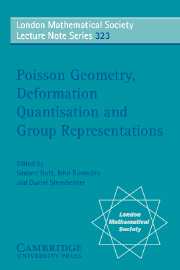
Edited by J. Rawnsley / University of Warwick
S. Gutt / Universite Libre de Bruxelles
D. Sternheimer / Universite de Bourgogne, France
Poisson Geometry, Deformation Quantisation and Group
Representations
Series: London Mathematical Society Lecture Note Series
Paperback (ISBN-10: 0521615054 )
available from July 2005
 Poisson geometry lies at the cusp of noncommutative algebra and
differential geometry, with natural and important links to
classical physics and quantum mechanics. This book presents an
introduction to the subject from a small group of leading
researchers, and the result is a volume accessible to graduate
students or experts from other fields. The contributions are:
Poisson Geometry and Morita Equivalence by Bursztyn and
Weinstein; Formality and Star Products by Cattaneo; Lie
Groupoids, Sheaves and Cohomology by Moerdijk and Mrcun;
Geometric Methods in Representation Theory by Schmid; Deformation
Theory: A Powerful Tool in Physics Modelling by Sternheimer.
Poisson geometry lies at the cusp of noncommutative algebra and
differential geometry, with natural and important links to
classical physics and quantum mechanics. This book presents an
introduction to the subject from a small group of leading
researchers, and the result is a volume accessible to graduate
students or experts from other fields. The contributions are:
Poisson Geometry and Morita Equivalence by Bursztyn and
Weinstein; Formality and Star Products by Cattaneo; Lie
Groupoids, Sheaves and Cohomology by Moerdijk and Mrcun;
Geometric Methods in Representation Theory by Schmid; Deformation
Theory: A Powerful Tool in Physics Modelling by Sternheimer.
●Presents an introduction to the subject from a small group of leading
researchers
● A volume accessible to graduate students or experts from other fields
● Contributions from an array of leading researchers in the field
Contents
1. Poisson geometry and Morita equivalence Henrique Bursztyn and
Alan Weinstein; 2. Formality and star products Alberto S.
Cattaneo and D. Indelicato; 3. Lie groupoids, sheaves and
cohomology; 4. Geometric methods in representation theory
Wilfried Schmid and Matvei Libine; 5. Deformation theory: a
powerful tool in physics modelling Daniel Sternheimer.
Contributors
Henrique Bursztyn, Alan Weinstein, Alberto S. Cattaneo, D.
Indelicato, Wilfried Schmid, Matvei Libine, Daniel Sternheimer