F. Iachello / Yale University, Connecticut
P. van Isacker /
The Interacting Boson-Fermion Model
Series: Cambridge Monographs on Mathematical Physics
Paperback (ISBN-10: 0521021642 | ISBN-13: 9780521021647)
The interacting boson-fermion model has become in recent years
the standard model for the description of atomic nuclei with an
odd number of protons and/or neutrons. This book describes the
mathematical framework on which the interacting boson-fermion
model is built and presents applications to a variety of
situations encountered in nuclei. The book addresses both the
analytical and the numerical aspects of the problem. The
analytical aspect requires the introduction of rather complex
group theoretic methods, including the use of graded (or super)
Lie algebras. The first (and so far only) example of
supersymmetry occurring in nature is also discussed. The book is
the first comprehensive treatment of the subject and will appeal
to both theoretical and experimental physicists. The large number
of explicit formulas for level energies, electromagnetic
transition rates and intensities of transfer reactions presented
in the book provide a simple but detailed way to analyse
experimental data. This book can also be used as a textbook for
advanced graduate students.
Contents
Part I. The Interacting Boson-Fermion Model - 1: 1. Operators; 2.
Algebras; 3. Bose-Fermi symmetries; 4. Superalgebras; 5.
Numerical studies; 6. Geometry; Part II. The Interacting Boson-Fermion
Model - 2: 7. Operators; 8. Algebras; 9. Superalgebras; 10.
Numerical studies; Part III. The Interacting Boson-Fermion Model-K:
11. The interacting boson-fermion models 3 and 4; Part IV.
Yuri Makeenko
Institute of Theoretical and Experimental Physics, Moscow
Methods of Contemporary Gauge Theory
Series: Cambridge Monographs on Mathematical Physics
Paperback (ISBN-10: 0521022150 | ISBN-13: 9780521022156)
This book introduces the quantum theory of gauge fields. Emphasis
is placed on four non-perturbative methods: path integrals,
lattice gauge theories, the 1/N expansion, and reduced matrix
models, all of which have important contemporary applications.
Written as a textbook, it assumes a knowledge of quantum
mechanics and elements of perturbation theory, while many
relevant concepts are pedagogically introduced at a basic level
in the first half of the book. The second half comprehensively
covers large-N Yang-Mills theory. The book uses a modern approach
to gauge theories based on path-dependent phase factors known as
the Wilson loops, and contains problems with detailed solutions
to aid understanding. Suitable for advanced graduate courses in
quantum field theory, the book will also be of interest to
researchers in high energy theory and condensed matter physics as
a survey of recent developments in gauge theory.
- Introduces gauge theories in a pedagogical way
-
Written in a clear and accessible style
-
Ideal as a textbook for advanced graduate courses on quantum field theory
Contents
Preface; Part I. Path Integrals: 1. Operator calculus; 2. Second
quantization; 3. Quantum anomalies from path integral; 4.
Instantons in quantum mechanics; Part II. Lattice Gauge Theories:
5. Observables in gauge theories; 6. Gauge fields on a lattice; 7.
Lattice methods; 8. Fermions on a lattice; 9. Finite
temperatures; Part III. 1/N Expansion: 10. O(N) vector models; 11.
Multicolor QCD; 12. QCD in loop space; 13. Matrix models; Part IV.
Reduced Models: 14. Eguchi?Kawai model; 15. Twisted reduced
models; 16. Non-commutative gauge theories.
Robert L. Carpenter / Carnegie Mellon University, Pennsylvania
The Logic of Typed Feature Structures
With Applications to Unification Grammars, Logic Programs and
Constraint Resolution
Series: Cambridge Tracts in Theoretical Computer Science (No.
32)
Paperback (ISBN-10: 0521022541 | ISBN-13: 9780521022545)
This book develops the theory of typed feature structures, a data
structure that generalizes both first-order terms and feature
structures of unification-based grammars to include inheritance,
typing, inequality, cycles and intensionality. The resulting
synthesis serves as a logical foundation for grammars, logic
programming and constraint-based reasoning systems. A logical
perspective is adopted which employs an attribute-value
description language along with complete equational
axiomatizations of the various systems of feature structures. At
the same time, efficiency concerns are kept in mind and
complexity and representability results are provided. The
application of feature structures to phrase structure grammars is
described and completeness results are shown for standard
evaluation strategies. Definite clause logic programs are treated
as a special case of phrase structure grammars. Constraint
systems are introduced and an enumeration technique is developed
for solving arbitrary attribute-value logic constraints. This
book, with its innovative approach to data structure, will be
essential reading for researchers in computational linguistics,
logic programming and knowledge representation. Its self-contained
presentation makes it flexible enough to serve as both a research
tool and a text book.
Contents
Acknowledgements; Part I. Basics: 1. Introduction; 2. Types and
inheritance; 3. Feature structures; 4. Attribute-value
descriptions and satisfaction; Part II. Extensions: 5. Acyclic
feature structures; 6. Appropriateness and typing; 7.
Inequations; 8. Identity and extensionality; 9. Maximality,
groundedness and closed world inference; Part III. Alternatives:
10. Variables and assignments; 11. Feature algebras; 12. Infinite
feature structures and domains; Part IV. Applications: 13.
Unification-based phrase structure grammars; 14. Definite clause
programming; 15. Recursive type constraint systems; Bibliography.
V. Adrian Parsegian / National Institute of Child Health and Human Development, USA
Van der Waals Forces
Handbook for Biologists, Chemists, Engineers, and Physicists
Hardback (ISBN-10: 0521839068 | ISBN-13: 9780521839068)
Paperback (ISBN-10: 0521547784 | ISBN-13: 9780521547789)
This should prove to be the definitive work explaining van der
Waals forces, how to calculate them and take account of their
impact under any circumstances and conditions. These weak
intermolecular forces are of truly pervasive impact, and
biologists, chemists, physicists and engineers will profit
greatly from the thorough grounding in these fundamental forces
that this book offers. Parsegian has organized his book at three
successive levels of mathematical sophistication, to satisfy the
needs and interests of readers at all levels of preparation. The
Prelude and Level 1 are intended to give everyone an overview in
words and pictures of the modern theory of van der Waals forces.
Level 2 gives the formulae and a wide range of algorithms to let
readers compute the van der Waals forces under virtually any
physical or physiological conditions. Level 3 offers a rigorous
basic formulation of the theory.
■ Author is among the most highly respected biophysicists
■ Van der Waals forces are significant for a wide range of questions and
problems in the life sciences, chemistry, physics, and engineering, ranging
up to the macro level
■ No other book that develops the subject vigorously, and this book also
makes the subject intuitively accessible to students who had not previously
been mathematically sophisticated enough to calculate them
Contents
Foreword; Prelude; 1. Introduction; 2. Practice; 3. Foundations.
Isaac Chavel / City College, City University of New York
Riemannian Geometry: A Modern Introduction, 2nd Edition
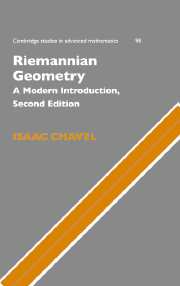 Series: Cambridge Studies in Advanced Mathematics
Hardback (ISBN-10: 0521853680 | ISBN-13: 9780521853682)
Paperback (ISBN-10: 0521619548 | ISBN-13: 9780521619547)
This book provides an introduction to Riemannian geometry, the
geometry of curved spaces, for use in a graduate course.
Requiring only an understanding of differentiable manifolds, the
author covers the introductory ideas of Riemannian geometry
followed by a selection of more specialized topics. Also featured
are Notes and Exercises for each chapter, to develop and enrich
the reader’s appreciation of the subject. This second edition
has a clearer treatment of many topics than the first edition,
with new proofs of some theorems and a new chapter on the
Riemannian geometry of surfaces. The main themes here are the
effect of the curvature on the usual notions of classical
Euclidean geometry, and the new notions and ideas motivated by
curvature itself. Among the classical topics shown in a new
setting is isoperimetric inequalities - the interplay of volume
of sets and the areas of their boundaries - in curved spaces.
Completely new themes created by curvature include the classical
Rauch comparison theorem and its consequences in geometry and
topology, and the interaction of microscopic behavior of the
geometry with the macroscopic structure of the space.
■ Assumes familiarity with differentiable manifolds so that more topics
in Riemannian geometry can be treated
■ User-friendly presentation, with the right balance in notation and detail
■ The variety of advanced topics and the Notes and Exercises sections
give great flexibility both in teaching from the book and for self-study
Contents
1. Riemannian manifolds; 2. Riemannian curvature; 3. Riemannian
volume; 4. Riemannian coverings; 5. Surfaces; 6. Isoperimetric
inequalities (constant curvature); 7. The kinetic density; 8.
Isoperimetric inequalities (variable curvature); 9. Comparison
and finiteness theorems.
Jaan Oitmaa / University of New South Wales, Sydney
Chris Hamer / University of New South Wales, Sydney
Weihong Zheng / University of New South Wales, Sydney
Series Expansion Methods for Strongly Interacting Lattice
Models
Hardback (ISBN-10: 0521842425 | ISBN-13: 9780521842426)
Perturbation series expansion methods are sophisticated numerical
tools used to provide quantitative calculations in many areas of
theoretical physics. This book gives a comprehensive guide to the
use of series expansion methods for investigating phase
transitions and critical phenomena, and lattice models of quantum
magnetism, strongly correlated electron systems and elementary
particles. Early chapters cover the classical treatment of
critical phenomena through high temperature expansions, and
introduce graph theoretical and combinatorial algorithms. The
book then discusses high-order linked-cluster perturbation
expansions for quantum lattice models, finite temperature
expansions, and lattice gauge models. Also included are numerous
detailed examples and case studies, and an accompanying resources
website, www.cambridge.org/9780521842426, contains programs for
implementing these powerful numerical techniques. A valuable
resource for graduate students and postdoctoral researchers
working in condensed matter and particle physics, this book will
also be useful as a reference for specialized graduate courses on
series expansion methods.
■ Hands on approach, suitable for self-learning
■ A comprehensive guide to series expansion methods for lattice models
in theoretical physics
■ Applications to models in condensed matter theory and particle physics
■ IComputer programs for implementation of this powerful numerical technique
are available at www.cambridge.org/9780521842426
Contents
1. Introduction; 2. High and low temperature expansions for the
Ising Model; 3. Models with continuous symmetry and the free
graph expansion; 4. Quantum spin models at T = 0; 5. Quantum
antiferromagnets at T = 0; 6. Correlators, dynamical structure
factors and multiparticle excitations; 7. Quantum spin models at
finite temperature; 8. Electronic models; 9. Review of lattice
gauge theory; 10. Series expansions for lattice gauge models; 11.
Additional topics; Appendices; References; Index