Edited by Albert Fathi / Ecole Normale Superieure, Lyon
J.-C. Yoccoz / College de France, Paris
Dynamical Systems
Hardback (ISBN-10: 0521860687 | ISBN-13: 9780521860680)
January 2006
Michael Robert Herman had a profound impact on the theory of
dynamical systems over the last 30 years. His seminar at the
Ecole Polytechnique had major worldwide influence and was the
main vector in the development of the theory of dynamical systems
in France. His interests covered most aspects of the subject
though closest to his heart were the so-called small divisors
problems, in particular those related to the stability of
quasiperiodic motions. This volume aims to reflect the depth and
variety of these interests and the frontier of present research;
a frontier shaped decisively by Michael Herman's contributions.
Contents
1. Michael Robert Herman, 1942-2000 A. Fathi and J. C. Yoccoz; 2.
L2 regularity of measurable solutions of a finite-difference
equation of the circle Michael Robert Herman; 3. On Herman's
theorem for ergodic, amenable group extensions of endomorphisms
Jon Aaronson and Benjamin Weiss; 4. Lyapunov exponents with
multiplicity 1 for deterministic products of matrices C. Bonnati
and M. Viana; 5. Remarks on stability and diffusion in high-dimensional
Hamiltonian systems and partial differential equations Jean
Bourgain; 6. Stable manifolds and the Perron?Irwin method Marc
Chaperon; 7. C2 densely the 2-sphere has an elliptic closed
geodesic Gonzalo Contreras and Fernando Oliveira; 8. Further
rigidity properties of conformal Anosov systems R. De La Lave; 9.
On some approximation of the 3D Euler system E. I. Dinaburg and
Ya G. Sinai; 10. Lyapunov 1-forms for flows M. Farber, T.
Kappeler, J. Latschev and E. Zehnder; 11. Constructions in
elliptic dynamics Bassam Fayad and Anatole Katok; 12.
Demonstration du ‘theoreme d'Arnold’ sur la stabilite du
systeme planetaire (d'apres Herman) Jacques Fejoz; 13. Sur le
theoreme de Bertrand (d'apres Michael Herman) Jacques Fejoz and
Laurent Kaczmarek; 14. Commutators and diffeomorphisms of
surfaces Jean-Marc Gambaudo and Etienne Ghys; 15. Wandering
domains and random walks in Gevrey near-integrable systems Jean-Pierre
Marco and David Sauzin; 16. Examples of Aubry sets John N.
Mather; 17. New phenomena associated with homoclinic tangencies
Sheldon E. Newhouse; 18. On holomorphic critical quasi-circle
maps Carsten Lunde Petersen; 19. KAM theorem for Gevrey
Hamiltonians G. Popov; 20. Convergent transformations into a
normal form in analytic Hamiltonian systems with two degrees of
freedom on the zero energy surface near degenerate elliptic
singularities Helmut Russmann; 21. Sur les structures de Poisson
singulieres Laurent Stolovitch.
Contributors
A. Fathi, J.C. Yoccoz, Michael Robert Herman, Jon Aaronson,
Benjamin Weiss, C. Bonnati, M. Viana, Jean Bourgain, Marc
Chaperon, Gonzalo Contreras, Fernando Oliveira, R. De La Lave, E.
I. Dinaburg, Ya G. Sinai, M. Farber, T. Kappeler, J. Latschev, E.
Zehnder, Bassam Fayad, Anatole Katok, Jacques Fejoz, Laurent
Kaczmarek, Jean-Marc Gambaudo, Etienne Ghys, Jean-Pierre Marco,
David Sauzin, John N. Mather, Sheldon E. Newhouse, Carsten Lunde
Petersen, G. Popov, Helmut Russmann, Laurent Stolovitch
Mitchell Katz
University of California, San Francisco
Study Design and Statistical Analysis
A Practical Guide for Clinicians
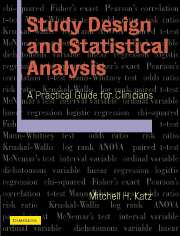 Paperback (ISBN-10: 0521534070 | ISBN-13: 9780521534079)
Hardback (ISBN-10: 0521826756 | ISBN-13: 9780521826754)
March 2006
This book takes the reader through the entire research process:
choosing a question, designing a study, collecting the data,
using univariate, bivariate and multivariable analysis, and
publishing the results. It does so by using plain language rather
than complex derivations and mathematical formulae. It focuses on
the nuts and bolts of performing research by asking and answering
the most basic questions about doing research studies. Making
good use of numerous tables, graphs and tips, this book helps to
demystify the process. A generous number of up-to-date examples
from the clinical literature give an illustrated and practical
account of how to use multivariable analysis.
? Provides a conceptual understanding in a non mathematical way
? Nuts and bolts practical approach for clinical relevance
? Provides answers to basic questions
Contents
Preface; 1. Introduction; 2. Designing a study; 3. Data
management; 4. Univariate statistics; 5. Bivariate statistics; 6.
Multivariable statistics; 7. Sample size calculation; 8.
Diagnostic and prognostic studies; 9. Limitations of statistics;
10. Special topics; 11. Writing up the study for publication; 12.
Conclusion; Index.
Les Kirkup / University of Technology, Sydney
Bob Frenkel / National Measurement Institute, Sydney
An Introduction to Uncertainty in Measurement
Using the GUM (Guide to the Expression of Uncertainty in
Measurement)
 Paperback (ISBN-10: 0521605792 | ISBN-13: 9780521605793)
Hardback (ISBN-10: 0521844282 | ISBN-13: 9780521844284)
March 2006
Measurement shapes scientific theories, characterises
improvements in manufacturing processes and promotes efficient
commerce. In concert with measurement is uncertainty, and
students in science and engineering need to identify and quantify
uncertainties in the measurements they make. This book introduces
measurement and uncertainty to second and third year students of
science and engineering. Its approach relies on the
internationally recognised and recommended guidelines for
calculating and expressing uncertainty (known by the acronym GUM).
The statistics underpinning the methods are considered and worked
examples and exercises are spread throughout the text. Detailed
case studies based on typical undergraduate experiments are
included to reinforce the principles described in the book. This
guide is also useful to professionals in industry who are
expected to know the contemporary methods in this increasingly
important area. Additional online resources are available to
support the book at www.cambridge.org/9780521605793.
? First text primarily for undergraduate students which
introduces and applies internationally accepted guidelines for
expressing uncertainty
? Assumes little prior knowledge of uncertainties
? Contains worked examples, student exercises, and detailed case
studies to reinforce principles and applications
? Includes necessary statistical background to quantifying
uncertainties
Contents
Preface; 1. The importance of uncertainty in science and
technology; 2. Measurement fundamentals; 3. Terms used in
measurement; 4. Introduction to uncertainty in measurement; 5.
Some statistical concepts; 6. Systematic errors; 7. Calculation
of uncertainties; 8. Probability density, the Gaussian
distribution and the Central Limit Theorem; 9. Sampling a
Gaussian distribution; 10. The t-distribution, and the Welch-Satterthwaite
formula; 11. Case studies in measurement uncertainty; Appendices;
References; Index.
John Lewis , S. Lakshmivaraham ,Sudarshan Dhall
University of Oklahoma
Dynamic Data Assimilation
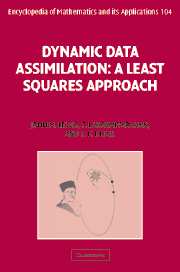 Hardback (ISBN-10: 0521851556 | ISBN-13: 9780521851558)
May 2006
Dynamic data assimilation is the assessment, combination and
synthesis of observational data, scientific laws and mathematical
models to make predictions about how a complex physical system
will behave. This book is designed to be a basic one-stop
reference for graduate students and researchers. It is based on
graduate courses taught over a decade to mathematicians,
scientists, and engineers, and its modular structure accommodates
the various audience requirements. Chapters end with a section
that provides pointers to the literature, and a set of exercises
with instructive hints. Computation is encouraged: algorithms are
liberally scattered throughout the text. Accompanying refresher
material - in many areas of mathematics including vector spaces,
optimization and probability theory - will be available from www.cambridge.org/0521851556.
The book ends with a comprehensive bibliography.
A comprehensive and self-contained introduction to data
assimilation, with background material available from www.cambridge.org/0521851556
? A wide spectrum of scientific views of data assimilation
including problems from atmospheric chemistry, oceanography,
astronomy, fluid dynamics and meteorology
? Rich set of problems, with instructive hints, at the end of
each chapter
Contents
1. Synopsis; 2. Pathways into data assimilation: illustrative
examples; 3. Applications; 4. Brief history of data assimilation;
5. Linear least squares estimation: method of normal equations; 6.
A geometric view: projection and invariance; 7. Nonlinear least
squares estimation; 8. Recursive least squares estimation; 9.
Matrix methods; 10. Optimization: steepest descent method; 11.
Conjugate direction/gradient methods; 12. Newton and quasi-Newton
methods; 13. Principles of statistical estimation; 14.
Statistical least squares estimation; 15. Maximum likelihood
method; 16. Bayesian estimation method; 17. From Gauss to Kalman:
sequential, linear minimum variance estimation; 18. Data
assimilation-static models: concepts and formulation; 19.
Classical algorithms for data assimilation; 20. 3DVAR - a
Bayesian formulation; 21. Spatial digital filters; 22. Dynamical
data assimilation: the straight line problem; 23. First-order
adjoint method: linear dynamics; 24. First-order adjoint method:
nonlinear dynamics; 25. Second-order adjoint method; 26. The
ADVAR problem: a statistical and a recursive view; 27. Linear
filtering - Part I: Kalman filter; 28. Linear filtering-part II;
29. Nonlinear filtering; 30. Reduced rank filters; 31.
Predictability: a stochastic view; 32. Predictability: a
deterministic view; Bibliography; Index.