Korte, Bernhard, Vygen, Jens
Combinatorial Optimization, 3rd ed.
Theory and Algorithms
Series: Algorithms and Combinatorics, Vol. 21
2006, XVI, 597 p., Hardcover
ISBN: 3-540-25684-9
About this textbook
This comprehensive textbook on combinatorial optimization puts
special emphasis on theoretical results and algorithms with
provably good performance, in contrast to heuristics. It has
arisen as the basis of several courses on combinatorial
optimization and more special topics at graduate level. Since the
complete book contains enough material for at least four
semesters (4 hours a week), one usually selects material in a
suitable way. The book contains complete but concise proofs, also
for many deep results, some of which did not appear in a book
before. Many very recent topics are covered as well, and many
references are provided. Thus this book represents the state of
the art of combinatorial optimization. This third edition
contains a new chapter on facility location problems, an area
which has been extremely active in the past few years.
Furthermore there are several new sections and further material
on various topics. New exercises and updates in the bibliography
were added.
Table of contents
Preface.- Introduction.- Graphs.- Linear Programming.- Linear
Programming Algorithms.- Integer Programming.- Spanning Trees and
Arborescences.- Shortest Paths.- Network Flows.- Minimum Cost
Flows.- Maximum Matchings.- Weighted Matching.- b-Matchings and T-Joins.-
Matroids.- Generalizations of Matroids.- NP-Completeness.-
Approximation Algorithms.- The Knapsack Problem.- Bin Packing.-
Multicommodity Flows and Edge-Disjoint Paths.- Network Design
Problems.- The Traveling Salesman Problem.- Facility Location.-
Notation Index.- Author Index.- Subject Index.
Dager, Rene, Zuazua, Enrique
Wave Propagation, Observation and Control in 1-d Flexible
Multi-Structures
Series: Mathematiques et Applications, Vol. 50
2006, IX, 221 p. with blank pages: X, 8, 102, 182, 196, 204, 212,
220., Softcover
ISBN: 3-540-27239-9
About this book
This volume presents a detailed study of partial differential
equations on planar graphs modeling networked flexible mechanical
structures. Special emphasis is laid on the understanding of wave
propagation phenomena, through the analysis of the problems of
observability and controllability from small regions of the graph
or its boundary. Some of these results are extended to the heat,
beam and Schrodinger equations on planar graphs. Designed as a
self-contained introductory course on control and observation of
networks, the volume contains also some advanced topics and new
techniques which may be of interest for researchers in this area.
It also includes a list of open problems and topics for future
research.
Table of contents
Li, Zhong; Halang, Wolfgang A.; Chen, Guanrong (Eds.)
Integration of Fuzzy Logic and Chaos Theory
Series: Studies in Fuzziness and Soft Computing, Vol. 187
2005, Approx. 250 p., Hardcover
ISBN: 3-540-26899-5
About this book
This book attempts to present some current research progress and
results on the interplay of fuzzy logic and chaos theory. More
specifically, this book includes a collections of some state-of-the-art
surveys, tutorials, and application examples written by some
experts working in the interdisciplinary fields overlapping fuzzy
logic and chaos theory. The content of the book covers fuzzy
definition of chaos, fuzzy modeling and control of chaotic
systems using both Mamdani and Takagi-Sugeno models, fuzzy model
identification using genetic algorithms and neural network
schemes, bifurcation phenomena and self-referencing in fuzzy
systems, complex fuzzy systems and their collective behaviours,
as well as some applications of combining fuzzy logic and chaotic
dynamics, such as fuzzy-chaos hybrid controllers for nonlinear
dynamic systems, and fuzzy-model-based chaotic cryptosystems.
This book can serve as a handy reference for researchers working
in the interdisciplines related, among others, to both fuzzy
logic and chaos theory.
Table of contents
Beyond the Li-Yorke definition of chaos.- Chaotic dynamics with
fuzzy systems.- Fuzzy modeling and control of chaotic systems.-
Fuzzy model identification using a hybrid mGA scheme with
application to chaotic system modeling.- Fuzzy control of chaos.-
Chaos control using fuzzy controllers.- Digital fuzzy set-point
regulated chaotic systems: An intelligent digital redesign
approach.- Anti-control of chaos for Takagi-Sugeno fuzzy systems.-
Fuzzy chaos synchronization via sampled driving signals.-
Bifurcation phenomena in elementary Takagi-Sugeno fuzzy systems.-
Self-reference, chaos, and fuzzy logic.- Chaotic behaviour in
recurrent Takagi-Sugeno models.- A theory of fuzzy chaos for
simulation and control of nonlinear systems.- Complex fuzzy
systems and their collective behaviour.- Real-time identification
and forecasting of chaotic time series using hybrid systems of
computational intelligence.- Fuzzy-chaos hybrid controllers for
nonlinear dynamic systems.- Fuzzy model-based chaotic
cryptosystems.- Evolution of complexity.- Problem solving via
fuzziness-based coding of continuous constraints yielding
synergetic and chaos-dependent origination structures.- Some
applications of fuzzy dynamic models with chaotic properties.
Gurariy, Vladimir I., Lusky, Wolfgang
Geometry of Muntz Spaces and Related Questions
Series: Lecture Notes in Mathematics, Vol. 1870
2005, XIII, 182 p., Softcover
ISBN: 3-540-28800-7
About this book
Starting point and motivation for this volume is the classical
Muentz theorem which states that the space of all polynomials on
the unit interval, whose exponents have too many gaps, is no
longer dense in the space of all continuous functions. The
resulting spaces of Muentz polynomials are largely unexplored as
far as the Banach space geometry is concerned and deserve the
attention that the authors arouse. They present the known
theorems and prove new results concerning, for example, the
isomorphic and isometric classification and the existence of
bases in these spaces. Moreover they state many open problems.
Although the viewpoint is that of the geometry of Banach spaces
they only assume that the reader is familiar with basic
functional analysis. In the first part of the book the Banach
spaces notions are systematically introduced and are later on
applied for Muentz spaces. They include the opening and
inclination of subspaces, bases and bounded approximation
properties and versions of universality.
Table of contents
Preface.- Part I Subspaces and Sequences in Banach Spaces:
Disposition of Subspaces.- Sequences in Normed Spaces.-
Isomorphism, Isometries and Embeddings.- Spaces of Universal
Disposition.- Bounded Approximation Properties.- Part II On the
Geometry of Muntz Sequences: Coefficient Estimates and the Muntz
Theorem.- Classification and Elementary Properties of Muntz
Sequences.- More on the Geometry of Muntz Sequences and Muntz
Polynomials.- Operators of Finite Rank and Bases in Muntz Spaces.-
Projection Types and the Isomorphism Problem for Muntz Spaces.-
The Classes [M], A, P, and Pe.- Finite Dimensional Muntz Limiting
Spaces in C.- References.- Index.
Ausloos, Marcel; Dirickx, Michel (Eds.)
The Logistic Map and the Route to Chaos
From The Beginnings to Modern Applications
This title is included in the Springer Complexity program
Series: Understanding Complex Systems
2006, Approx. 400 p., Hardcover
ISBN: 3-540-28366-8
About this book
Pierre-Francois Verhulst, with his seminal work using the
logistic map to describe population growth and saturation, paved
the way for the many applications of this tool in modern
mathematics, physics, chemistry, biology, economics and sociology.
Indeed nowadays the logistic map is considered a useful and
paragdigmatic showcase for the route leading to chaos. This
volume gathers contributions from some of the leading specialists
in the field to present a state-of-the art view of the many
ramification of the developments initiated by Verhulst over a
century ago.
Table of contents
Chaotic Growth With The Logistic Model of P.F.Verhulst.- Pierre-Francoiss
Verhultst`s Final Triumph.- Limits to Sucess. The Iron Law of
Verhulst.- Recurrent Generation of Verhulst Chaos Maps .-
Coherence in Complex Networks of Oscillators. Agglomeraton /Aggregation
and Chaotic Behaviour.- Logistic Population Growth and Beyond.-
Extinction Dynamics in Lotka-Volterra Ecosystems on Evolving
Networks.- A Chaos and Fractal Dynamic Approach to Fracture
Mechanics.- Singular Dynamics at The Edge of Chaos.- Exact Law of
Live Nature.- Manifestation of Chaos in Real Complex Systems:
Case of Parkinson`s Disease.- Monte Carlo Simulatons of Ageing
and Speciation.- Influence of Information Flow in the Formation
of Economic Cycles.- Logistic Function in Large Financial Crashes.-
Growth of Random Sequences.- Quantum Chaos Versus Classical Chaos.-
Using Riemannian Geometry for Prediction Chaos in Restricted
Three-Body Problem.- Order and Chaos in Some Hamiltonian Systems
of Interest in Plasma Physics.- Non-Linear Dynamics and Fractal
Avalanches in Pile of Rice.- Agent Based Approaches to Income
Distributions and the Impact of Memory.
Jakimovski, Amnon, Sharma, Ambikeshwar, Szabados, Jozsef
Walsh Equiconvergence of Complex Interpolating Polynomials
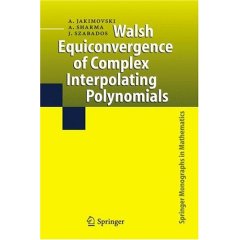 Series: Springer Monographs in Mathematics
2006, Approx. 295 p., Hardcover
ISBN: 1-4020-4174-8
About this book
This book is a collection of the various old and new results,
centered around the following simple and beautiful observation of
J.L. Walsh - If a function is analytic in a finite disc, and not
in a larger disc, then the difference between the Lagrange
interpolant of the function, at the roots of unity, and the
partial sums of the Taylor series, about the origin, tends to
zero in a larger disc than the radius of convergence of the
Taylor series, while each of these operators converges only in
the original disc.
This book will be particularly useful for researchers in
approximation and interpolation theory.
Table of contents
Dedication. Preface. Lagrange Interpolation and Walsh
Equiconvergence.- Hermite and Hermite-Birkhoff Interpolation and
Walsh Equiconvergence.- A generalization of the Taylor Series to
Rational Functions and Walsh Equiconvergence.- Sharpness Results.-
Converse Results.- Pade Approximation and Walsh Equiconvergence
for Meromorphic Functions with v-Poles.- Quantitative Results in
the Equiconvergence of Approximation of Meromorphic Functions.-
Equiconvergence for Functions Analytic in an Ellipse.- Walsh
Equiconvergence Theorems for the Faber Series.- Equiconvergence
on Lemniscates.- Walsh Equiconvergence and Summability.-
References.