edited by Michael Beaney and Erich H. Reck
Gottlob Frege: Critical Assessments of Leading Philosophers 4vols.
August 2005
Pages c. 1680 pp. (4 volumes)
ISBN 0-415-30601-9 (set)
0-415-30602-7 (Vol. I)
0-415-30603-5 (Vol. II)
0-415-30604-3 (Vol. III)
0-415-30605-1 (Vol. IV)
Volume I: Frege’s Philosophy in Context
Volume II: Frege’s Philosophy of Logic
Volume III: Frege’s Philosophy of Mathematics
Volume IV: Frege’s Philosophy of Thought and Language
General Introduction
George F. Carrier, Max Krook, and Carl E. Pearson
Functions of a Complex Variable: Theory and Technique
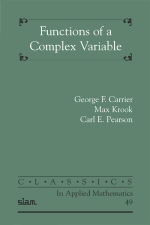 [This volume] is a classic textbook and reference on the
subject of complex variables. It established a gold standard
against which all other texts in applied mathematics should be
judged・ As the authors intended, the theory part is concise and
quickly leads the reader from an introduction to complex numbers
to useful and powerful techniques, with applications to integral
representation of special functions, transform and asymptotic
methods in the complex plane, and integral equations, just to
name a few. It is in the application of these techniques where
the authors devoted most of the efforts. These were done
masterfully. This book remains a relevant and must-read book for
applied mathematicians today.-・K.K. Tung, Professor and Chair
of Applied Mathematics, University of Washington.
[This volume] is a classic textbook and reference on the
subject of complex variables. It established a gold standard
against which all other texts in applied mathematics should be
judged・ As the authors intended, the theory part is concise and
quickly leads the reader from an introduction to complex numbers
to useful and powerful techniques, with applications to integral
representation of special functions, transform and asymptotic
methods in the complex plane, and integral equations, just to
name a few. It is in the application of these techniques where
the authors devoted most of the efforts. These were done
masterfully. This book remains a relevant and must-read book for
applied mathematicians today.-・K.K. Tung, Professor and Chair
of Applied Mathematics, University of Washington.
[This] is a book for those looking for applications of complex
variables above and beyond what is found in standard elementary
texts. I know of no single source where one finds such advanced
topics as asymptotics, transforms, the Wiener-Hopf method, and
dual and singular integral equations treated with such insight,
thoroughness, and flair or where one finds such a rich, non-trivial
collection of examples and exercises. Here is the power of
complex variables as a practical tool on full display.-・Jim
Simmonds, Emeritus Professor of Civil Engineering, University of
Virginia.
Functions of a complex variable are used to solve applications in
various branches of mathematics, science, and engineering.
Functions of a Complex Variable: Theory and Technique is a book
in a special category of influential classics because it is based
on the authors・extensive experience in modeling complicated
situations and providing analytic solutions. The book makes
available to readers a comprehensive range of these analytical
techniques based upon complex variable theory.
Proficiency in these techniques requires practice. The authors
provide many exercises, incorporating them into the body of the
text. By completing a substantial number of these exercises, the
reader will more fully benefit from this book.
Audience
Based on graduate courses in applied mathematics, Functions of a
Complex Variable: Theory and Technique is intended for applied
mathematicians, scientists, engineers, and senior or graduate-level
students who have advanced knowledge in calculus and are
interested in such subjects as complex variable theory, function
theory, mathematical methods, advanced engineering mathematics,
and mathematical physics.
Contents
Preface; Erratum; Chapter 1: Complex Numbers And Their Elementary
Properties; Chapter 2: Analytic Functions; Chapter 3: Contour
Integration; Chapter 4: Conformal Mapping; Chapter 5: Special
Functions; Chapter 6: Asymptotic Methods; Chapter 7: Transform
Methods; Chapter 8: Special Techniques; Index.
July 2005 / xiv + 438 pages / Softcover / ISBN 0-89871-595-4
R.M.M. Mattheij, S.W. Rienstra, J.H.M. ten Thije Boonkkamp
Partial Differential Equations: Modeling, Analysis,
Computation
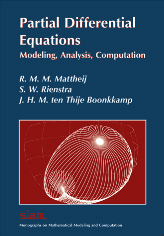 Partial differential equations (PDEs) are used to describe a
large variety of physical phenomena, from fluid flow to
electromagnetic fields, and are indispensable to such disparate
fields as aircraft simulation and computer graphics. While most
existing texts on PDEs deal with either analytical or numerical
aspects of PDEs, this innovative and comprehensive textbook
features a unique approach that integrates analysis and numerical
solution methods and includes a third component?modeling?to
address real-life problems. The authors believe that modeling can
be learned only by doing; hence a separate chapter containing 16
user-friendly case studies of elliptic, parabolic, and hyperbolic
equations is included and numerous exercises are included in all
other chapters.
Partial differential equations (PDEs) are used to describe a
large variety of physical phenomena, from fluid flow to
electromagnetic fields, and are indispensable to such disparate
fields as aircraft simulation and computer graphics. While most
existing texts on PDEs deal with either analytical or numerical
aspects of PDEs, this innovative and comprehensive textbook
features a unique approach that integrates analysis and numerical
solution methods and includes a third component?modeling?to
address real-life problems. The authors believe that modeling can
be learned only by doing; hence a separate chapter containing 16
user-friendly case studies of elliptic, parabolic, and hyperbolic
equations is included and numerous exercises are included in all
other chapters.
Partial Differential Equations: Modeling, Analysis, Computation
enables readers to deepen their understanding of a topic
ubiquitous in mathematics and science and to tackle practical
problems. The advent of fast computers and the development of
numerical methods have enabled the modern engineer to use a large
variety of packages to find numerical approximations to solutions
of PDEs. Problems are usually standard and a thorough knowledge
of a well-chosen subset of analytical and numerical tools and
methodologies is necessary when dealing with real-life problems.
When one is dealing with PDEs in practice, it becomes clear that
both numerical and analytical treatments of the problem are
needed.
Audience
This comprehensive book is intended for graduate students in
applied mathematics, engineering, and physics and may be of
interest to advanced undergraduate students. Mathematicians,
scientists, and engineers also will find the book useful.
Contents
List of Figures; List of Tables; Notation; Preface; Chapter 1:
Differential and difference equations; Chapter 2:
Characterization and classification; Chapter 3: Fourier theory;
Chapter 4: Distributions and fundamental solutions; Chapter 5:
Approximation by finite differences; Chapter 6: The Equations of
continuum mechanics and electromagnetics; Chapter 7: The art of
modeling; Chapter 8: The analysis of elliptic equations; Chapter
9: Numerical methods for elliptic equations; Chapter 10: Analysis
of parabolic equations; Chapter 11: Numerical methods for
parabolic equations; Chapter 12: Analysis of hyperbolic
equations; Chapter 13: Numerical methods for scalar hyperbolic
equations; Chapter 14: Numerical methods for hyperbolic systems;
Chapter 15: Perturbation methods; Chapter 16: Modeling,
analyzing, and simulating problems from practice; Appendices:
Useful definitions and properties; Bibliography; Index.
2005 / xxxiii + 665 pages / Softcover / ISBN 0-89871-594-6
Albrecht Bottcher and Sergei M. Grudsky
Spectral Properties of Banded Toeplitz Matrices
This is a wonderful book, full of the latest material on
Toeplitz matrices and operators, including norms, spectra,
pseudospectra, fields of values, and polynomial hulls. The notes
at the end of the chapters are especially interesting and the
exercises are challenging. The writing is careful and precise but
also entertaining. --Anne Greenbaum, Professor of Mathematics,
University of Washington.
This book is a tremendous resource for all aspects of the
spectral theory of banded Toeplitz matrices. It will be the first
place I turn when looking for many results in this field, and
given this book's amazing breadth and depth, I expect to find
just what I need. -- Mark Embree, Assistant Professor of
Computational and Applied Mathematics, Rice University.
This self-contained introduction to the behavior of several
spectral characteristics of large Toeplitz band matrices is the
first systematic presentation of a relatively large body of
knowledge. Covering everything from classic results to the most
recent developments, Spectral Properties of Banded Toeplitz
Matrices is an important resource. The spectral characteristics
include determinants, eigenvalues and eigenvectors, pseudospectra
and pseudomodes, singular values, norms, and condition numbers.
Toeplitz matrices emerge in many applications and the literature
on them is immense. They remain an active field of research with
many facets, and the material on banded ones until now has
primarily been found in research papers.
The book may serve both as a text for introducing the material
and as a reference. The approach is based on the know-how and
experience of the authors in combining functional analytical
methods with hard analysis and in applying operator theoretical
methods to matrix theory, which reveals the essence of several
phenomena and leads to significant improvements in existing
results. All basic results presented in the book are precisely
stated as theorems and accompanied by full proofs.
Audience
This book is written for applied mathematicians, engineers, and
scientists who encounter Toeplitz matrices in their research. It
also will be of interest to mathematicians in the fields of
operator theory, numerical analysis, structured matrices, or
random matrix theory, and physicists, chemists, biologists, and
economists who deal with stationary statistical and stochastic
problems. Parts of the book are suitable for use as a graduate-level
text on Toeplitz matrices or analysis.
Contents
Preface; Chapter 1: Infinite Matrices; Chapter 2: Determinants;
Chapter 3: Stability; Chapter 4: Instability; Chapter 5: Norms;
Chapter 6: Condition Numbers; Chapter 7: Substitutes for the
Spectrum; Chapter 8: Transient Behavior; Chapter 9: Singular
Values; Chapter 10: Extreme Eigenvalues; Chapter 11: Eigenvalue
Distribution; Chapter 12: Eigenvectors and Pseudomodes; Chapter
13: Structured Perturbations; Chapter 14: Impurities;
Bibliography; Index.
2005 / x + 411 pages / Softcover / ISBN 0-89871-599-7
Editors Wataru Takahashi, Tamaki Tanaka
Nonlinear Analysis and Convex Analysis.
3rd Int'l. Conference Tokyo 2003, JAPAN
ISBN 4-946552-15-4 Hardcover pp. 591
Contents;
 Koji Aoyama
A survey: An inverse of the Berge maximum theorem
Sachiko Atsushiba
Strong convergence theorems for finite nonexpansive mappings in
Banach spaces
Xiaosong Ding, Love Ekenberg, and Mats Danielson A fast bilinear
optimization algorithm
Jun Ichi Fujii and Masatoshi Fujii
Jensen's Inequalities on any interval for operators
Kiyoko Furuya
Approximation of semigroups generated by $-i\partial
\Tilde{\Psi}$
Pando Gr. Georgiev
Random critical points
Ryusuke Hohzaki
A search game with several types of false contacts
Masayuki Horiguchi and Masami Kurano
Stopped semi-Markov decision processes with multiple constraints
Takanori Ibaraki and Wataru Takahashi
Convergence of regularized solutions of ill-posed problem with
monotone operators in a Banach space
Shigeru Iemoto, Tomonari Suzuki, and Wataru Takahashi
Nadler's fixed point theorem with a vector-valued distance
Hideaki Iiduka and Wataru Takahashi
Strong and weak convergence theorems by a hybrid steepest descent
method in a Hilbert space
H.C. Jimbo, A. Ouentcheu, and R.E. Bozeman
Portfolio optimization with the growth model
Shoji Kamimura
The proximal point algorithm in a Banach space
Jun Kawabe
The portmanteau theorem for Dedekind complete Riesz space-valued
measures
Hidefumi Kawasaki
A game-theoretic aspect of conjugate sets for a nonlinear
programming problem
Kazuo Kido
A nonlinear approximation of the nucleolus
Gang Eun Kim and Hirobumi Kiuchi
Strong convergences of Ishikawa iterations for asymptotically
quasi-nonexpansive mappings in the intermediate sense
Kenji Kimura and Tamaki Tanaka
Existence result for vector-valued saddle-point problem by using
convex envelope
Yasunori Kimura
Mosco convergence and maximal monotone operators in Banach spaces
Fumiaki Kohsaka and Wataru Takahashi
Weak and strong convergence theorems for minimax problems in
Banach spaces
Naoto Komuro
Domination property of the set of upper bounds in ordered linear
spaces
Masamichi Kon
On fuzzy multicriteria location problems
Masami Kurano, Masami Yasuda, Jun-ichi Nakagami, and Yuji Yoshida
A fuzzy stopping problem with the concept of perception: The
finite and infinite horizon cases
Anthony To-Ming Lau and Wataru Takahashi
Submeans and nonlinear analysis
Yukihiro Maruyama
Associative sequential decision process
Takashi Matsuhisa
Communication leading to Nash equilibrium without acyclic
condition
Takashi Matsuhisa, Ryuichiro Ishikawa, and Yoshiaki Hoshino
Core equivalence in economy under generalized information
Mitsutaka Matsumoto and Satoshi Fuchimoto
An evolutionary game approach to sanctioning problems
Shin-ya Matsushita and Wataru Takahashi
An iterative algorithm for relatively nonexpansive mappings by a
hybrid method and applications
Hiromichi Miyake
A fixed point theorem for asymptotically nonexpansive mappings in
metric spaces with convex structure
Atsushi Moritani, Tetsuzo Tanino, Kojiro Kuroki, and Keiji
Tatsumi
Cooperative fuzzy games with restrictions on coalitions
Yoshiaki Muroya and Emiko Ishiwata
Global stability for nonlinear difference equations with variable
delay
Natalia Nadezhkina and Wataru Takahashi
Modified extragradient method for solving variational
inequalities in real Hilbert spaces
Koichiro Naito
Recurrent dimensions of quasi-periodic orbits with multiple
frequencies: Extended common multiples and Diophantine conditions
K. Nakajo, K. Shimoji, and W. Takahashi
A weak convergence theorem by products of mappings in Hilbert
spaces
Rabia Nessah and Moussa Larbani
g-maximum equality
Toshihiko Nishishiraho
The degree of convergence of equi-uniform approximation processes
of integral operators in Banach spaces
Ichiro Nishizaki, Masatoshi Sakawa, Hideki Katagiri, and Yoshio
Uemura
Cost allocation based on the solution concept from fuzzy
cooperative games for a production and transportation problem ---a
case study---
Ryohei Nozawa and Werner Oettli
The polarization principle in dynamic optimization
Tetsuya Nuriya and Daishi Kuroiwa
An observation of approximate saddle points
Hideho Ogasawara
A factorized form of the Broyden family of updates from the
preconvex class
Sehie Park
Fixed points, Roberts spaces, and the compact AR problem
Leon A. Petrosjan
Cooperation in games with incomplete information
Seiji Saito
Boundary value problems of fuzzy differential equations
Siegfried Schaible and Jianming Shi
Recent developments in fractional programming: Single-ratio and
max-min case
Yoshiyuki Sekiguchi
Necessary optimality conditions for general mathematical
programming with continuous constraints
Tomoo Shimizu
The almost fixed point property for multivalued nonexpansive
mappings of a metric space with some kind of convexity
Tomonari Suzuki
Krasnoselskii and Mann's type sequences and Ishikawa's strong
convergence theorem
M. Tsukada, T. Miura, S. Wada, Y. Takahashi, and S.-E. Takahasi
On Wirtinger-Beesack type integral inequalities
Hiroshi Yabe
Global convergence of conjugate gradient methods for
unconstrained minimization
Isao Yamada and Nobuhiko Ogura
Adaptive projected subgradient method and its applications to
signal processing problems
Takeshi Yoshimoto
On non-integral orders of strong ergodicity in nonlinear ergodic
theory