Seneta, E.
Non-negative Matrices and Markov Chains, 2nd ed.
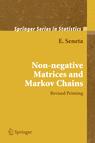 Series: Springer Series in Statistics
2006, XVI, 288 p., Softcover
ISBN: 0-387-29765-0
Due: March 2006
About this book
This book is a photographic reproduction of the book of the same
title published in 1981, for which there has been continuing
demand on account of its accessible technical level. Its
appearance also helped generate considerable subsequent work on
inhomogeneous products of matrices. This printing adds an
additional bibliography on coefficients of ergodicity and a list
of corrigenda.
Eugene Seneta received his Ph.D. in 1968 from the Australian
National University. He left Canberra in 1979 to become Professor
and Head of the Department of Mathematical Statistics at the
University of Sydney. He has been a regular visitor to the United
States, most frequently to the University of Virginia. Now
Emeritus Professor at the University of Sydney, he has recently
developed a renewed interest in financial mathematics. He was
elected Fellow of the Australian Academy of Science in 1985 and
awarded the Pitman Medal of the Statistical Society of Australia
for his distinguished research contributions.
The first edition of this book, entitled Non-Negative Matrices,
appeared in 1973, and was followed in 1976 by his Regularly
Varying Functions in the Springer Lecture Notes in Mathematics,
later translated into Russian. Both books were pioneering in
their fields. In 1977, Eugene Seneta coauthored (with C. C. Heyde
) I.J. Bienayme : Statistical Theory Anticipated, which is
effectively a history of probability and statistics in the 19th
century, and in 2001 co-edited with the same colleague
Statisticians of the Centuries, both published by Springer.
Having served on the editorial board of the Encyclopedia of
Statistical Science, he is currently Joint Editor of the
International Statistical Review.
Table of contents
Fundamental concepts and results in the theory of non-negative
matrices.- Some secondary theory with emphasis on irreducible
matrices and applications.- Inhomogenous products of non-negative
matrices.- Markov chains and finite stochastic matrices.-
Countable stochastic matrices.- Countable non-negative matrices.-
Truncations of infinite stochastic matrices.
Brezin, E.; Kazakov, V.; Serban, D.;
Wiegmann, P.; Zabrodin, A. (Eds.)
Applications of Random Matrices in Physics
Proceedings of the NATO Advanced Study Institute
on Applications of Random Matrices in Physics, held in Les
Houches, France, 6-25 June 2004
Series: NATO Science Series II: Mathematics,
Physics and Chemistry, Vol. 221
2006, Approx. 505 p., Hardcover
ISBN: 1-4020-4529-8
Due: March 2006
About this book
Random matrices are widely and successfully used in physics for
almost 60-70 years, beginning with the works of Dyson and Wigner.
Although it is an old subject, it is constantly developing into
new areas of physics and mathematics. It constitutes now a part
of the general culture of a theoretical physicist. Mathematical
methods inspired by random matrix theory become more powerful,
sophisticated and enjoy rapidly growing applications in physics.
Recent examples include the calculation of universal correlations
in the mesoscopic system, new applications in disordered and
quantum chaotic systems, in combinatorial and growth models, as
well as the recent breakthrough, due to the matrix models, in two
dimensional gravity and string theory and the non-abelian gauge
theories. The book consists of the lectures of the leading
specialists and covers rather systematically many of these topics.
It can be useful to the specialists in various subjects using
random matrices, from PhD students to confirmed scientists.
Table of contents
Stephane Fischler - Eric Gaudron - Samy Khemira (Ed.)
Formes modulaires et transcendance - Colloque Jeunus.
Seminaires et Congres 12 (2005), xiv+271 pages
Acheter l'ouvrage
Resume :
Ce livre presente un etat des lieux precis des (rares) preuves de
transcendance ou d'independance algebrique de nombres provenant
de la theorie des formes modulaires. Il dresse en outre un
tableau de techniques plus generales (theorie des periodes,
crochets de Rankin-Cohen, methode des pentes, formes modulaires
de Hilbert...), offrant ainsi de nouvelles perspectives.
Le recueil rassemble les actes du colloque qui s'est tenu au C.I.R.M.
du 26 au 30 mai 2003. Il est compose de quatre textes rediges
sous forme de mini-cours, incluant de nombreux rappels. Bien que
les developpements les plus recents soient aussi traites, la
majeure partie du volume reste accessible au non-specialiste.
Mots clefs : Forme modulaire, periode de forme parabolique,
periode de forme non parabolique, produit scalaire de Petersson,
crochet de Rankin-Cohen, fonction L, isomorphisme d'Eichler-Shimura,
structure rationnelle, structure differentielle, forme
quasimodulaire, forme modulaire presque holomorphe, valeur
speciale, systeme multiplicatif, independance algebrique, series
d'Eisenstein, lemme de multiplicite, lemme de zeros, theorie de
l'elimination, geometrie diophantienne, theoreme de Bezout,
transcendance, geometrie d'Arakelov, hauteur de Faltings, methode
des pentes, forme modulaire de Hilbert, plusieurs variables
complexes, operateurs differentiels
Abstract:
Modular forms and Transcendence
The present volume arises from a conference on the links between
modular forms and transcendence held at the C.I.R.M. (Marseille)
from May 26th to May 30th 2003.
It includes an overview of the few existing proofs of
transcendence or algebraic independence of numbers coming from
modular forms theory as well as more general techniques offering
new perspectives (periods, Rankin-Cohen brackets, slope method,
Hilbert modular forms...). The book is divided into four
independent chapters; although the most recent developments are
studied, it remains mostly accessible to non-specialists.
Key words: Modular form, period of a cuspidal form, period of a
non cuspidal modular form, Petersson scalar product, Rankin-Cohen
bracket, L function, Eichler-Shimura isomorphism, rational
structure, differential structure, quasimodular form, quasi
holomorphic modular form, special value, multiplicative system,
algebraic independence, Eisenstein series, multiplicity estimate,
zero estimate, elimination theory, diophantine geometry, Bezout
theorem, transcendence, Arakelov geometry, Faltings' height,
slope method, Hilbert modular form, several complex variables,
differential operators
Constantin, P., Gallavotti, G., Kazhikhov, A.V., Meyer, Y., Ukai, S.
Cannone, Marco; Miyakawa, Tetsuro (Eds.)
Mathematical Foundation of Turbulent Viscous Flows
Lectures given at the C.I.M.E. Summer School held in Martina
Franca, Italy, September 1-5, 2003
Series: Lecture Notes in Mathematics
Subseries: Fondazione C.I.M.E., Firenze, Vol. 1871
2006, IX, 252 p. 8 illus., Softcover
ISBN: 3-540-28586-5
About this book
Five leading specialists reflect on different and complementary
approaches to fundamental questions in the study of the Fluid
Mechanics and Gas Dynamics equations. Constantin presents the
Euler equations of ideal incompressible fluids and discusses the
blow-up problem for the Navier-Stokes equations of viscous
fluids, describing some of the major mathematical questions of
turbulence theory. These questions are connected to the
Caffarelli-Kohn-Nirenberg theory of singularities for the
incompressible Navier-Stokes equations that is explained in
Gallavotti's lectures. Kazhikhov introduces the theory of strong
approximation of weak limits via the method of averaging, applied
to Navier-Stokes equations. Y. Meyer focuses on several nonlinear
evolution equations - in particular Navier-Stokes - and some
related unexpected cancellation properties, either imposed on the
initial condition, or satisfied by the solution itself, whenever
it is localized in space or in time variable. Ukai presents the
asymptotic analysis theory of fluid equations. He discusses the
Cauchy-Kovalevskaya technique for the Boltzmann-Grad limit of the
Newtonian equation, the multi-scale analysis, giving the
compressible and incompressible limits of the Boltzmann equation,
and the analysis of their initial layers.
Delbaen, Freddy, Schachermayer, Walter
The Mathematics of Arbitrage
Series: Springer Finance
2006, XVI, 371 p., Hardcover
ISBN: 3-540-21992-7
About this book
This long-awaited book aims at a rigorous mathematical treatment
of the theory of pricing and hedging of derivative securities by
the principle of 'no arbitrage'. The first part presents a
relatively elementary introduction, restricting itself to the
case of finite probability spaces. The second part consists of an
updated edition of seven original research papers by the authors,
which analyse the topic in the general framework of semi-martingale
theory.
Table of contents
Pfaff, Bernhard
Analysis of Integrated and Co-integrated Time Series with R
R-code for examples in the book
Series: Use R
2006, XI, 139 p., Softcover
ISBN: 0-387-27959-8
About this book
The analysis of integrated and cointegrated time series can be
considered as the main methodology employed in applied
econometrics. This book not only introduces readers to this topic
but also enables them to conduct the various unit root tests and
cointegration methods by utilizing the free statistical
programming environment R. The book encompasses seasonal unit
roots, fractional integration, coping with structural breaks, and
inference in co-integrated vector autoregressive models. The book
is enriched by numerous programming examples to artificial and
real data so that it is suitable as a supplementary text for
computer lab classes.
Bernhard Pfaff studied economics at the universities of
Gottingen, Germany; Davis, California; and Freiburg im Breisgau,
Germany. He obtained a diploma and a doctorate degree at the
economics department of the last one where he was employed as a
research and teaching assistant. He has worked for many years as
economist and quantitative analyst in research departments of
financial institutions. Bernhard Pfaff is the author and
maintainer of the contributed R package "urca".
Table of contents
Berglund, Nils, Gentz, Barbara
Noise-Induced Phenomena in Slow-Fast Dynamical Systems
A Sample-Paths Approach
Series: Probability and its Applications
2005, XIV, 276 p. 57 illus., Hardcover
ISBN: 1-84628-038-9
About this book
Stochastic differential equations play an increasingly important
role in modeling the dynamics of a large variety of systems in
the natural sciences, and in technological applications. This
book is aimed at advanced undergraduate and graduate students,
and researchers in mathematics, physics, the natural sciences,
and engineering. It presents a new constructive approach to the
quantitative description of solutions to systems of stochastic
differential equations evolving on well-separated timescales. The
method, which combines techniques from stochastic analysis and
singular perturbation theory, allows the domains of concentration
for typical sample paths to be determined, and provides precise
estimates on the transition probabilities between these domains.
In addition to the detailed presentation of the set-up and
mathematical results, applications to problems in physics,
biology, and climatology are discussed. The emphasis lies on
noise-induced phenomena such as stochastic resonance, hysteresis,
excitability, and the reduction of bifurcation delay.