Felix Hausdorff
Set Theory
Description This work is a translation into English of the
Third Edition of the classic German language work Mengenlehre by
Felix Hausdorff published in 1937.
From the Preface (1937): "The present book has as its
purpose an exposition of the most important theorems of the
theory of sets, along with complete proofs, so that the reader
should not find it necessary to go outside this book for
supplementary details while, on the other hand, the book should
enable him to undertake a more detailed study of the voluminous
literature on the subject. The book does not presuppose any
mathematical knowledge beyond the differential and integral
calculus, but it does require a certain maturity in abstract
reasoning; qualified college seniors and first year graduate
students should have no difficulty in making the material their
own ... The mathematician will ... find in this book some things
that will be new to him, at least as regards formal presentation
and, in particular, as regards the strengthening of theorems, the
simplification of proofs, and the removal of unnecessary
hypotheses."
Readership
Graduate students and research mathematicians.
Contents
Sets and the Combining of Sets: 1.1 Sets; 1.2 Functions; 1.3 Sum
and intersection; 1.4 Product and power
Cardinal Numbers: 2.5 Comparison of sets; 2.6 Sum, product, and
power; 2.7 The scale of cardinal numbers; 2.8 The elementary
cardinal numbers
Order Types: 3.9 Order; 3.10 Sum and product; 3.11 The types
aleph_0 and aleph
Ordinal Numbers: 4.12 The well-ordering theorem; 4.13 The
comparability of ordinal numbers; 4.14 The combining of ordinal
numbers; 4.15 The alefs; 4.16 The general concept of product
Systems of Sets: 5.17 Rings and fields; 5.18 Borel systems; 5.19
Suslin sets
Point Sets: 6.20 Distance; 6.21 Convergence; 6.22 Interior points
and border points; 6.23 The alpha, beta, and gamma points; 6.24
Relative and absolute concepts; 6.25 Separable spaces; 6.26
Complete spaces; 6.27 Sets of the first and second categories; 6.28
Spaces of sets; 6.29 Connectedness
Point Sets and Ordinal Numbers: 7.30 Hulls and kernels; 7.31
Further applications of ordinal numbers; 7.32 Borel and Suslin
sets; 7.33 Existence proofs; 7.34 Criteria for Borel sets
Mappings of Two Spaces: 8.35 Continuous mappings; 8.36 Interval-images;
8.37 Images of Suslin sets; 8.38 Homeomorphism; 8.39 Simple
curves; 8.40 Topological spaces
Real Functions: 9.41 Functions and inverse image sets; 9.42
Functions of the first class; 9.43 Baire functions; 9.44 Sets of
convergence
Supplement: 10.45 The Baire condition; 10.46 Half-schlicht
mappings
Appendixes
Bibliography
Further references
Index
Details:
Series: AMS Chelsea Publishing
Publication Year: 1957
Reprint/Revision History: Reprinted 2005
ISBN: 0-8218-3835-0
Paging: 352 pp.
Binding: Hardcover
Edited by: Gestur Olafsson, Louisiana State University, Baton Rouge, LA,
and Eric Todd Quinto, Tufts University, Medford, MA
The Radon Transform, Inverse Problems, and Tomography
Description
Since their emergence in 1917, tomography and inverse problems
remain active and important fields that combine pure and applied
mathematics and provide strong interplay between diverse
mathematical problems and applications. The applied side is best
known for medical and scientific use, in particular, medical
imaging, radiotherapy, and industrial non-destructive testing.
Doctors use tomography to see the internal structure of the body
or to find functional information, such as metabolic processes,
noninvasively. Scientists discover defects in objects, the
topography of the ocean floor, and geological information using X-rays,
geophysical measurements, sonar, or other data.
This volume, based on the lectures in the Short Course The Radon
Transform and Applications to Inverse Problems at the American
Mathematical Society meeting in Atlanta, GA, January 3-4, 2005,
brings together articles on mathematical aspects of tomography
and related inverse problems. The articles cover introductory
material, theoretical problems, and practical issues in 3-D
tomography, impedance imaging, local tomography, wavelet methods,
regularization and approximate inverse, sampling, and emission
tomography. All contributions are written for a general audience,
and the authors have included references for further reading.
Readership
Graduate students and research mathematicians interested in
inverse problems and mathematical tomography.
Contents
E. T. Quinto -- An introduction to X-ray tomography and radon
transforms
A. K. Louis -- Development of algorithms in computerized
tomography
A. Faridani -- Fan-beam tomography and sampling theory
P. Kuchment -- Generalized transforms of radon type and their
applications
P. Massopust -- Inverse problems in pipeline inspection
L. Borcea -- Robust interferometric imaging in random media
Index
Details:
Series: Proceedings of Symposia in Applied Mathematics,Volume: 63
Publication Year: 2006
ISBN: 0-8218-3930-6
Paging: 158 pp.
Binding: Hardcover
Maurice Mashaal, Pour la Science, Paris, France
Bourbaki: A Secret Society of Mathematicians
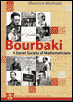 Expected publication date is June 23, 2006
Description
The name Bourbaki is known to every mathematician. Many also know
something of the origins of Bourbaki, yet few know the full story.
In 1935, a small group of young mathematicians in France decided
to write a fundamental treatise on analysis to replace the
standard texts of the time. They ended up writing the most
influential and sweeping mathematical treatise of the twentieth
century, Les elements de mathematique.
Maurice Mashaal lifts the veil from this secret society, showing
us how heated debates, schoolboy humor, and the devotion and hard
work of the members produced the ten books that took them over
sixty years to write. The book has many first-hand accounts of
the origins of Bourbaki, their meetings, their seminars, and the
members themselves. He also discusses the lasting influence that
Bourbaki has had on mathematics, through both the Elements and
the Seminaires. The book is illustrated with numerous remarkable
photographs.
Readership
Students, mathematicians, and historians interested in the group
of mathematicians known as Bourbaki.
Contents
A group forms
The story of a name
Young Turks against stubborn priests
Bourbaki's textit{Elements de Mathematique}
Towards axioms and structures
A snapshot of Bourbaki's work: Filters
The Bourbaki seminar
Subtle and austere schoolboys
"For the honor of the human spirit"
New math in the classroom
An immortal mathematician?
Acknowledgments
Bibliography
Captions
Supplementary material
Details:
Publication Year: 2006
ISBN: 0-8218-3967-5
Paging: approx. 260 pp.
Binding: Softcover
Robert E. Greene, University of California, Los Angeles, CA,
and Steven G. Krantz, Washington University, St. Louis, MO
Function Theory of One Complex Variable: Third Edition
Expected publication date is April 16, 2006
Description
Complex analysis is one of the most central subjects in
mathematics. It is compelling and rich in its own right, but it
is also remarkably useful in a wide variety of other mathematical
subjects, both pure and applied. This book is different from
others in that it treats complex variables as a direct
development from multivariable real calculus. As each new idea is
introduced, it is related to the corresponding idea from real
analysis and calculus. The text is rich with examples and
exercises that illustrate this point.
The authors have systematically separated the analysis from the
topology, as can be seen in their proof of the Cauchy theorem.
The book concludes with several chapters on special topics,
including full treatments of special functions, the prime number
theorem, and the Bergman kernel. The authors also treat H^p
spaces and Painleve's theorem on smoothness to the boundary for
conformal maps.
This book is a text for a first-year graduate course in complex
analysis. It is an engaging and modern introduction to the
subject, reflecting the authors' expertise both as mathematicians
and as expositors.
Readership
Graduate students interested complex analysis.
Contents
Fundamental concepts
Complex line integrals
Applications of the Cauchy integral
Meromorphic functions and residues
The zeros of a holomorphic function
Holomorphic functions as geometric mappings
Harmonic functions
Infinite series and products
Applications of infinite sums and products
Analytic continuation
Topology
Rational approximation theory
Special classes of holomorphic functions
Hilbert spaces of holomorphic functions, the Bergman kernel, and
biholomorphic mappings
Special functions
The prime number theorem
Appendix A: Real analysis
Appendix B: The statement and proof of Goursat's theorem
References
Index
Details:
Series: Graduate Studies in Mathematics,Volume: 40
Publication Year: 2006
ISBN: 0-8218-3962-4
Paging: 504 pp.
Binding: Hardcover
Joseph A. Cima, University of North Carolina, Chapel Hill, NC, Alec L. Matheson, Lamar University, Beaumont,
TX, and William T. Ross, University of Richmond, VA
The Cauchy Transform
Expected publication date is April 26, 2006
Description
The Cauchy transform of a measure on the circle is a subject of
both classical and current interest with a sizable literature.
This book is a thorough, well-documented, and readable survey of
this literature and includes full proofs of the main results of
the subject. This book also covers more recent perturbation
theory as covered by Clark, Poltoratski, and Aleksandrov and
contains an in-depth treatment of Clark measures.
Readership
Graduate students and research mathematicians interested in
classical and modern complex analysis.
Contents
Overview
Preliminaries
The Cauchy transform as a function
The Cauchy transform as an operator
Topologies on the space of Cauchy transforms
Which functions are Cauchy integrals?
Multipliers and divisors
The distribution function for Cauchy transforms
The backward shift on H^2
Clark measures
The normalized Cauchy transform
Other operators on the Cauchy transforms
List of symbols
Bibliography
Index
Details:
Series: Mathematical Surveys and Monographs, Volume: 125
Publication Year: 2006
ISBN: 0-8218-3871-7
Paging: 272 pp.
Binding: Hardcover