Paul S Wesson (University of Waterloo, Canada & Stanford University, USA)
FIVE-DIMENSIONAL PHYSICS
Classical and Quantum Consequences of Kaluza-Klein Cosmology
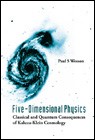 Extra dimensions ・beyond space and time ・are the best
methods for unifying gravity with particle physics. The basic
extension is to five dimensions (5D), as in the induced-matter
and membrane theory. This descriptive text gives an up-to-date
account of the classical and quantum consequences of 5D physics.
It includes topics that range from Einstein's original theory of
relativity to modern views on matter. The book is mathematically
precise and focuses on new ideas which appeal to readers.
Examples of new ideas are: The big-bang universe, which is curved
by matter in 4D, may be viewed as a smooth and empty world in 5D;
the uncertainty of quantum interactions in spacetime may be
regarded as the consequence of deterministic laws in higher
dimensions. This book will interest people who think about the
僧eaning of things・
Extra dimensions ・beyond space and time ・are the best
methods for unifying gravity with particle physics. The basic
extension is to five dimensions (5D), as in the induced-matter
and membrane theory. This descriptive text gives an up-to-date
account of the classical and quantum consequences of 5D physics.
It includes topics that range from Einstein's original theory of
relativity to modern views on matter. The book is mathematically
precise and focuses on new ideas which appeal to readers.
Examples of new ideas are: The big-bang universe, which is curved
by matter in 4D, may be viewed as a smooth and empty world in 5D;
the uncertainty of quantum interactions in spacetime may be
regarded as the consequence of deterministic laws in higher
dimensions. This book will interest people who think about the
僧eaning of things・
Contents:
Higher-Dimensional Physics
The Big Bang Revisited
Paths in Hyperspace
Quantum Consequences
The Cosmological 鼎onstant・and Vacuum
Embeddings in N ? 5 Dimensions
Perspectives in Physics
Readership: Graduate students and researchers in physics and
astronomy.
232pp Pub. date: Feb 2006
ISBN 981-256-661-9
edited by P Ciarlini (CNR, Istituto di Applicazione del Calcolo, Roma, Italy), E Filipe (Instituto Portugues da Qualidade,
Caparica, Portugal), A B Forbes (National Physical Laboratory, Middlesex,
UK), F Pavese (CNR, Istituto di Metrologia, Torino, Italy & National
Institute for Research in Metrology (INRiM), Torino, Italy), C Perruchet
(UTAC, Montlhery, France) & B R L Siebert (Physikalisch-Technische
Bundesanstalt, Berlin, Germany)
ADVANCED MATHEMATICAL AND COMPUTATIONAL TOOLS IN METROLOGY VII
 This volume collects the refereed contributions based on the presentations
made at the Seventh Workshop on Advanced Mathematical and Computational
Tools in Metrology, a forum for metrologists, mathematicians and software
engineers that will encourage a more effective synthesis of skills, capabilities
and resources. The volume contains articles by world renowned metrologists
and mathematicians involved in measurement science and, together with the
six previous volumes in this series, constitutes an authoritative source
of the mathematical, statistical and software tools necessary in modern
metrology.
This volume collects the refereed contributions based on the presentations
made at the Seventh Workshop on Advanced Mathematical and Computational
Tools in Metrology, a forum for metrologists, mathematicians and software
engineers that will encourage a more effective synthesis of skills, capabilities
and resources. The volume contains articles by world renowned metrologists
and mathematicians involved in measurement science and, together with the
six previous volumes in this series, constitutes an authoritative source
of the mathematical, statistical and software tools necessary in modern
metrology.
Contents:
Modeling Measurement Processes in Complex Systems with Partial
Differential Equations: From Heat Conduction to the Heart (M Bar
et al.)
Mereotopological Approach for Measurement Software (E Benoit
& R Dapoigny)
Data Evaluation of Key Comparisons Involving Several Artefacts (M
G Cox et al.)
Box?Cox Transformations and Robust Control Charts in SPC (M I
Gomes & F O Figueiredo)
Multisensor Data Fusion and Its Application to Decision Making (P
S Girao et al.)
Generic System Design for Measurement Databases ? Applied to
Calibrations in Vacuum Metrology, Bio-Signals and a Template
System (H Gross et al.)
Evaluation of Repeated Measurements from the Viewpoint of
Conventional and Bayesian Statistics (I Lira & W Woger)
Detection of Outliers in Interlaboratory Testing (C Perruchet)
On Appropriate Methods for the Validation of Metrological
Software (D Richter et al.)
Data Analysis ? A Dialogue with the Data (D S Sivia)
Validation of Soft Sensors in Monitoring Ambient Parameters (P
Ciarlini et al.)
Evaluation of Standard Uncertainties in Nested Structures (E
Filipe)
Measurement System Analysis and Statistical Process Control (A B
Forbes)
Monte Carlo Study on Logical and Statistical Correlation (B
Siebert et al.)
Some Problems Concerning the Estimate of the Degree of
Equivalence in MRA Key Comparisons and of Its Uncertainty (F
Pavese)
Preparing for a European Research Area Network in Metrology:
Where are We Now? (M Kuhne et al.)
and other papers
Readership: Researchers, graduate students, academics and
professionals in metrology.
Ivan Francis Wilde (formerly of King's College London, UK)
LECTURE NOTES ON COMPLEX ANALYSIS
 This book is based on lectures presented over many years to
second and third year mathematics students in the Mathematics
Departments at Bedford College, London, and King's College,
London, as part of the BSc. and MSci. program. Its aim is to
provide a gentle yet rigorous first course on complex analysis.
This book is based on lectures presented over many years to
second and third year mathematics students in the Mathematics
Departments at Bedford College, London, and King's College,
London, as part of the BSc. and MSci. program. Its aim is to
provide a gentle yet rigorous first course on complex analysis.
Metric space aspects of the complex plane are discussed in
detail, making this text an excellent introduction to metric
space theory. The complex exponential and trigonometric functions
are defined from first principles and great care is taken to
derive their familiar properties. In particular, the appearance
of p, in this context, is carefully explained.
The central results of the subject, such as Cauchy's Theorem and
its immediate corollaries, as well as the theory of singularities
and the Residue Theorem are carefully treated while avoiding
overly complicated generality. Throughout, the theory is
illustrated by examples.
A number of relevant results from real analysis are collected,
complete with proofs, in an appendix.
The approach in this book attempts to soften the impact for the
student who may feel less than completely comfortable with the
logical but often overly concise presentation of mathematical
analysis elsewhere.
Contents:
Complex numbers
Sequences and Series
Metric Space Properties of the Complex Plane
Analytic Functions
The Complex Exponential and Trigonometric Functions
The Complex Logarithm
Complex Integration
Cauchy痴 Theorem
The Laurent Expansion
Singularities and Meromorphic Functions
Theory of Residues
The Argument Principle
Maximum Modulus Principle
Mobius Transformations
Harmonic Functions
Local Properties of Analytic Functions
Readership: Undergraduate mathematics students (both single
subject and joint honours) as well as mathematics or physical
science graduate students wishing to acquire familiarity with the
subject.
260pp (approx.) Pub. date: Scheduled Summer 2006
ISBN 1-86094-642-9
ISBN 1-86094-643-7(pbk)
S Kesavan (The Institute of Mathematical Sciences, India)
SYMMETRIZATION AND APPLICATIONS
 The study of isoperimetric inequalities involves a fascinating interplay
of analysis, geometry and the theory of partial differential equations.
Several conjectures have been made and while many have been resolved, a
large number still remain open.
The study of isoperimetric inequalities involves a fascinating interplay
of analysis, geometry and the theory of partial differential equations.
Several conjectures have been made and while many have been resolved, a
large number still remain open.
One of the principal tools in the study of isoperimetric
problems, especially when spherical symmetry is involved, is
Schwarz symmetrization, which is also known as the spherically
symmetric and decreasing rearrangement of functions. The aim of
this book is to give an introduction to the theory of Schwarz
symmetrization and study some of its applications.
The book gives an modern and up-to-date treatment of the subject
and includes several new results proved recently. Effort has been
made to keep the exposition as simple and self-contained as
possible. A knowledge of the existence theory of weak solutions
of elliptic partial differential equations in Sobolev spaces is,
however, assumed. Apart from this and a general mathematical
maturity at the graduate level, there are no other prerequisites.
Contents:
Symmetrization
Some Classical Inequalities
Comparison Theorems
Eigenvalue Problems
Nonlinear Problems
Readership: Mathematicians and research scholars interested in
the calculus of variance, isoperimetric inequalities, partial
differential equations and mathematical physics.
160pp (approx.) Pub. date: Scheduled Summer 2006
ISBN 981-256-733-X