Bluman, George, Anco, Stephen
Advanced Symmetry Method Differential Equations
Series: Applied Mathematical Sciences, Preliminary entry 200
2005, Hardcover
ISBN: 0-387-98612-X
Due: April 2006
About this book
This is an acessible book on the advanced symmetry methods for
differential equations, including such subjects as conservation
laws, Lie-Backlund symmetries, contact transformations, adjoint
symmetries, Nother's Theorem, mappings with some modification,
potential symmetries, nonlocal symmetries, nonlocal mappings, and
non-classical method. Of use to graduate students and researchers
in mathematics and physics.
Written for:
Graduate and senior graduate students, researchers
Table of contents
Chapter 1 Introductory chapter where basic ideas are introduced
in an elementary way as motivation for later chapters including
summary of relevant material from Symmetry Methods of
Differential Equations * Chapter 2 Conservation laws, Lie-Backlund
symmetries, contact transformations, adjoint symmetries,
Noether's Theorem, new work of Anco/Bluman introducing new
conservation law formula * Chapter 3 Mappings with some
modification * Chapter 4 Potential symmetries, nonlocal
symmetries, nonlocal mappings, Chapter 5 Non-classical methods
Pitman, Jim / Picard, Jean (Ed.)
Combinatorial Stochastic Processes
Ecole d'Ete de Probabilites de Saint-Flour XXXII - 2002
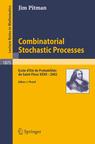 Series: Lecture Notes in Mathematics, Vol. 1875
2006, VIII, 260 p. 16 illus., Softcover
ISBN: 3-540-30990-X
Due: April 5, 2006
About this book
The purpose of this text is to bring graduate students
specializing in probability theory to current research topics at
the interface of combinatorics and stochastic processes, in
particular the theory of random combinatorial structures such as
partitions, permutations, trees, forests, and mappings, and
connections between the asymptotic theory of enumeration of such
structures and the theory of stochastic processes like Brownian
motion and Poisson processes. The course is a summary and review
of the author's research over the last ten years, much of it
joint work with coauthors David Aldous, Jean Bertoin, Steven
Evans, and Marc Yor.
Written for:
Researchers and graduate students in probability and stochastic
processes and in combinatorics
Table of contents
Preliminaries.- Bell polynomials, composite structures and Gibbs
partitions.-Exchangeable random partitions.- Sequential
constructions of random partitions.- Poisson constructions of
random partitions.- Coagulation and fragmentation processes.-
Random walks and random forests.- The Brownian forest.- Brownian
local times, branching and Bessel processes.- Brownian bridge
asymptotics for random mappings.- Random forests and the additive
coalescent.- Bibliography.- Index.
Herrlich, Horst
Axiom of Choice
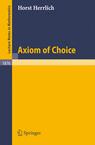 Series: Lecture Notes in Mathematics, Vol. 1876
2006, XIV, 200 p. 1 illus., Softcover
ISBN: 3-540-30989-6
Due: April 5, 2006
About this book
AC, the axiom of choice, because of its non-constructive
character, is the most controversial mathematical axiom, shunned
by some, used indiscriminately by others. This treatise shows
paradigmatically that:
- Disasters happen without AC: Many fundamental mathematical
results fail (being equivalent in ZF to AC or to some weak form
of AC).
- Disasters happen with AC: Many undesirable mathematical
monsters are being created (e.g., non measurable sets and
undeterminate games).
- Some beautiful mathematical theorems hold only if AC is
replaced by some alternative axiom, contradicting AC (e.g., by
AD, the axiom of determinateness).
Illuminating examples are drawn from diverse areas of
mathematics, particularly from general topology, but also from
algebra, order theory, elementary analysis, measure theory, game
theory, and graph theory.
Written for:
Researchers and graduate students interested in set theory,
topology, order theory, algebra, analysis, measure theory, graph
theory, and game theory
Table of contents
Origins: Hilbert's First Problem.- Choice Principles: Some
Equivalents to the Axiom of Choice, Some Concepts Related to the
Axiom of Choice.- Elementary Observations: Hidden Choice,
Unnecessary Choice, Concepts Split Up: Compactness.- Disasters
without Choice: Finiteness, Disasters in Cardinal Arithmetic,
Disasters in Order Theory, Disasters in Algebra I: Vector Spaces,
Disasters in Algebra II: Categories, Disasters in Elementary
Analysis: The Reals and Continuity, Disasters in Topology I:
Countable Sums, Disasters in Topology II: Products (The Tychonoff
and the Cech-Stone Theorem), Disasters in Topology III: Function
Spaces (The Ascoli Theorem), Disasters in Topology IV: The Baire
Category Theorem, Disasters in Graph Theory: Coloring Problems.-
Disasters with Choice: Disasters in Elementary Analysis,
Disasters in Geometry: Paradoxical Decompositions.- Disasters
either way: Disasters in Game Theory.- Beauty without Choice:
Lindelof = Compact, Measurability (The Axiom of Determinateness).
Dumortier, Freddy, Llibre, Jaume, Artes, Joan C.
Qualitative Theory of Planar Differential Systems
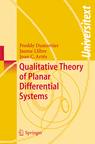 Series: Universitext
2006, Approx. 370 p., Softcover
ISBN: 3-540-32893-9
Due: June 19, 2006
About this textbook
The book deals essentially with systems of polynomial autonomous
ordinary differential equations in two real variables. The
emphasis is mainly qualitative, although attention is also given
to more algebraic aspects as a thorough study of the center/focus
problem and recent results on integrability. In the last two
chapters the performant software tool P4 is introduced.
From the start, differential systems are represented by vector
fields enabling, in full strength, a dynamical systems approach.
All essential notions, including invariant manifolds, normal
forms, desingularization of singularities, index theory and limit
cycles, are introduced and the main results are proved for smooth
systems with the necessary specifications for analytic and
polynomial systems.
The book is very appropriate for a first course in dynamical
systems. Not only does it provide simple and appropriate proofs,
but it also contains a lot of exercises and presents a survey of
interesting results with the necessary references to the
literature.
Table of contents
Basic Results on the Qualitative Theory of Differential Equations.-
Normal Forms and Elementary Singularities.- Desingularization of
Non-elementary Singularities. Centers and Lyapunov Constants. -
Poincare and Poincare-Lyapunov Compactification.- Indices of
Planar Singular Points.- Limit Cycles and Structural Stability.-
Integrability and Algebaric Solutions in Polynomial Vector Fields.-
Polynomial Planar Phase Portraits.- Examples for Running P4. -
Bibliography
Knoebel, A., Laubenbacher, R., Lodder, J., Pengelley, D.
Mathematical Masterpieces
Further Chronicles by the Explorers
Series: Undergraduate Texts in Mathematics
2006, Approx. 350 p.,
Hardcover ISBN: 0-387-33060-7
Softcover ISBN: 0-387-33061-5
Due: May 2006
About this textbook
This book traces the historical development of four different
mathematical concepts by presenting readers with the original
sources. Although primary sources can be more demanding, the
investment yields the rewards of a deeper understanding of the
subject, an appreciation of the details, and a glimpse into the
direction research has taken.
Each chapter contains a different story, each anchored around a
sequence of selected primary sources showcasing a masterpiece of
mathematical achievement. The authors begin by studying the
interplay between the discrete and continuous, with a focus on
sums of powers. They proceed to the development of algorithms for
finding numerical solutions of equations as developed by Newton,
Simpson and Smale. Next they explore our modern understanding of
curvature, with its roots in the emerging calculus of the 17th
century, while the final chapter ends with an exploration of the
elusive properties of prime numbers, and the patterns found
therein.
This book emerged from a course taught at New Mexico State
University to juniors and seniors majoring in mathematics. The
intended audience is juniors and seniors majoring in mathematics,
as well as anyone pursuing independent study. The authors have
included exercises, numerous historical photographs, and an
annotated bibliography.
Written for:
undergrad mathematics students mathematics teachersmathematicians
Table of contents
* The Bridge Between the Continuous and the Discrete * Numerical
Solutions of Equations * The Quadratic Reciprocity Law: Secrets
of Prime Numbers * Prime Decomposition of Ideals: The Maturation
of Abstract Algebra * Curvature and the Notion of Space