Platen, Eckhard, Heath, David
A Benchmark Approach to Quantitative Finance
Series: Springer Finance
2006, Hardcover
ISBN: 3-540-26212-1
Due: August 2006
About this book
The benchmark approach provides a general framework for financial
market modeling, which extends beyond the standard risk neutral
pricing theory. It permits a unified treatment of portfolio
optimization, derivative pricing, integrated risk management and
insurance risk modeling. The existence of an equivalent risk-neutral
pricing measure is not required. Instead, it leads to pricing
formulae with respect to the real world probability measure. This
yields important modeling freedom which turns out to be necessary
for the derivation of realistic, parsimonious market models. The
first part of the book describes the necessary tools from
probability theory, statistics, stochastic calculus and the
theory of stochastic differential equations with jumps. The
second part is devoted to financial modeling under the benchmark
approach. Various quantitative methods for the fair pricing and
hedging of derivatives are explained. The general framework is
used to provide an understanding of the nature of stochastic
volatility. The book is intended for a wide audience that
includes quantitative analysts, postgraduate students and
practitioners in finance, economics and insurance. It aims to be
a self-contained, accessible but mathematically rigorous
introduction to quantitative finance for readers that have a
reasonable mathematical or quantitative background. Finally, the
book should stimulate interest in the benchmark approach by
describing some of its power and wide applicability.
Table of contents
Preliminaries.- Statistical Methods.- Modeling via Stochastic
Processes.- Diffusion Processes.- Martingales and Stochastic
Integrals.- The Ito Integral or Stochastic Chain Rule.-
Stochastic Differential Equations.- Continuous Benchmark Models.-
Introduction to Option Pricing.- Various Approaches to Asset
Pricing.- Numerical Methods for Derivatives Pricing.- Pricing of
Derivatives.- Benchmark Models with Jumps.
Tsiatis, Anastasios A.
Semiparametric Theory and Missing Data
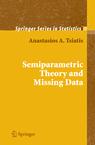 Series: Springer Series in Statistics
2006, Approx. 395 p., Hardcover
ISBN: 0-387-32448-8
Due: August 2006
About this book
This book reviews contemporary understanding of the theory of
estimation for semiparametric models with missing data in an
organized and comprehensive manner. The description of the theory
of estimation for semiparametric models is both rigorous and
intuitive, relying on geometric ideas to reinforce the intuition
and understanding of the theory. These methods are then applied
to problems with missing, censored, and coarsened data, with the
goal of deriving estimators that are as robust and efficient as
possible.
Table of contents
Introduction to semiparametric models.- Hilbert space for random
vectors.- The geometry of influence functions.- Semiparametric
models.- Other examples of semiparametric models.- Models and
methods for missing data.- Missing and coarsening at random for
semiparametric models.- The nuisance tangent space and its
orthogonal complement.- Augmented inverse probability weighted
complete case estimators.- Improving efficiency and double-robustness
with coarsened data.- Locally-efficient estimators for coarsened
data semiparametric models.- Approximate methods for gaining
efficiency.- Double robust estimator of the average causal
treatment effect.- Multiple imputation: a frequentist perspective.
Berestycki, Henri, Hamel, Francois
Reaction-Diffusion Equations and Propagation Phenomena
Series: Applied Mathematical Sciences, Preliminary entry 600
2007, Approx. 410 p., Hardcover
ISBN: 0-387-34158-7
Due: October 2006
About this book
This book is about reaction diffusions in unbounded domains with
a special emphasis on travelling waves and their generalizations
and on different notions of propagation. Several models of
applications of reaction-diffusion and front propagation are
discussed, ranging from combustion models to ecological invasion
models.
Table of contents
Introduction.-the Maximum Principle.-Planar Fronts and
Propagation in Homogenous Media .-Conical fronts and other fronts
for homogeneous equations in Rn.-Curved fronts in infinite
cylinders.-Pulsating fronts in periodic excitable media.-Formulas
and speeds of propagation.-The role of advection, diffusion and
geometry.-Singular reaction-terms, free boundary problems.-Fronts
and propagation in general heterogeneous media.-Biological
invasion in heterogeneous periodic environments.-Further models
in biology and combustion theory.-References
O Searcoid, Micheal
Metric Spaces
Series: Springer Undergraduate Mathematics Series
2006, 102 illus., Softcover
ISBN: 1-84628-369-8
Due: October 2006
About this textbook
The abstract concepts of metric spaces are often perceived as
difficult. This book offers a unique approach to the subject
which gives readers the advantage of a new perspective on ideas
familiar from the analysis of a real line. Rather than passing
quickly from the definition of a metric to the more abstract
concepts of convergence and continuity, the author takes the
concrete notion of distance as far as possible, illustrating the
text with examples and naturally arising questions. Attention to
detail at this stage is designed to prepare the reader to
understand the more abstract ideas with relative ease.
The book goes on to provide a thorough exposition of all the
standard necessary results of the theory and, in addition,
includes selected topics not normally found in introductory
books, such as: the Tietze Extension Theorem; the Hausdorff
metric and its completeness; and the existence of curves of
minimum length. Other features include:
end-of-chapter summaries and numerous exercises to reinforce what
has been learnt;
extensive cross-referencing to help the reader follow arguments;
a Cumulative Reference Chart, showing the dependencies throughout
the book on a section-by-section basis as an aid to course design.
The book is designed for third- and fourth-year undergraduates
and beginning graduates. Readers should have some practical
knowledge of differential and integral calculus and have
completed a first course in real analysis. With its many
examples, careful illustrations, and full solutions to selected
exercises, this book provides a gentle introduction that is ideal
for self-study and an excellent preparation for applications.
Table of contents
To the Reader.- Cumulative Reference Chart.- Metrics.- Distance.-
Boundary.- Open, Closed and Dense Sets.- Balls.- Convergence.-
Bounds.- Continuity.- Uniform Continuity.- Completeness.-
Connectedness.- Compactness.- Equivalence.- Appendices: Language
and Logic.- Sets.- Solutions.- List of Symbols.- Index
Shores, Thomas S.
Applied Linear Algebra and Matrix Analysis
Series: Undergraduate Texts in Mathematics
2007, Approx. 360 p. 40 illus., Softcover
ISBN: 0-387-33195-6
Due: March 2006
About this textbook
This text is intended for a one or two semester sophomore level
course in linear algebra. It is designed to provide a balance of
applications, theory and computation, and to emphasize their
interdependence. The text has a strong orientation towards
numerical computation and the linear algebra needed in applied
mathematics. At the same time, it contains a rigorous and self-contained
development of most of the traditional topics in a linear algebra
course. It provides background for numerous projects, which
frequently require computational tools, but is not tied to any
one computational platform.
Table of contents
Linear Systems of Equations.- Matrix Algebra.- Vector Spaces.-
Geometrical Aspects of Standard Spaces.- The Eigenvalue Problem.-
Geometrical Aspects of Abstract Spaces.- Table of Symbols.-
Solutions to Selected Exercises.- Bibliography.- Index.