Howard Baer / Florida State University
Xerxes Tata / University of Hawaii, Honolulu
Weak Scale Supersymmetry
From Superfields to Scattering Events
 Hardback (ISBN-13: 9780521857864 | ISBN-10: 0521857864)
Publication is planned for May 2006 | 556 pages | 247 x 174 mm
Supersymmetric models of particle physics predict new
superpartner matter states for each particle in the Standard
Model. These superpartners will have wide ranging implications,
from cosmology to observations at high energy accelerators, such
as CERN's LHC. In this text, the authors develop the basic
concepts of supersymmetry and show how it can be incorporated
into a theoretical framework for describing unified theories of
elementary particles. They develop the technical tools of
supersymmetry using four-component spinor notation familiar to
high energy experimentalists and phenomenologists. The text takes
the reader from an abstract formalism to a straightforward recipe
for writing supersymmetric gauge theories of particle physics,
and ultimately to the calculations necessary for practical
applications at colliders and in cosmology. This is a
comprehensive, practical and accessible introduction to
supersymmetry for experimental and phenomenological particle
physicists and graduate students. Exercises and worked examples
that clarify the material are interspersed throughout.
* Develops very general supersymmetric models for the
interactions of elementary particles from basic principles
* Uses 4-component spinor notation to develop the superfield
formalism (a necessary technical tool)
* Extensively treats the experimental implications of
supersymmetry
* Contains over 100 exercises and worked examples throughout the
text
Contents
Preface; 1. The Standard Model; 2. What lies beyond the Standard
Model; 3. The Wess-Zumino model; 4. The supersymmetry algebra; 5.
Superfield formalism; 6. Supersymmetric gauge theories; 7.
Supersymmetry breaking; 8. The Minimal Supersymmetric Standard
Model; 9. Implications of the MSSM; 10. Local supersymmetry; 11.
Realistic supersymmetric models; 12. Sparticle production at
colliders; 13. Sparticle decays; 14. Supersymmetric event
generation; 15. The search for supersymmetry at colliders; 16. R
parity violation; 17. Epilogue; Appendices.
Ingemar Bengtsson / Stockholms Universitet
Karol Zyczkowski / Jagiellonian University, Krakow
Geometry of Quantum States
An Introduction to Quantum Entanglement
 Hardback (ISBN-13: 9780521814515 | ISBN-10: 0521814510)
Publication is planned for May 2006 | 418 pages | 247 x 174 mm
Courses:
Although the book is not primarily a text book, it might be used
as an auxiliary textbook in the following graduate courses:
Quantum Information Theory, Geometrical Methods in Mathematical
Physics
Levels: GRADUATE
Quantum information theory is at the frontiers of physics,
mathematics and information science, offering a variety of
solutions that are impossible using classical theory. This book
provides an introduction to the key concepts used in processing
quantum information and reveals that quantum mechanics is a
generalisation of classical probability theory. After a gentle
introduction to the necessary mathematics the authors describe
the geometry of quantum state spaces. Focusing on finite
dimensional Hilbert spaces, they discuss the statistical distance
measures and entropies used in quantum theory. The final part of
the book is devoted to quantum entanglement - a non-intuitive
phenomenon discovered by Schrodinger, which has become a key
resource for quantum computation. This richly-illustrated book is
useful to a broad audience of graduates and researchers
interested in quantum information theory. Exercises follow each
chapter, with hints and answers supplied.
* The first book to focus on the geometry of quantum states
* Stresses the similarities and differences between classical and
quantum theory
* Uses a non-technical style and numerous figures to make the
book accessible to non-specialists
Contents
Preface; 1. Convexity, colours and statistics; 2. Geometry of
probability distributions; 3. Much ado about spheres; 4. Complex
projective spaces; 5. Outline of quantum mechanics; 6. Coherent
states and group actions; 7. The stellar representation; 8. The
space of density matrices; 9. Purification of mixed quantum
states; 10. Quantum operations; 11. Duality: maps versus states;
12. Density matrices and entropies; 13. Distinguishability
measures; 14. Monotone metrics and measures; 15. Quantum
entanglement; Epilogue; Appendices; Refererences; Index.
Juergen Bokowski
Technische Universitat, Darmstadt, Germany
Computational Oriented Matroids
 Hardback (ISBN-13: 9780521849302 | ISBN-10: 0521849306)
Publication is planned for May 2006 | 338 pages | 247 x 174 mm
Oriented matroids play the role of matrices in discrete geometry,
when metrical properties, such as angles or distances, are
neither required nor available. Thus they are of great use in
such areas as graph theory, combinatorial optimization and convex
geometry. The variety of applications corresponds to the variety
of ways they can be defined. Each of these definitions
corresponds to a differing data structure for an oriented
matroid, and handling them requires computational support, best
realised through a functional language. Haskell is used here,
and, for the benefit of readers, the book includes a primer on it.
The combination of concrete applications and computation, the
profusion of illustrations, many in colour, and the large number
of examples and exercises make this an ideal introductory text on
the subject. It will also be valuable for self-study for
mathematicians and computer scientists working in discrete and
computational geometry.
* Has a large number of examples and exercises which will make
this an ideal text for introductory courses on the subject
* Is valuable for self-study for mathematicians and computer
scientists working in discrete and computational geometry
* Contains many colour illustrations
Contents
1. Geometric matrix models i; 2. Geometric matrix models ii; 3.
From matrices to rank 3 oriented matroids; 4. Oriented matroids
of arbitrary rank; 5. From oriented matroids to face lattices; 6.
From face lattices to oriented matroids i; 7. From face lattices
to oriented matroids ii; 8. From oriented matroids to matrices; 9.
Computational synthetic geometry; 10. Some oriented matroid
applications; 11. Some inttrinsic oriented matroid problems;
Bibliography; Index.
Anton Bovier
Technische Universitat Berlin and Weierstraβ-Institut fur
Angewandte Analysis und Stochastik
Statistical Mechanics of Disordered Systems
A Mathematical Perspective
 Series: Cambridge Series in Statistical and Probabilistic Mathematics (No. 18)
Hardback (ISBN-13: 9780521849913 | ISBN-10: 0521849918)
Not yet published - available from May 2006
Our mathematical understanding of the statistical mechanics of
disordered systems is going through a period of stunning progress.
This self-contained book is a graduate-level introduction for
mathematicians and for physicists interested in the mathematical
foundations of the field, and can be used as a textbook for a two-semester
course on mathematical statistical mechanics. It assumes only
basic knowledge of classical physics and, on the mathematics
side, a good working knowledge of graduate-level probability
theory. The book starts with a concise introduction to
statistical mechanics, proceeds to disordered lattice spin
systems, and concludes with a presentation of the latest
developments in the mathematical understanding of mean-field spin
glass models. In particular, recent progress towards a rigorous
understanding of the replica symmetry-breaking solutions of the
Sherrington-Kirkpatrick spin glass models, due to Guerra,
Aizenman-Sims-Starr and Talagrand, is reviewed in some detail.
* Comprehensive introduction to an active and fascinating area of
research
* Clear exposition that builds to the state of the art in the
mathematics of spin glasses
* Written by a well-known and active researcher in the field
Contents
Preface; Part I. Statistical Mechanics: 1. Introduction; 2.
Principles of statistical mechanics; 3. Lattice gases and spin
systems; 4. Gibbsian formalism; 5. Cluster expansions; Part II.
Disordered Systems: Lattice Models: 6. Gibbsian formalism and
metastates; 7. The random field Ising model; Part III: Disordered
Systems: Mean Field Models; 8. Disordered mean field models; 9.
The random energy model; 10. Derrida’s generalised random
energy models; 11. The SK models and the Parisi solution; 12.
Hopfield models; 13. The number partitioning problem;
Bibliography; Index of notation; Index.
Nicolo Cesa-Bianchi / Universita degli Studi di Milano
Gabor Lugosi / Universitat Pompeu Fabra, Barcelona
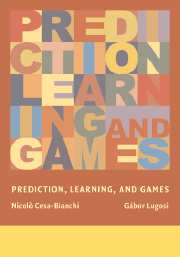
Prediction, Learning, and Games
 Hardback (ISBN-13: 9780521841085 | ISBN-10: 0521841089)
Publication is planned for May 2006 | 406 pages | 253 x 177 mm
This important new text and reference for researchers and
students in machine learning, game theory, statistics and
information theory offers the first comprehensive treatment of
the problem of predicting individual sequences. Unlike standard
statistical approaches to forecasting, prediction of individual
sequences does not impose any probabilistic assumption on the
data-generating mechanism. Yet, prediction algorithms can be
constructed that work well for all possible sequences, in the
sense that their performance is always nearly as good as the best
forecasting strategy in a given reference class. The central
theme is the model of prediction using expert advice, a general
framework within which many related problems can be cast and
discussed. Repeated game playing, adaptive data compression,
sequential investment in the stock market, sequential pattern
analysis, and several other problems are viewed as instances of
the experts' framework and analyzed from a common nonstochastic
standpoint that often reveals new and intriguing connections. Old
and new forecasting methods are described in a mathematically
precise way in order to characterize their theoretical
limitations and possibilities.
* First book to offer comprehensive treatment of the subject
matter
* Unifies different approaches developed in machine learning,
game theory, statistics and information theory
* Offers a self-contained introduction to the subject and
presents the latest advances of the field
Contents
1. Introduction; 2. Prediction with expert advice; 3. Tight
bounds for specific losses; 4. Randomized prediction; 5.
Efficient forecasters for large classes of experts; 6. Prediction
with limited feedback; 7. Prediction and playing games; 8.
Absolute loss; 9. Logarithmic loss; 10. Sequential investment; 11.
Linear pattern recognition; 12. Linear classification; 13.
Appendix.