Andrew Majda / New York University
Xiaoming Wang / Florida State University and Iowa State
University
Nonlinear Dynamics and Statistical Theories for Basic
Geophysical Flows
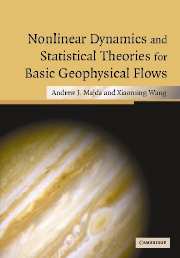 Hardback (ISBN-13: 9780521834414 | ISBN-10: 0521834414)
Publication is planned for May 2006 | 564 pages | 247 x 174 mm
The general area of geophysical fluid mechanics is truly
interdisciplinary. Now ideas from statistical physics are being
applied in novel ways to inhomogeneous complex systems such as
atmospheres and oceans. In this book, the basic ideas of
geophysics, probability theory, information theory, nonlinear
dynamics and equilibrium statistical mechanics are introduced and
applied to large time-selective decay, the effect of large scale
forcing, nonlinear stability, fluid flow on a sphere and
Jupiter's Great Red Spot. The book is the first to adopt this
approach and it contains many recent ideas and results. Its
audience ranges from graduate students and researchers in both
applied mathematics and the geophysical sciences. It illustrates
the richness of the interplay of mathematical analysis,
qualitative models and numerical simulations which combine in the
emerging area of computational science.
* First book combining nonlinear dynamical and statistical
approaches at elementary level
* Only basic prerequisites; many topics introduced through
examples as and when required
* Many applications to geophysics including Great Red Spot of
Jupiter
Contents
1. Barotropic geophysical flows and two-dimensional fluid flows:
an elementary introduction; 2. The Response to large scale
forcing; 3. The selective decay principle for basic geophysical
flows; 4. Nonlinear stability of steady geophysical flows; 5.
Topographic mean-flow interaction, nonlinear instability, and
chaotic dynamics; 6. Introduction to empirical statistical
theory; 7. Equilibrium statistical mechanics for systems of
ordinary differential equations; 8. Statistical mechanics for the
truncated quasi-geostrophic equations; 9. Empirical statistical
theories for most probable states; 10. Assessing the potential
applicability of equilibrium statistical theories for geophysical
flows: an overview; 11. Predictions and comparison of equilibrium
statistical theories; 12. Equilibrium statistical theories and
dynamical modeling of flows with forcing and dissipation; 13.
Predicting the jets and spots on Jupiter by equilibrium
statistical mechanics; 14. Statistically relevant and irrelevant
conserved quantities for truncated quasi-geostrophic flow and the
Burger Hopf model; 15. A mathematical framework for quantifying
predictability utilizing relative entropy; 16. Barotropic quasi-geostrophic
equations on the sphere; Bibliography; Index.
Robert Messer / Albion College, Michigan
Philip Straffin / Beloit College, Wisconsin
Topology Now !
 Series: Classroom Resource Material
Hardback (ISBN-13: 9780883857441 | ISBN-10: 0883857448)
Publication is planned for May 2006 | 250 pages | 253 x 177 mm
Courses: Introduction to topology, topology
Topology is a branch of mathematics packed with intriguing
concepts, fascinating geometrical objects, and ingenious methods
for studying them. The authors have written this textbook to make
the material accessible to undergraduate students without
requiring extensive prerequisites in upper-level mathematics. The
approach is to cultivate the intuitive ideas of continuity,
convergence, and connectedness so students can quickly delve into
knot theory, the topology of surfaces and three-dimensional
manifolds, fixed points and elementary homotopy theory. The
fundamental concepts of point-set topology appear at the end of
the book when students can see how this level of abstraction
provides a sound logical basis for the geometrical ideas that
have come before. This organization exposes students to the
exciting world of topology now(!) rather than later. Students
using this textbook should have some exposure to the geometry of
objects in higher-dimensional Euclidean spaces together with an
appreciation of precise mathematical definitions and proofs.
* Develops intuitive geometric ideas before moving on to
axiomatic topological ideas
* The approach allows students rapid access to the exciting
geometric ideas of topology
* The well written text is supplemented by many instructive
diagrams, exercises and worked examples
Contents
Preface; Acknowledgments; 1. Deformations; 2. Knots and links; 3.
Surfaces; 4. Three-dimensional manifolds; 5. Fixed points; 6. The
fundamental group; 7. Metric and topological spaces; Index.
Ivo Sachs / Ludwig-Maximilians-Universitat Munchen
Siddartha Sen / Trinity College, Dublin
James Sexton / Trinity College, Dublin
Elements of Statistical Mechanics
With an Introduction to Quantum Field Theory and Numerical
Simulation
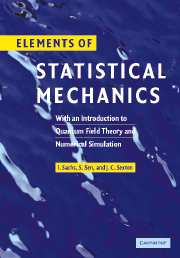 Hardback (ISBN-13: 9780521841986 | ISBN-10: 0521841984)
Publication is planned for May 2006 | 346 pages | 247 x 174 mm
Courses: Statistical Mechanics Statistical Physics Thermodynamics
Levels: ADVANCED UNDERGRADUATE AND GRADUATE
This textbook provides a concise introduction to the key concepts
and tools of modern statistical mechanics. It also covers
advanced topics such as non-relativistic quantum field theory and
numerical methods. After introducing classical analytical
techniques, such as cluster expansion and Landau theory, the
authors present important numerical methods with applications to
magnetic systems, Lennard-Jones fluids and biophysics. Quantum
statistical mechanics is discussed in detail and applied to Bose-Einstein
condensation and topics in astrophysics and cosmology. In order
to describe emergent phenomena in interacting quantum systems,
canonical non-relativistic quantum field theory is introduced and
then reformulated in terms of Feynman integrals. Combining the
authors' many years' experience of teaching courses in this area,
this textbook is ideal for advanced undergraduate and graduate
students in physics, chemistry and mathematics.
* Analytical and numerical techniques in one text, including
sample codes and solved problems on the web at www.cambridge.org/0521841984
* Covers a wide range of applications including magnetic systems,
turbulence astrophysics, and biology
* Contains a concise introduction to Markov processes and
molecular dynamics
Contents
1. The problem; 2. Statistical mechanics; 3. Variations of a
theme; 4. Handling interactions; 5. Monte Carlo integration; 6.
Numerical molecular dynamics; 7. Quantum statistical mechanics; 8.
Astrophysics; 9. Non-relativistic quantum field theory; 10.
Superfluidity; 11. Path integrals; 12. A second look; 13. Phase
transitions and the renormalization group.
Andrew Whitaker / The Queen's University of Belfast
Einstein, Bohr and the Quantum Dilemma, 2nd Edition
From Quantum Theory to Quantum Information
 Paperback (ISBN-13: 9780521671026 | ISBN-10: 0521671027)
Not yet published - available from May 2006
Quantum theory, the most successful physical theory of all time,
provoked intense debate between the twentieth century's two
greatest physicists, Niels Bohr and Albert Einstein. Quantum
information theory has emerged from intensive study of the
structure and interpretation of quantum theory to become one of
the fastest growing areas of twenty-first century science. This
second edition has been extensively revised and updated to cover
recent developments, including the findings of papers published
since the well-received first edition. A substantial new chapter
is devoted to the development and structure of quantum
information theory. Developments in the experimental and
theoretical study of Bell's Theorem are also covered in detail,
and the accounts of ongoing work have been brought up to date. A
fascinating account of the development of quantum theory, this
book will appeal to anyone with an interest in the fundamental
questions of physics, its philosophy and its history.
* Straightforward account of the work of Bohr, Einstein and Bell
which elucidated the nature of quantum theory
* Updated to include a readable account of quantum information
theory
* Contains very little mathematics
Contents
1. Bohr and Einstein: Einstein and Bohr; 2. The peace before the
quantum; 3. A glance at relativity; 4. The slow rise of the
quantum; 5. Bohr: what does it all mean?; 6. Einstein’s
negative views; 7. Bohm, Bell and experimental philosophy; 8. A
round-up of recent developments; 9. Quantum information theory -
an introduction; 10. Bohr or Einstein?; References; Bibliography.
Reviews
From reviews of the first edition: ‘This book is a potential
block-buster. Written in a nice style, structured like a popular
lecture, its language is lucid and the contents well selected …
it has the most thorough coverage and clear explanation of
classical physics that I have read for a long time … It has
additonally the advantages of being well-researched, with the
latest available material … and written by a first rate
physicist with excellent communication skills.’ Samar Jha, The
Statesman
‘Whitaker’s book is admirably clear and deceptively simple:
he has a real knack of describing difficult ideas in an
accessible form. He is up-to-date, never descends to the facile
level so often adopted by writers of introductory books, and what’s
more, has provided a thorough bibliography so that the really
interested reader can find the original treatment. I recommend
this book not only for students but for anyone with an interest
in fundamental issues in physics.’ P. L. Knight, Journal of
Modern Optics
‘I most strongly recommend this book to anyone - lay person,
student and professional alike - interested in the foundations of
our candidate for the fundamental theory of physics (quantum
mechanics).’ James T. Cushing, The Times Higher Education
Supplement