Many aspects of the internal and external workings of computers
can be viewed as a series of communication processes.
Communication complexity is the mathematical theory of such
communication processes. It is also often used as an abstract
model of other aspects of computation. This book surveys this
mathematical theory, concentrating on the question of how much
communication is necessary for any particular process. The first
part of the book is devoted to the simple two-party model
introduced by Yao in 1979, which is still the most widely studied
model. The second part treats newer models developed to deal with
more complicated communication processes. Finally, applications
of these models, including computer networks, VLSI circuits, and
data structures, are treated in the third part of the book. This
is an essential resource for graduate students and researchers in
theoretical computer science, circuits, networks and information
theory.
* Only book in area
* Presents unified approach to many issues in many branches of
theoretical computer science
* Shows how communication is a key ingredient in those branches
Contents
Part I. Two Party Communication Complexity: 1. Basics; 2. More on
covers; 3. Randomization; 4. Advanced topics; Part II. Other
Models of Communication: 5. The communication complexity of
relations; 6. Multiparty communication complexity; 7. Variable
partition models; Part III. Applications: 8. Networks,
communication, and VLSI; 9. Decision trees and data structures;
10. Boolean circuit depth; 11. More boolean circuit lower bounds;
12. Time and space; 13. Randomness; 14. Further topics.
Exploring philosophical questions about infinity, Graham Oppy
examines how the infinite lurks everywhere, both in science and
in our ordinary thoughts about the world. He also analyzes the
many puzzles and paradoxes that follow in the train of the
infinite, addressing such simple notions as counting, adding, and
maximizing present serious difficulties. Other topics examined
include the nature of space and time, infinities in physical
science, infinities in theories of probability and decision, the
nature of part/whole relations, mathematical theories of the
infinite, and infinite regression and principles of sufficient
reason.
* Provides detailed treatment of a wide range of puzzles about
infinity and the infinite
* Discusses the role of the infinite in many different parts of
philosophy: metaphysics, epistemology, philosophy of science and
mathematics
* Addresses questions in metaphysics, epistemology, and
philosophy of science that are of the utmost importance for
philosophy of religion
Contents
Introduction; 1. Beginnings and puzzles; 2. Mathematical
preliminaries; 3. Some cases discussed; 4. Space, time, and
spacetime; 5. Physical infinities; 6. Probability and decision
theory; 7. Mereology; 8. Philosophical theories; 9. Infinite
regress and sufficient reason.
Jos W. R. Twisk / VU Medical Canter, Amsterdam
Applied Multilevel Analysis
A Practical Guide for Medical Researchers
Series: Practical Guides to Biostatistics and Epidemiology
Paperback (ISBN-13: 9780521614986 | ISBN-10: 0521614988)
This is a practical introduction to multilevel analysis suitable
for all those doing research. Most books on multilevel analysis
are written by statisticians, and they focus on the mathematical
background. These books are difficult for non-mathematical
researchers. In contrast, this volume provides an accessible
account on the application of multilevel analysis in research. It
addresses the practical issues that confront those undertaking
research and wanting to find the correct answers to research
questions. This book is written for non-mathematical researchers
and it explains when and how to use multilevel analysis. Many
worked examples, with computer output, are given to illustrate
and explain this subject. Datasets of the examples are available
on the internet, so the reader can reanalyse the data. This
approach will help to bridge the conceptual and communication gap
that exists between those undertaking research and statisticians.
* Non-mathematical approach
* Computer output of all examples
* Comparison between software packages
Contents
Preface; 1. Introduction; 2. Basic principles behind multilevel
analysis; 3. What do we gain by applying multilevel analysis?; 4.
Multilevel analysis with different outcome variables; 5.
Multilevel modelling; 6. Multilevel analysis in longitudinal
studies; 7. Multivariate multilevel analysis; 8. Sample size
calculations in multilevel studies; 9. Software for multilevel
analysis; References; Index.
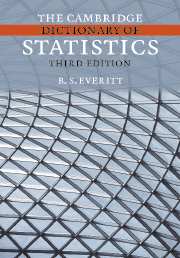
B. S. Everitt / King's College London
The Cambridge Dictionary of Statistics, 3rd Edition
If you use statistics and need easy access to simple, reliable
definitions and explanations of modern statistical and statistics-related
concepts, then look no further than this dictionary. Over 3600
terms are defined, covering medical, survey, theoretical, and
applied statistics, including computational aspects. Entries are
provided for standard and specialised statistical software. In
addition, short biographies of over 100 important statisticians
are given. Definitions provide enough mathematical detail to
clarify concepts and give standard formulae when these are
helpful. The majority of definitions then give a reference to a
book or article where the user can seek further or more
specialised information, and many are accompanied by graphical
material to aid understanding. Designed by human and not by
committee, this is statistics as it is spoken today.
* Trusted author in touch with contemporary statistical practice
* Carefully chosen pointers to the literature give users access
to information beyond the basic definitions
* Ideal balance between concepts and details
Contents
Preface; Notes on use; Acknowledgements; Sources; The Dictionary.
Reviews
Earlier edition: ‘This is already the most useful book on my
shelf … excellent value and it is highly recommended as a
reference text for anyone who is even mildly interested in
statistics.’ The Statistician
Earlier edition: ‘This is a ‘must-have’ reference for
statisticians and students of statistics.’ Journal of the
American Statistical Association
Earlier edition: ‘This is a valuable reference book for all
statisticians and medical researchers who use and who need to
understand statistics … [It] should be purchased by
statisticians, libraries that support medical and veterinary
departments, and research workers in medicine.’ Journal of
Applied Ecology
Lewis Fry Richardson
Weather Prediction by Numerical Process, 2nd Edition
The idea of forecasting the weather by calculation was first
dreamt of by Lewis Fry Richardson. He set out in this book a
detailed algorithm for systematic numerical weather prediction.
The method of computing atmospheric changes, which he mapped out
in great detail in this book, is essentially the method used
today. He was greatly ahead of his time because, before his ideas
could bear fruit, advances in four critical areas were needed:
better understanding of the dynamics of the atmosphere; stable
computational algorithms to integrate the equations; regular
observations of the free atmosphere; and powerful automatic
computer equipment. Over the ensuing years, progress in numerical
weather prediction has been dramatic. Weather prediction and
climate modelling have now reached a high level of
sophistication, and are witness to the influence of Richardson's
ideas. This new edition contains a new foreword by Peter Lynch
that sets the original book in context.
* Classic book which was the first comprehensive description of
numerical weather prediction
* Sets out in detail the steps required to make a numerical
forecast
* Essential text for all practitioners and students of
meteorology and climatology
* New edition with new foreword by Peter Lynch setting the
original book in context
Contents
Foreword; 1. Summary; 2. Introductory example; 3. The choice of
cooordinate differences; 4. The fundamental equations; 5. Finding
the vertical velocity; 6. Special treatment for the stratosphere;
7. The arrangement of points and instants; 8. Review of
operations in sequence; 9. An example worked on computing forms;
10. Smoothing the initial data; 11. Some remaining problems; 12.
Units and notation; Index of persons; Index of subsidiary
subjects.
 Paperback (ISBN-13: 9780521690270 | ISBN-10: 0521690277)