Bela Bollobas
Trinity College, Cambridge
The Art of Mathematics
Coffee Time in Memphis
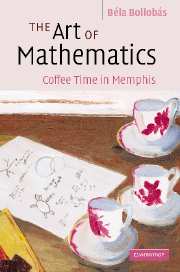 Hardback (ISBN-13: 9780521872287 | ISBN-10: 0521872286)
Paperback (ISBN-13: 9780521693950 | ISBN-10: 0521693950)
available from August 2006
Can a Christian escape from a lion? How quickly can a rumour
spread? Can you fool an airline into accepting oversize baggage?
Recreational mathematics is full of frivolous questions where the
mathematician's art can be brought to bear. But play often has a
purpose, In mathematics, it can sharpen skills, provide
amusement, or simply surprise, and books of problems have been
the stock-in-trade of mathematicians for centuries. This
collection is designed to be sipped from, rather than consumed in
one sitting. The questions range in difficulty: the most
challenging offer a glimpse of deep results that engage
mathematicians today; even the easiest are prompt readers to
think about mathematics. All come with solutions, many with
hints, and most with illustrations. Whether you are an expert, or
a beginner or an amateur mathematician, this book will delight
for a lifetime.
* Aimed at a broad audience ranging from professional
mathematicians to interested amateur * Entertaining mix of
problems ranging from the frivolous to others that show how
mathematicians discover new ideas * Inspired by two of the
twentieth century's leading mathematicians, Paul Erdos and J. E.
Littlewood, who were both inveterate problem posers and solvers
Contents
Preface: Part I. The Problems: Part II. The Hints; Part III. The
Solutions.
Katrin Becker / University of Utah
Melanie Becker / University of Maryland, College Park
John Schwarz / California Institute of Technology
String Theory and M-Theory
A Modern Introduction
Hardback (ISBN-13: 9780521860697 | ISBN-10: 0521860695)
available from November 2006
String theory is one of the most exciting and challenging areas
of modern theoretical physics. This book guides the reader from
the basics of string theory to recent developments. It introduces
the basics of perturbative string theory, world-sheet
supersymmetry, space-time supersymmetry, conformal field theory
and the heterotic string, before describing modern developments,
including D-branes, string dualities and M-theory. It then covers
string geometry and flux compactifications, applications to
cosmology and particle physics, black holes in string theory and
M-theory, and the microscopic origin of black-hole entropy. It
concludes with Matrix theory, the AdS/CFT duality and its
generalizations. This book is ideal for graduate students and
researchers in modern string theory, and will make an excellent
textbook for a one-year course on string theory. It contains over
120 exercises with solutions, and over 200 homework problems with
solutions available on a password protected website for lecturers
at www.cambridge.org/9780521860697.
* Comprehensive coverage of topics from basics of string theory
to recent developments * Ideal textbook for a one-year course in
string theory * Includes over 100 exercises with solutions *
Contains over 200 homework problems with solutions available to
lecturers on-line
Contents
1. Introduction; 2. The bosonic string; 3. Conformal field theory
and string interactions; 4. Strings with world-sheet
supersymmetry; 5. Strings with space-time supersymmetry; 6. T-duality
and D-branes; 7. The heterotic string; 8. M-theory and string
duality; 9. String geometry; 10. Flux compactifications; 11.
Black holes in string theory; 12. Gauge theory/string theory
dualities; References; Index.
Cliff Burgess / McGill University, Montreal
Guy More / McGill University, Montreal
The Standard Model
A Primer
Hardback (ISBN-13: 9780521860369 | ISBN-10: 0521860369)
available from November 2006
The standard model brings together two theories of particle
physics in order to describe the interactions of subatomic
particles, except those due to gravity. This book uses the
standard model as a vehicle for introducing quantum field theory.
In doing this the book also introduces much of the phenomenology
on which this model is based. The book uses a modern approach,
emphasizing effective field theory techniques, and contains brief
discussions of some of the main proposals for going beyond the
standard model, such as seesaw neutrino masses, supersymmetry,
and grand unification. Requiring only a minimum of background
material, this book is ideal for graduate students in theoretical
and experimental particle physics. It concentrates on getting
students to the level of being able to use this theory by doing
real calculations with the minimum of formal development, and
contains several problems. Password protected solutions are
available to lecturers at www.cambridge.org/9780521860369.
* Introduces students to phenomena of current interest and
practices computational techniques * Contains a modern and up-to-date
discussion of neutrino masses and oscillations * Has an extensive
discussion of the main proposals for physics beyond the Standard
Model
Contents
Part I. Theoretical Framework: 1. Field theory review; 2. The
standard model: general features; 3. Cross sections and
lifetimes; Part II. Applications: Leptons: 4. Elementary boson
decays; 5. Leptonic weak interactions: decays; 6. Leptonic weak
interactions: collisions; 7. Effective Lagrangians; Part III.
Applications: Hadrons: 8. Hadrons and QCD; 9. Hadronic
interactions; Part IV. Beyond the Standard Model: 10. Neutrino
masses; 11. Open questions, proposed solutions; Appendix A.
Experimental values for the parameters; Appendix B. Symmetries
and group theory review; Appendix C. Lorentz group and the Dirac
algebra; Appendix D. E-gauge Feynman rules; Appendix E. Metric
convention conversion table; Appendix F. Bibliography; Index.
Jacob Kogan
University of Maryland, Baltimore
Clustering Large and High Dimensional Data
Hardback (ISBN-13: 9780521852678 | ISBN-10: 0521852676)
Paperback (ISBN-13: 9780521617932 | ISBN-10: 0521617936)
available from January 2007
There is a growing need for a more automated system of
partitioning data sets into groups, or clusters. For example,
digital libraries and the World Wide Web continue to grow
exponentially, the ability to find useful information
increasingly depends on the indexing infrastructure or search
engine. Clustering techniques can be used to discover natural
groups in data sets and to identify abstract structures that
might reside there, without having any background knowledge of
the characteristics of the data. Clustering has been used in a
variety of areas, including computer vision, VLSI design, data
mining, bio-informatics (gene expression analysis), and
information retrieval, to name just a few. This book focuses on a
few of the most important clustering algorithms, providing a
detailed account of these major models in an information
retrieval context. The beginning chapters introduce the classic
algorithms in detail, while the later chapters describe
clustering through divergences and show recent research for more
advanced audiences.
* Rather than providing comprehensive coverage of the area, the
book focuses on a few important clustering algorithms * A
detailed and elementary description of the algorithms is provided
in the beginning chapters, to be easily absorbed by
undergraduates * Recent research results involving sophisticated
mathematics are of interest for graduate students and research
experts
Contents
1. Introduction and motivation; 2. Quadratic k-means algorithm; 3.
BIRCH; 4. Spherical k-means algorithm; 5. Linear algebra
techniques; 6. Information-theoretic clustering; 7. Clustering
with optimization techniques; 8. k-means clustering with
divergence; 9. Assessment of clustering results; 10. Appendix:
Optimization and Linear Algebra Background; 11. Solutions to
selected problems.
Mark Srednicki
University of California, Santa Barbara
Quantum Field Theory
Hardback (ISBN-13: 9780521864497 | ISBN-10: 0521864496)
available from January 2007
Quantum theory is used to describe the physics of elementary
particles, and has applications in many areas of particle and
condensed matter physics. This textbook is a complete and
essential introduction to the theory of elementary particles. It
is written in a modular format, and each chapter is self-contained.
The prerequisite material needed for each chapter is listed,
giving the book great flexibility. It covers all the key theories
necessary to understand the standard model and contains
treatments of modern topics, including the renormalization group,
spinor-helicity, methods for quark and gluon scattering, magnetic
monopoles, instantons, supersymmetry, and unification forces.
Assuming an undergraduate knowledge of quantum mechanics and
special relativity, this book is ideal for graduate students
studying quantum field theory and elementary particle theory. It
is based on a year long course given by the author and contains
extensive problems, with password protected solutions available
to lecturers at www.cambridge.org/9780521864497.
* A complete treatment of elementary particle theory from basics
to advanced topics * Contains 250 excercises with solutions
available to lecturers at www.cambridge.org/9780521864497 *
Presented in a logical sequence ? Written in a flexible, modular
format with fully self-contained chapters
Contents
Preface for students; Preface for instructors; Acknowledgements;
Part I. Spin Zero: 1. Attempts at relativistic quantum mechanics;
2. Lorentz invariance; 3. Canonical quantization of scalar
fields; 4. The spin-statistics theorem; 5. The LSZ reduction
formula; 6. Path integrals in quantum mechanics; 7. The path
integral for the harmonic oscillator; 8. The path integral for
free field theory; 9. The path integral for interacting field
theory; 10. Scattering amplitudes and the Feynman rules; 11.
Cross sections and decay rates; 12. Dimensional analysis with ?=c=1;
13. The Lehmann-Kallen form; 14. Loop corrections to the
propagator; 15. The one-loop correction in Lehmann-Kallen form;
16. Loop corrections to the vertex; 17. Other 1PI vertices; 18.
Higher-order corrections and renormalizability; 19. Perturbation
theory to all orders; 20. Two-particle elastic scattering at one
loop; 21. The quantum action; 22. Continuous symmetries and
conserved currents; 23. Discrete symmetries: P, T, C, and Z; 24.
Nonabelian symmetries; 25. Unstable particles and resonances; 26.
Infrared divergences; 27. Other renormalization schemes; 28. The
renormalization group; 29. Effective field theory; 30.
Spontaneous symmetry breaking; 31. Broken symmetry and loop
corrections; 32. Spontaneous breaking of continuous symmetries;
Part II. Spin One Half: 33. Representations of the Lorentz Group;
34. Left- and right-handed spinor fields; 35. Manipulating spinor
indices; 36. Lagrangians for spinor fields; 37. Canonical
quantization of spinor fields I; 38. Spinor technology; 39.
Canonical quantization of spinor fields II; 40. Parity, time
reversal, and charge conjugation; 41. LSZ reduction for spin-one-half
particles; 42. The free fermion propagator; 43. The path integral
for fermion fields; 44. Formal development of fermionic path
integrals; 45. The Feynman rules for Dirac fields; 46. Spin sums;
47. Gamma matrix technology; 48. Spin-averaged cross sections; 49.
The Feynman rules for majorana fields; 50. Massless particles and
spinor helicity; 51. Loop corrections in Yukawa theory; 52. Beta
functions in Yukawa theory; 53. Functional determinants; Part III.
Spin One: 54. Maxwell?s equations; 55. Electrodynamics in coulomb
gauge; 56. LSZ reduction for photons; 57. The path integral for
photons; 58. Spinor electrodynamics; 59. Scattering in spinor
electrodynamics; 60. Spinor helicity for spinor electrodynamics;
61. Scalar electrodynamics; 62. Loop corrections in spinor
electrodynamics; 63. The vertex function in spinor
electrodynamics; 64. The magnetic moment of the electron; 65.
Loop corrections in scalar electrodynamics; 66. Beta functions in
quantum electrodynamics; 67. Ward identities in quantum
electrodynamics I; 68. Ward identities in quantum electrodynamics
II; 69. Nonabelian gauge theory; 70. Group representations; 71.
The path integral for nonabelian gauge theory; 72. The Feynman
rules for nonabelian gauge theory; 73. The beta function for
nonabelian gauge theory; 74. BRST symmetry; 75. Chiral gauge
theories and anomalies; 76. Anomalies in global symmetries; 77.
Anomalies and the path integral for fermions; 78. Background
field gauge; 79. Gervais-Neveu gauge; 80. The Feynman rules for N
x N matrix fields; 81. Scattering in quantum chromodynamics; 82.
Wilson loops, lattice theory, and confinement; 83. Chiral
symmetry breaking; 84. Spontaneous breaking of gauge symmetries;
85. Spontaneously broken abelian gauge theory; 86. Spontaneously
broken nonabelian gauge theory; 87. The standard model: Gauge and
Higgs sector; 88. The standard model: Lepton sector; 89. The
standard model: Quark sector; 90. Electroweak interactions of
hadrons; 91. Neutrino masses; 92. Solitons and monopoles; 93.
Instantons and theta vacua; 94. Quarks and theta vacua; 95.
Supersymmetry; 96. The minimal supersymmetric standard model; 97.
Grand unification; Bibliography.