Sergey V. Matveev (Chelyabinsk State University, Russia):
Lectures on Algebraic Topology
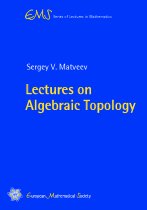 EMS Series of Lectures in Mathematics
ISBN 3-03719-023-X
April 2006, 108 pages, softcover, 17.0 cm x 24.0 cm.
Algebraic topology is the study of the global properties of
spaces by means of algebra. It is an important branch of modern
mathematics with a wide degree of applicability to other fields,
including geometric topology, differential geometry, functional
analysis, differential equations, algebraic geometry, number
theory, and theoretical physics.
This book provides an introduction to the basic concepts and
methods of algebraic topology for the beginner. It presents
elements of both homology theory and homotopy theory, and
includes various applications.
The author's intention is to rely on the geometric approach by
appealing to the reader's own intuition to help understanding.
The numerous illustrations in the text also serve this purpose.
Two features make the text different from the standard literature:
first, special attention is given to providing explicit
algorithms for calculating the homology groups and for
manipulating the fundamental groups. Second, the book contains
many exercises, all of which are supplied with hints or solutions.
This makes the book suitable for both classroom use and for
independent study.
Table of contents
Sergei B. Kuksin (Heriot-Watt University, Edinburgh, UK):
Randomly forced nonlinear PDEs and statistical hydrodynamics
in 2 space dimensions
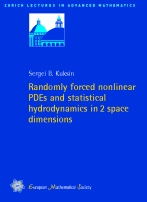 Zurich Lectures in Advanced Mathematics
ISBN 3-03719-021-3
April 2006, 104 pages, softcover, 17.0 cm x 24.0 cm.
The book gives an account of recent achievements in the
mathematical theory of two-dimensional turbulence, described by
the 2D Navier-Stokes equation, perturbed by a random force. The
main results presented here were obtained during the last five to
ten years and, up to now, have been available only in papers in
the primary literature. Their summary and synthesis here,
beginning with some preliminaries on partial differential
equations and stochastics, make the book a self-contained account
that will appeal to readers with a general background in analysis.
After laying the groundwork, the author goes on to recent results
on ergodicity of random dynamical systems, which the randomly
forced Navier-Stokes equation defines in the function space of
divergence-free vector fields, including a Central Limit Theorem.
The physical meaning of these results is discussed as well as
their relations with the theory of attractors. Next, the author
studies the behaviour of solutions when the viscosity goes to
zero. In the final section these dynamical methods are used to
derive the so-called balance relations - the infinitely many
algebraical relations satisfied by the solutions.
Table of contents
Alberto Cattaneo - Bernhard Keller - Charles Torossian - Alain Bruguieres
Deformation, Quantification, Theorie de Lie
Panoramas et Syntheses 20 (2005), viii+186 pages
Resume :
En 1997, M. Kontsevich demontra que toute variete de Poisson
admet une quantification formelle, canonique a equivalence pres,
resolvant ainsi un probleme ancien de physique mathematique. Par
sa demonstration, et l'interpretation qu'il fit d'une
demonstration ulterieure due a Tamarkin, M. Kontsevich a ouvert
des voies de recherche nouvelles en theorie de Lie, groupes
quantiques, theorie des deformations, theorie des operades... et
revele des liens fascinants entre ces sujets et la theorie des
nombres, la theorie des n?uds et la theorie des motifs. Ce
travail sur la quantification par deformation va continuer a
influencer ces domaines dans les annees a venir. Dans les trois
parties de ce volume, nous allons 1) presenter les resultats
principaux de la prepublication de 1997 de Kontsevich et
esquisser son interpretation de l'approche de Tamarkin, 2)
montrer la pertinence du theoreme de Kontsevich pour la theorie
de Lie et 3) expliquer l'idee provenant de la theorie des cordes
topologiques qui a inspire l'approche de Kontsevich. Un appendice
est consacre a la geometrie des espaces de configurations.
Mots clefs : Theorie des deformations, quantification par
deformation, physique mathematique, variete de Poisson,
cohomologie de Hochschild, algebre de Lie, isomorphisme de Duflo,
formule de Campbell-Baker-Hausdorff, theorie des cordes, espace
de configurations.
Abstract:
Deformation, Quantization, Lie theory
In 1997, M. Kontsevich proved that every Poisson manifold admits
a formal quantization, canonical up to equivalence. In doing so
he solved a longstanding problem in mathematical physics. Through
his proof and his interpretation of a later proof given by
Tamarkin, he also opened up new research avenues in Lie theory,
quantum group theory, deformation theory and the study of operads...
and uncovered fascinating links of these topics with number
theory, knot theory and the theory of motives. Without doubt, his
work on deformation quantization will continue to influence these
fields for many years to come. In the three parts of this volume,
we will 1) present the main results of Kontsevich's 1997 preprint
and sketch his interpretation of Tamarkin's approach, 2) show the
relevance of Kontsevich's theorem for Lie theory and 3) explain
the idea from topological string theory which inspired
Kontsevich's proof. An appendix is devoted to the geometry of
configuration spaces.
Key words: Deformation theory, deformation quantization,
mathematical physics, Poisson manifold, Hochschild cohomology,
Lie algebra, Duflo isomorphism, Campbell-Baker-Hausdorff formula,
string theory, configuration space.
Theodore G. Faticoni
The Mathematics of Infinity: A Guide to Great Ideas
ISBN: 0-471-79432-5
Hardcover
304 pages
June 2006
The Mathematics of Infinity addresses infinite cardinals and is
appropriate for readers at any level. Inviting the reader to
imagine constructing an infinite chain infinities, which are
called cardinals, the author successfully prepares and motivates
readers for topics covered within the book. The most unique
feature of the book is that set theoretic depth is achieved
without losing the target audience. Complementing existing
popular books on infinity by actually doing the mathematics
involved in addition to talking about the mathematics, the reader
is gently led into the world of mathematical proofs.
Table of Contents
1. Elementary Set Theory.
2. Functions.
3. Counting Infinite Sets.
4. Infinite Cardinals.
5. Well Ordered Sets.
6. Inductions and Numbers.
7. Prime Numbers.
8. Thoughts on Logic Beyond Mathematics.
Douglas C. Montgomery, Elizabeth A. Peck, G. Geoffrey Vining
Introduction to Linear Regression Analysis, 4th Edition
ISBN: 0-471-75495-1
Hardcover
640 pages
August 2006
The Fourth Edition of Introduction to Linear Regression Analysis
describes both the conventional and less common uses of linear
regression in the practical context of today's mathematical and
scientific research. This popular book blends both theory and
application to equip the reader with an understanding of the
basic principles necessary to apply regression model-building
techniques in a wide variety of application environments. It
assumes a working knowledge of basic statistics and a familiarity
with hypothesis testing and confidence intervals, as well as the
normal, t, x2, and F distributions.
Illustrating all of the major procedures employed by the
contemporary software packages MINITABR, SASR, and S-PLUSR, the
Fourth Edition begins with a general introduction to regression
modeling, including typical applications. A host of technical
tools are outlined, such as basic inference procedures,
introductory aspects of model adequacy checking, and polynomial
regression models and their variations. The book discusses how
transformations and weighted least squares can be used to resolve
problems of model inadequacy and also how to deal with
influential observations. Subsequent chapters discuss:
Indicator variables and the connection between regression and
analysis-of-variance models
Variable selection and model-building techniques and strategies
The multicollinearity problem?its sources, effects, diagnostics,
and remedial measures
Robust regression techniques such as M-estimators, and properties
of robust estimators
The basics of nonlinear regression
Generalized linear models
Using SASR for regression problems
This book is a robust resource that offers solid methodology for
statistical practitioners and professionals in the fields of
engineering, physical and chemical sciences, economics,
management, life and biological sciences, and the social sciences.
Both the accompanying FTP site, which contains data sets,
extensive problem solutions, software hints, and PowerPointR
slides, as well as the book's revised presentation of topics in
increasing order of complexity, facilitate its use in a classroom
setting.
With its new exercises and structure, this book is highly
recommended for upper-undergraduate and beginning graduate
students in mathematics, engineering, and natural sciences.
Scientists and engineers will find the book to be an excellent
choice for reference and self-study.
Table of Contents
Erich Zauderer
Partial Differential Equations of Applied Mathematics, 3rd
Edition
ISBN: 0-471-69073-2
Hardcover
1010 pages
July 2006
This new edition features the latest tools for modeling,
characterizing, and solving partial differential equations
The Third Edition of this classic text offers a comprehensive
guide to modeling, characterizing, and solving partial
differential equations (PDEs). The author provides all the theory
and tools necessary to solve problems via exact, approximate, and
numerical methods. The Third Edition retains all the hallmarks of
its previous editions, including an emphasis on practical
applications, clear writing style and logical organization, and
extensive use of real-world examples.
Among the new and revised material, the book features:
A new section at the end of each original chapter, exhibiting the
use of specially constructed Maple procedures that solve PDEs via
many of the methods presented in the chapters. The results can be
evaluated numerically or displayed graphically.
Two new chapters that present finite difference and finite
element methods for the solution of PDEs. Newly constructed Maple
procedures are provided and used to carry out each of these
methods. All the numerical results can be displayed graphically.
A related FTP site that includes all the Maple code used in the
text.
New exercises in each chapter, and answers to many of the
exercises are provided via the FTP site. A supplementary
Instructor's Solutions Manual is available.
The book begins with a demonstration of how the three basic types
of equations?parabolic, hyperbolic, and elliptic?can be derived
from random walk models. It then covers an exceptionally broad
range of topics, including questions of stability, analysis of
singularities, transform methods, Green's functions, and
perturbation and asymptotic treatments. Approximation methods for
simplifying complicated problems and solutions are described, and
linear and nonlinear problems not easily solved by standard
methods are examined in depth. Examples from the fields of
engineering and physical sciences are used liberally throughout
the text to help illustrate how theory and techniques are applied
to actual problems.
With its extensive use of examples and exercises, this text is
recommended for advanced undergraduates and graduate students in
engineering, science, and applied mathematics, as well as
professionals in any of these fields. It is possible to use the
text, as in the past, without use of the new Maple material
Table of Contents