Hulin Wu, Jin-Ting Zhang
Nonparametric Regression Methods for Longitudinal Data
Analysis: Mixed-Effects Modeling Approaches
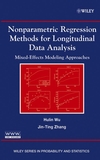 ISBN: 0-471-48350-8
Hardcover
400 pages
April 2006
Incorporates mixed-effects modeling techniques for more powerful
and efficient methods
This book presents current and effective nonparametric regression
techniques for longitudinal data analysis and systematically
investigates the incorporation of mixed-effects modeling
techniques into various nonparametric regression models. The
authors emphasize modeling ideas and inference methodologies,
although some theoretical results for the justification of the
proposed methods are presented.
With its logical structure and organization, beginning with basic
principles, the text develops the foundation needed to master
advanced principles and applications. Following a brief overview,
data examples from biomedical research studies are presented and
point to the need for nonparametric regression analysis
approaches. Next, the authors review mixed-effects models and
nonparametric regression models, which are the two key building
blocks of the proposed modeling techniques.
The core section of the book consists of four chapters dedicated
to the major nonparametric regression methods: local polynomial,
regression spline, smoothing spline, and penalized spline. The
next two chapters extend these modeling techniques to
semiparametric and time varying coefficient models for
longitudinal data analysis. The final chapter examines discrete
longitudinal data modeling and analysis.
Each chapter concludes with a summary that highlights key points
and also provides bibliographic notes that point to additional
sources for further study. Examples of data analysis from
biomedical research are used to illustrate the methodologies
contained throughout the book. Technical proofs are presented in
separate appendices.
With its focus on solving problems, this is an excellent textbook
for upper-level undergraduate and graduate courses in
longitudinal data analysis. It is also recommended as a reference
for biostatisticians and other theoretical and applied research
statisticians with an interest in longitudinal data analysis. Not
only do readers gain an understanding of the principles of
various nonparametric regression methods, but they also gain a
practical understanding of how to use the methods to tackle real-world
problems.
Table of Contents
Preface.
Acronyms.
1. Introduction.
2. Parametric Mixed-Effects Models.
3. Nonparametric Regression Smoothers.
4. Local Polynomial Methods.
5. Regression Spline Methods.
6. Smoothing Splines Methods.
7. Penalized Spline Methods.
8. Semiparametric Models.
9. Time-Varying Coefficient Models.
10. Discrete Longitudinal Data.
References.
Index.
George E. P. Box
Improving Almost Anything: Ideas and Essays, Revised Edition
ISBN: 0-471-72755-5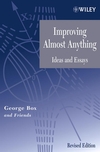
Paperback
598 pages
April 2006
Masterworks in process improvement and quality technology? by
George Box and friends
George Box has a unique ability to explain complex ideas simply
and eloquently. This revised edition of his masterworks since
1982 clearly demonstrates the range of his wit and intellect.
These fascinating readings represent the cornerstones in the
theory and application of process improvement, product design,
and process control. Readers will gain valuable insights into the
fundamentals and philosophy of scientific method using statistics
and how it can drive creativity and discovery.
The book is divided into five key parts:
Part A, Some Thoughts on Quality Improvement, concerns the
democratization of the scientific method and, in such papers as
"When Murphy Speaks?Listen," advises managers to view
operation of their processes as ongoing opportunities for
improvement.
Part B, Design of Experiments for Process Improvement,
illustrates the enormous advantages offered by experimental
design in the pursuit of better products and processes.
Part C, Sequential Investigation and Discovery, shows how
sequential assembly of designs allows the experimenter to match
the difficulty of the problem with the effort needed to solve it.
Part D, Control, describes application of feedback control in the
Statistical Process Control (SPC) environment. A simple graphical
technique using Box-Jenkins charts is set forth to appropriately
adjust processes to target.
Part E, Variance Reduction and Robustness, demonstrates how the
existence of more than one source of variation may be used to
achieve products robust to the environment in which they must
function and emphasizes the importance of error transmission and
data transformation in producing robust assemblies.
A Foreword by Dr. J. Stuart Hunter allows readers to gain insight
into the workings of a remarkable mind and explains how these
ideas can greatly catalyze their efforts in process improvement.
Table of Contents
by Keith B. Oldham,Jerome Spanier
The Fractional Calculus:
Theory and Applications of Differentiation and Integration to Arbitrary Order
 ISBN: 0486450015
The product of a collaboration between a mathematician and a
chemist, this text is geared toward advanced undergraduates and
graduate students. Not only does it explain the theory underlying
the properties of the generalized operator, but it also
illustrates the wide variety of fields to which these ideas may
be applied. Topics include integer order, simple and complex
functions, semiderivatives and semiintegrals, and transcendental
functions. The text concludes with overviews of applications in
the classical calculus and diffusion problems. 1974 ed.
Table of Contents
1. Introduction
2. Differentiation and Integrations to Integer Order
3. Fractional Derivatives and Integrals: Definitions and
Equivalences
4. Differintegration of Simple Functions
5. General Properties
6. Differintegration of More Complex Functions
7. Semiderivatives and Semiintegrals
8. Techniques in the Fractional Calculus
9. Representation of Transcendental Functions
10. Applications in the Classical Calculus
11. Applications to Diffusion Problems
References
Index
Jan Awrejcewicz Technical University of Lodz, Poland
Vadim A. Krysko Technical University, Sazatov, Russia
Introduction to Asymptotic Methods
Series: Modern Mechanics and Mathematics Volume: 5 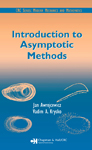
ISBN: 1584886773
Publication Date: 5/3/2006
Number of Pages: 272
Explores the fundamental elements of the process of mathematical
modelling
Discusses new analytical tools such as the Pad・approximation
Demonstrates the usefulness of asymptotic methods for
investigating complex mathematical problems
Illustrates how the application of elongated coordinates and
renormalization methods yields highly accurate results
Shows how the application of the methods of renormalization and
multiple scales can achieve uniformly suitable solutions
Among the theoretical methods for solving many problems of
applied mathematics, physics, and technology, asymptotic methods
often provide results that lead to obtaining more effective
algorithms of numerical evaluation. Presenting the mathematical
methods of perturbation theory, Introduction to Asymptotic
Methods reviews the most important methods of singular
perturbations within the scope of application of differential
equations. The authors take a challenging and original approach
based on the integrated mathematical-analytical treatment of
various objects taken from interdisciplinary fields of mechanics,
physics, and applied mathematics. This new hybrid approach will
lead to results that cannot be obtained by standard theories in
the field.
Emphasizing fundamental elements of the mathematical modeling
process, the book provides comprehensive coverage of asymptotic
approaches, regular and singular perturbations, one-dimensional
non-stationary non-linear waves, Pad・approximations,
oscillators with negative Duffing type stiffness, and
differential equations with discontinuous nonlinearities. The
book also offers a method of construction for canonical variables
transformation in parametric form along with a number of examples
and applications. The book is applications oriented and features
results and literature citations that have not been seen in the
Western Scientific Community. The authors emphasize the dynamics
of the development of perturbation methods and present the
development of ideas associated with this wide field of research.
Table of Contents
by Harald J W Muler-Kirsten (University of Kaiserslautern, Germany)
INTRODUCTION TO QUANTUM MECHANICS
Schrodinger Equation and Path Integral
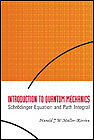 After a consideration of basic quantum mechanics, this introduction aims
at a side by side treatment of fundamental applications of the Schrodinger
equation on the one hand and the applications of the path integral on the
other. Different from traditional texts and using a systematic perturbation
method, the solution of Schrodinger equations includes also those with
anharmonic oscillator potentials, periodic potentials, screened Coulomb
potentials and a typical singular potential, as well as the investigation
of the large order behavior of the perturbation series. On the path integral
side, after introduction of the basic ideas, the expansion around classical
configurations in Euclidean time, such as instantons, is considered, and
the method is applied in particular to anharmonic oscillator and periodic
potentials. Numerous other aspects are treated on the way, thus providing
the reader an instructive overview over diverse quantum mechanical phenomena,
e.g. many other potentials, Green's functions, comparison with WKB, calculation
of lifetimes and sojourn times, derivation of generating functions, the
Coulomb problem in various coordinates, etc. All calculations are given
in detail, so that the reader can follow every step.
After a consideration of basic quantum mechanics, this introduction aims
at a side by side treatment of fundamental applications of the Schrodinger
equation on the one hand and the applications of the path integral on the
other. Different from traditional texts and using a systematic perturbation
method, the solution of Schrodinger equations includes also those with
anharmonic oscillator potentials, periodic potentials, screened Coulomb
potentials and a typical singular potential, as well as the investigation
of the large order behavior of the perturbation series. On the path integral
side, after introduction of the basic ideas, the expansion around classical
configurations in Euclidean time, such as instantons, is considered, and
the method is applied in particular to anharmonic oscillator and periodic
potentials. Numerous other aspects are treated on the way, thus providing
the reader an instructive overview over diverse quantum mechanical phenomena,
e.g. many other potentials, Green's functions, comparison with WKB, calculation
of lifetimes and sojourn times, derivation of generating functions, the
Coulomb problem in various coordinates, etc. All calculations are given
in detail, so that the reader can follow every step.
Contents:
Hamiltonian Mechanics
Mathematical Foundations of Quantum Mechanics
Dirac痴 Ket- and Bra-Formalism
Schringer Equation and Liouville Equation
Quantum Mechanics of the Harmonic Oscillator
Green痴 Functions
Time-Independent Perturbation Theory
The Density Matrix and Polarization Phenomena
Quantum Theory: The General Formalism
The Coulomb Interaction
Quantum Mechanical Tunneling
Linear Potentials
Classical Limit and WKB Method
Power Potentials
Screened Coulomb Potentials
Periodic Potentials
Anharmonic Oscillator Potentials
Singular Potentials
Large Order Behavior of Perturbation Expansions
The Path Integral Formalism
Classical Field Configurations
Path Integrals and Instantons
Path Integrals and Bounces on a Line
Periodic Classical Configurations
Path Integrals and Periodic Classical Configurations
Quantization of Systems with Constraints
The Quantum-Classical Crossover as Phase Transition
Readership: Undergraduate and graduate students in physics;
researchers in mathematical physics and particle physics.
828pp Pub. date: Mar 2006
ISBN 981-256-691-0
ISBN 981-256-692-9(pbk)