Edited By
Jean-Pierre Francoise, Universite Pierre et Marie Curie, Paris,
France
Gregory Naber, Drexel University, Philadelphia, USA
Sheung Tsun Tsou, University of Oxford, UK
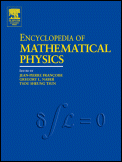
ENCYCLOPEDIA OF MATHEMATICAL PHYSICS
Five-Volume Set
 Description
The Encyclopedia of Mathematical Physics provides a complete
resource for researchers, students and lecturers with an interest
in mathematical physics. It enables readers to access basic
information on topics peripheral to their own areas, to provide a
repository of the core information in the area that can be used
to refresh the researcher's own memory banks, and aid teachers in
directing students to entries relevant to their course-work. The
Encyclopedia does contain information that has been distilled,
organised and presented as a complete reference tool to the user
and a landmark to the body of knowledge that has accumulated in
this domain. It also is a stimulus for new researchers working in
mathematical physics or in areas using the methods originating
from work in mathematical physics by providing them with focused
high quality background information. Editorial Board: Jean-Pierre
Francoise, Universite Pierre et Marie Curie, Paris, France
Gregory L. Naber, Drexel University, Philadelphia, PA, USA Tsou
Sheung Tsun, University of Oxford, UK Also available online via
ScienceDirect (2006) ? featuring extensive browsing, searching,
and internal cross-referencing between articles in the work, plus
dynamic linking to journal articles and abstract databases,
making navigation flexible and easy. For more information,
pricing options and availability visit www.info.sciencedirect.com.
Audience
Research students, researchers and professionals who are seeking
an authoritative source of information about any particular
aspect of mathematical physics.
Contents
Classical, Conformal and Topological Field Theory Classical
Mechanics Condensed Matter Physics and Optics Differential
Geometry Dirac Operators Dynamical Systems Fluid Dynamics
Functional Analysis and Variational Techniques Gauge Theory
General Relativity Integrable Systems Lie Groups and Lie Algebras
Many Particle Systems Noncommutative Geometry Partial
Differential Equations and ODEs Path Integrals and Functional
Integrals Perturbation Theory Quantization Techniques Quantum
Field Theory Quantum Gravity Quantum Groups Quantum Information
and Computation Quantum Mechanics Renormalization Scattering
Theory Semi-classical Approximations Singularity Theory
Statistical Mechanics Stochastic Methods String Theory and M-Theory
Supersymmetry Symmetry and Conservation Laws Symplectic
Techniques Topological Methods
Bibliographic & ordering Information
Hardbound, ISBN: 0-12-512660-3, 2750 pages, publication date:
2006
J. Aczel
Lectures on Functional Equations and Their Applications
 ISBN: 0486445232
Page Count: 544
Dimensions: 5 3/8 x 8 1/2
Numerous detailed proofs highlight this systematic treatment,
which offers upper-level undergraduates and graduate students an
elementary approach to functional equations. Starting with
equations that can be solved by simple substitutions, the first
part examines the determination of the values of the unknown
function on a dense set. It also surveys equations with several
unknown functions and methods of reduction to differential and
integral equations. The second part begins with simple equations
and advances to composite equations, equations with several
unknown functions of several variables, and reduction to partial
differential equations, concluding with explorations of vector
and matrix equations. 1966 ed.
Table of Contents
I. Equations for Functions of a Single Variable
1. Equations Which Can Be Solved by Simple Substitutions
2. Solution of Equations by Determining the Values of the Unknown
Function on a Dense Set
3. Equations with Several Unknown Functions
4. Reduction to Differential and Integral Equations, General
Methods
II. Equations for Functions of Several Variables
5. Simple Equations
6. Composite Equations
7. Equations with Several Unknown Functions of Several Variables.
Reduction to Partial Differential Equations
8. Vector and Matrix Equations
Concluding Remarks. Some Unsolved Problems
Bibliography
Author Index
Subject Index
Jerzy Trzeciak:
Writing Mathematical Papers in English
a practical guide
 ISBN 3-03719-014-0
August 2005, 48 pages, softcover, 14.8 cm x 21.0 cm.
This booklet is intended to provide practical help for authors of
mathematical papers. It is written mainly for non-English
speaking writers but should prove useful even to native speakers
of English who are beginning their mathematical writing and may
not yet have developed a command of the structure of mathematical
discourse.
The first part provides a collection of ready-made sentences and
expressions occurring in mathematical papers. The examples are
divided into sections according to their use (in introductions,
definitions, theorems, proofs, comments, references to the
literature, acknowledgements, editorial correspondence and
referee's reports). Typical errors are also pointed out.
The second part concerns selected problems of English grammar and
usage, most often encountered by mathematical writers. Just as in
the first part, an abundance of examples are presented, all of
them taken from actual mathematical texts.
`` The author has packed an awful lot in a few pages and has
obviously been collecting his best (or worst) examples for a long
time.''
Edwin F. Beschler
``The reviewer highly recommends this guide to authors as well as
to editors in mathematics.''
O. Ninnemann, Zentralblatt MATH
About the author: Jerzy Trzeciak, formerly of Polish Scientific
Publishers, is now the senior copy editor at the Institute of
Mathematics, Polish Academy of Sciences. He is responsible for
journals including Studia Mathematica, Fundamenta Mathematicae,
Acta Arithmetica and others.
Avner Ash and Robert Gross
Fearless Symmetry:
Exposing the Hidden Patterns of Numbers
 Cloth | July 2006 | ISBN: 0-691-12492-2
302 pp. | 6 x 9 | 3 line illus.
Mathematicians solve equations, or try to. But sometimes the
solutions are not as interesting as the beautiful symmetric
patterns that lead to them. Written in a friendly style for a
general audience, Fearless Symmetry is the first popular math
book to discuss these elegant and mysterious patterns and the
ingenious techniques mathematicians use to uncover them.
Hidden symmetries were first discovered nearly two hundred years
ago by French mathematician Evariste Galois. They have been used
extensively in the oldest and largest branch of mathematics--number
theory--for such diverse applications as acoustics, radar, and
codes and ciphers. They have also been employed in the study of
Fibonacci numbers and to attack well-known problems such as
Fermat's Last Theorem, Pythagorean Triples, and the ever-elusive
Riemann Hypothesis. Mathematicians are still devising techniques
for teasing out these mysterious patterns, and their uses are
limited only by the imagination.
The first popular book to address representation theory and
reciprocity laws, Fearless Symmetry focuses on how mathematicians
solve equations and prove theorems. It discusses rules of math
and why they are just as important as those in any games one
might play. The book starts with basic properties of integers and
permutations and reaches current research in number theory. Along
the way, it takes delightful historical and philosophical
digressions. Required reading for all math buffs, the book will
appeal to anyone curious about popular mathematics and its myriad
contributions to everyday life.
Avner Ash is Professor of Mathematics at Boston College. He is
the author (with D. Mumford, M. Rapoport, and Y. Tai) of Smooth
Compactification of Locally Symmetric Varieties. Robert Gross is
Associate Professor of Mathematics at Boston College.
Endorsement:
"All too often, abstract mathematics, one of the most
beautiful of human intellectual creations, is ground into the dry
dust of drills and proofs. Useful, yes; exciting, no. Avner Ash
and Robert Gross have done something different--by focusing on
the ideas that modern mathematicians actually care about.
Fearless Symmetry is a book about detecting hidden patterns,
about finding definitions that clarify, about the study of
numbers that has entranced some of our great thinkers for
thousands of years. It is a book that takes on number theory in a
way that a nonmathematician can follow-systematically but without
a barrage of technicalities. Ash and Gross are two terrific
guides who take the reader, scientist or layman, on a wonderful
hike through concepts that matter, culminating in the
extraordinary peaks that surround the irresistible, beckoning
claim of Fermat's Last Theorem."--Peter Galison, Harvard
University
Contents