A. F. J. Levi
University of Southern California
Applied Quantum Mechanics, 2nd Edition
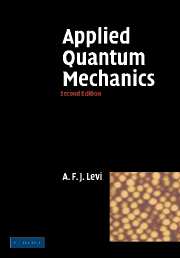 Hardback (ISBN-13: 9780521860963 | ISBN-10: 0521860962)
Electrical and mechanical engineers, materials scientists and
applied physicists will find Levi's uniquely practical
explanation of quantum mechanics invaluable. This updated and
expanded edition of the bestselling original text now covers
quantization of angular momentum and quantum communication, and
problems and additional references are included. Using real-world
engineering examples to engage the reader, the author makes
quantum mechanics accessible and relevant to the engineering
student. Numerous illustrations, exercises, worked examples and
problems are included; Matlab source codes to support the text
are available from www.cambridge.org/9780521860963.
* Engaging style with many examples and important real-world
applications
* Reviews classical mechanics and electromagnetism; develops both
analytic and numerical methods
* Detailed solutions to exercises and separate problems are given
at the end of each chapter; instructor’s solutions to problems
and Matlab code are provided on the web
Contents
Preface to the second edition; Preface to the first edition;
Matlab programs; 1. Introduction; 2. Toward quantum mechanics; 3.
Using the Schrodinger wave equation; 4. Electron propagation; 5.
Eigenstates and operators; 6. The harmonic oscillator; 7.
Fermions and bosons; 8. Time-dependent perturbation; 9. The
semiconductor laser; 10. Time-independent perturbation; 11.
Angular momentum and the hydrogenic atom; A. Physical values; B.
Coordinates; C. Expansions, differentiation, integrals, and
mathematical relations; D. Matrices and determinants; E. Vector
calculus and Maxwell’s equations; F. The Greek alphabet; Index.
Bernhard O. Palsson
University of California, San Diego
Systems Biology
Properties of Reconstructed Networks
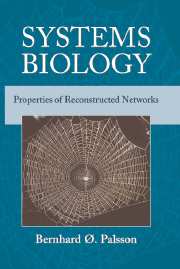 Hardback (ISBN-13: 9780521859035 | ISBN-10: 0521859034)
Genome sequences are now available that enable us to determine
the biological components that make up a cell or an organism. The
new discipline of systems biology examines how these components
interact and form networks, and how the networks generate whole
cell functions corresponding to observable phenotypes. This
textbook, the first devoted to systems biology, describes how to
model networks, how to determine their properties, and how to
relate these to phenotypic functions. The prerequisites are some
knowledge of linear algebra and biochemistry. Though the links
between the mathematical ideas and biological processes are made
clear, the book reflects the irreversible trend of increasing
mathematical content in biology education. Therefore to assist
both teacher and student, in an associated web site Palsson
provides problem sets, projects and Powerpoint slides, and keeps
the presentation in the book concrete with illustrative material
and experimental results.
* First textbook in the new field of systems biology
* Associated website with slides, projects, problems
* Open layout, summary points, guides to literature, lots of
illustrations
Contents
Preface; 1. Introduction; 2. Basic concepts in systems biology;
Part I. Reconstruction of Biochemical Networks: 3. Metabolic
networks; 4. Regulatory networks; 5. Signalling networks; Part II.
Mathematical Representation of Reconstructed Networks: 6. Basic
features of S; 7. Topological properties; 8. Fundamental
subspaces; 9. Null space of S; 10. The left null space of S; 11.
The row and column spaces of S; Part III. Capabilities of
Reconstructed Networks: 12. Dual causality; 13. Properties of
solution spaces; 14. Sampling properties of solution spaces; 15.
Finding functional states; 16. Parametric sensitivity; 17.
Epilogue; Appendix A. Nomenclature and abbreviations; Appendix B.
E. coli core metabolic network; Bibliography; Index.
By Ali Enayat (Editor), Iraj Kalantari (Editor), Mojtaba Moniri (Editor)
Logic in Tehran
Proceedings of the Workshop and Conference on Logic, Algebra, and Arithmetic, held October 18-22, 2003
 Lecture Notes in Logic 26
Summary
This proceedings volume contains research papers in mathematical logic, especially in model theory and its applications to algebra and formal theories of arithmetic. Other papers address interpretability theory, computable analysis, modal logic, and the history of mathematical logic in Iran. The conference was held in Tehran, Iran, in October 2003, with the expressed purpose of bringing together researchers with connections to Iranian logicians and promoting further research in mathematical logic in Iran.
Details
ISBN: 1-56881-295-7
Year: 2006
Format: Hardcover
ISBN: 1-56881-296-5
Format: Paperback
Pages: 361
by John Stillwell
Yearning for the Impossible
The Surprising Truths of Mathematics
 Summary
This book explores the history of mathematics from the perspective of the creative tension between common sense and the “impossible” as the author follows the discovery or invention of new concepts that have marked mathematical progress:
Irrational and Imaginary Numbers
The Fourth Dimension
Curved Space
Infinity and others
The author puts these creations into a broader context involving related “impossibilities” from art, literature, philosophy, and physics. By imbedding mathematics into a broader cultural context and through his clever and enthusiastic explication of mathematical ideas the author broadens the horizon of students beyond the narrow confines of rote memorization and engages those who are curious about the place of mathematics in our intellectual landscape.
Details
ISBN: 1-56881-254-X
Year: 2006
Format: Hardcover
Pages: 250