P. A. Martin
Colorado School of Mines
Multiple Scattering
Interaction of Time-Harmonic Waves with N Obstacles
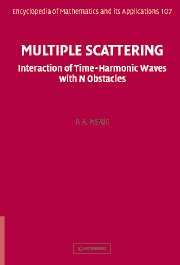 Series: Encyclopedia of Mathematics and its Applications (No. 107)
Hardback (ISBN-13: 9780521865548 | ISBN-10: 0521865549)
The interaction of waves with obstacles is an everyday phenomenon
in science and engineering, arising for example in acoustics,
electromagnetism, seismology and hydrodynamics. The mathematical
theory and technology needed to understand the phenomenon is
known as multiple scattering, and this book is the first devoted
to the subject. The author covers a variety of techniques,
describing first the single-obstacle methods and then extending
them to the multiple-obstacle case. A key ingredient in many of
these extensions is an appropriate addition theorem: a coherent,
thorough exposition of these theorems is given, and computational
and numerical issues around them are explored. The application of
these methods to different types of problems is also explained;
in particular, sound waves, electromagnetic radiation, waves in
solids and water waves. A comprehensive bibliography of some 1400
items rounds off the book, which will be an essential reference
on the topic for applied mathematicians, physicists and engineers.
* Describes all the main methods for solving multiple scattering
problems exactly, as well as the main approximate solution
methods; gives thorough exposition of addition theorems
* Contains many historical remarks and an extensive 1400-item
bibliography
* Covers the four main application areas of acoustics,
elastodynamics, electromagnetics and hydrodynamics
Contents
Preface; 1. Introduction; 2. Addition theorems in two dimensions;
3. Addition theorems in three dimensions; 4. Methods based on
separation of variables; 5. Integral equation methods I: basic
theory; 6. Integral equation methods II: further details; 7. Null-field
and T-matrix methods; 8. Approximations; Appendices; Comments on
the bibliography; Bibliography; Citation index; Index.
Angelo Favini University of Bologna, Italy
Alfredo Lorenzi Univ degli Studi di Milano, Italy
Differential Equations: Inverse and Direct Problems
 Series: Lecture Notes in Pure and Applied Mathematics Volume: 251
ISBN: 1584886048
Publication Date: 6/9/2006
Number of Pages: 304
Availability: In Stock
Covers topics in various disciplinary fields of differential
equations
Features contributions from leading international experts
Examines standard as well as new research results, such as
identification problems for degenerate integrodifferential
equations and complete abstract second-order equations of
elliptic type in a UMD Banach space
Illustrates the concepts and applications of the concepts with
over 500 equations
With contributions from some of the leading authorities in the
field, the work in Differential Equations: Inverse and Direct
Problems stimulates the preparation of new research results and
offers exciting possibilities not only in the future of
mathematics but also in physics, engineering, superconductivity
in special materials, and other scientific fields.
Exploring the hypotheses and numerical approaches that relate to
pure and applied mathematics, this collection of research papers
and surveys extends the theories and methods of differential
equations. The book begins with discussions on Banach spaces,
linear and nonlinear theory of semigroups, integrodifferential
equations, the physical interpretation of general Wentzell
boundary conditions, and unconditional martingale difference (UMD)
spaces. It then proceeds to deal with models in
superconductivity, hyperbolic partial differential equations (PDEs),
blowup of solutions, reaction-diffusion equation with memory, and
Navier-Stokes equations. The volume ends with analyses on Fourier-Laplace
multipliers, gradient estimates for Dirichlet parabolic problems,
a nonlinear system of PDEs, and the complex Ginzburg-Landau
equation.
By combining direct and inverse problems into one book, this
compilation is a useful reference for those working in the world
of pure or applied mathematics.
Contents
Alfred Gray / University of Maryland, College Park, MD
Elsa Abbena / University di Torino, Italy
Simon Salamon / Politecnico of Torino, Torino, Italy
Modern Differential Geometry of Curves and Surfaces with Mathematica,
Third Edition
 Series: Studies in Advanced Mathematics Volume: 47
ISBN: 1584884487
Publication Date: 6/21/2006
Number of Pages: 1016
Provides up-to-date Mathematica notebook files in each chapter
containing input code and important programs used in the book
Presents material about curves and surfaces, together with
accurate interesting pictures, Mathematica instructions for
making the pictures, and Mathematica programs for computing
functions such as curvature and torsion
Contains more than 400 illustrations and a range of new
applications that will appeal particularly to physicists and
engineers
Introduces techniques from numerical analysis to differential
geometry and gives Mathematica programs for numerical computation
and drawing of geodesics on an arbitrary surface
Includes capsule biographies with portraits of over 75
mathematicians and scientists that places the material in
perspective through history
Presenting theory while using Mathematica in a complementary way,
Modern Differential Geometry of Curves and Surfaces with
Mathematica, the third edition of Alfred Gray's famous textbook,
covers how to define and compute standard geometric functions
using Mathematica for constructing new curves and surfaces from
existing ones. Since Gray's death, authors Abbena and Salamon
have stepped in to bring the book up to date. While maintaining
Gray's intuitive approach, they reorganized the material to
provide a clearer division between the text and the Mathematica
code and added a Mathematica notebook as an appendix to each
chapter. They also address important new topics, such as
quaternions.
The approach of this book is at times more computational than is
usual for a book on the subject. For example, Brioshi's formula
for the Gaussian curvature in terms of the first fundamental form
can be too complicated for use in hand calculations, but
Mathematica handles it easily, either through computations or
through graphing curvature. Another part of Mathematica that can
be used effectively in differential geometry is its special
function library, where nonstandard spaces of constant curvature
can be defined in terms of elliptic functions and then plotted.
Using the techniques described in this book, readers will
understand concepts geometrically, plotting curves and surfaces
on a monitor and then printing them. Containing more than 300
illustrations, the book demonstrates how to use Mathematica to
plot many interesting curves and surfaces. Including as many
topics of the classical differential geometry and surfaces as
possible, it highlights important theorems with many examples. It
includes 300 miniprograms for computing and plotting various
geometric objects, alleviating the drudgery of computing things
such as the curvature and torsion of a curve in space.
Contents
John Cannon / University of Central Florida, Orlando, USA
Bhimsen Shivamoggi / University of Central Florida, Orlando, USA
Mathematical and Physical Theory of Turbulence
 Series: Lecture Notes in Pure and Applied Mathematics Volume: 250
ISBN: 0824723236
Publication Date: 6/15/2006
Number of Pages: 208
Availability: In Stock
Surveys recent developments and original expert research in 2D, 3D,
and scalar turbulence
Studies the use of wavelets to describe several aspects of Navier-Stokes
turbulence
Examines the connection among governing equations, constitutive
theory, and the closure problem
Discusses the significance of the law of conservation of angular
momentum for freely evolving homogeneous turbulence
Presents a new concept of turbulence modeling to simulate the
effect of turbulence on the flows as realistically as possible
Although the current dynamical system approach offers several
important insights into the turbulence problem, issues still
remain that present challenges to conventional methodologies and
concepts. These challenges call for the advancement and
application of new physical concepts, mathematical modeling, and
analysis techniques. Bringing together experts from physics,
applied mathematics, and engineering, Mathematical and Physical
Theory of Turbulence discusses recent progress and some of the
major unresolved issues in two- and three-dimensional turbulence
as well as scalar compressible turbulence.
Containing introductory overviews as well as more specialized
sections, this book examines a variety of turbulence-related
topics. The authors concentrate on theory, experiments,
computational, and mathematical aspects of Navier-Stokes
turbulence; geophysical flows; modeling; laboratory experiments;
and compressible/magnetohydrodynamic effects. The topics
discussed in these areas include finite-time singularities and
inviscid dissipation energy; validity of the idealized model
incorporating local isotropy, homogeneity, and universality of
small scales of high Reynolds numbers, Lagrangian statistics, and
measurements; and subrigid-scale modeling and hybrid methods
involving a mix of Reynolds-averaged Navier-Stokes (RANS), large-eddy
simulations (LES), and direct numerical simulations (DNS).
By sharing their expertise and recent research results, the
authoritative contributors in Mathematical and Physical Theory of
Turbulence promote further advances in the field, benefiting
applied mathematicians, physicists, and engineers involved in
understanding the complex issues of the turbulence problem.
Contents
Leandro Nunes de Castro / Catholic University of Santos, Brazil
Fundamentals of Natural Computing:
Basic Concepts, Algorithms, and Applications
 Series: Chapman & Hall/CRC Computer & Information Science Series Volume: 11
ISBN: 1584886439
Publication Date: 6/2/2006
Number of Pages: 696
Integrates the basic concepts, algorithms, and applications from
a wide range of disciplines in a single, coherent text
Presents worked examples that illustrate innovative concepts and
tools used for solving real-world problems
Includes 36 pseudocodes of algorithms for quick and efficient
implementation of natural computing algorithms
Contains a glossary with biological, chemical, and physical
terminology and a summary of theoretical, computing, and
mathematical background used in the text
Provides references to additional information in recent
literature and practical support materials available on relevant
Web sites, for students as well as instructors
Natural computing brings together nature and computing to develop
new computational tools for problem solving; to synthesize
natural patterns and behaviors in computers; and to potentially
design novel types of computers. Fundamentals of Natural
Computing: Basic Concepts, Algorithms, and Applications presents
a wide-ranging survey of novel techniques and important
applications of nature-based computing.
This book presents theoretical and philosophical discussions,
pseudocodes for algorithms, and computing paradigms that
illustrate how computational techniques can be used to solve
complex problems, simulate nature, explain natural phenomena, and
possibly allow the development of new computing technologies. The
author features a consistent and approachable, textbook-style
format that includes lucid figures, tables, real-world examples,
and different types of exercises that complement the concepts
while encouraging readers to apply the computational tools in
each chapter. Building progressively upon core concepts of nature-inspired
techniques, the topics include evolutionary computing,
neurocomputing, swarm intelligence, immunocomputing, fractal
geometry, artificial life, quantum computing, and DNA computing.
Fundamentals of Natural Computing is a self-contained
introduction and a practical guide to nature-based computational
approaches that will find numerous applications in a variety of
growing fields including engineering, computer science,
biological modeling, and bioinformatics.
contents