Bertail, Patrice; Doukhan, Paul; Soulier, Philippe (Eds.)
Dependence in Probability and Statistics
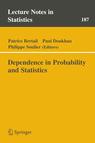 Series: Lecture Notes in Statistics , Vol. 187
2006, VIII, 490 p., 40 illus., Softcover
ISBN: 0-387-31741-4
About this book
This book gives an account of recent developments in the field of
probability and statistics for dependent data. It covers a wide
range of topics from Markov chain theory and weak dependence with
an emphasis on some recent developments on dynamical systems, to
strong dependence in times series and random fields. There is a
section on statistical estimation problems and specific
applications. The book is written as a succession of papers by
field specialists, alternating general surveys, mostly at a level
accessible to graduate students in probability and statistics,
and more general research papers mainly suitable to researchers
in the field.
Table of contents
Regeneration-based statistics for Harris recurrent Markov chains
(Patrice Bertail, Stephan Clemencon).- Subgeometric ergodicity of
Markov chains (Randal Douc, Eric Moulines, Philippe Soulier).-
Limit theorems for dependent U-statistics (Herold Dehling).-
Recent results on weak dependence for causal sequences.
statistical applications to dynamic systems (Clementine Prieur).-
Parametrized Kantorovic-Rubin?tein theorem and application to the
coupling of random variables (Jerome Dedecker, Clementine Prieur,
Paul Raynaud De Fitte).- Exponential inequalities and estimation
of conditional probabilities (V. Maume-Deschamps).- Martingale
approximation of non adapted stochastic processes with nonlinear
growth of variance (Dalibor Volny).- Almost periodically
correlated processes with long memory (Anne Philippe, Donatas
Surgailis, Marie-Claude Viano).- Long memory random fields (Frederic
Lavancier).- Long memory in nonlinear processes (Rohit Deo,
Mengchen Hsich, Clifford M. Hurvich, Philippe Soulier).- A LARCH
(8) vector valued process (Paul Doukhan, Gilles Teyssiere, Pablo
Winant).- On a Szego type limit theorem and the asymptotic theory
of random sums, integrals and quadratic forms (Florin Avram,
Murad S. Taqqu).- Aggregation of doubly stochastic interactive
Gaussian processes and Toeplitz forms of U-statistics (Didier
Dacunha-Castelle, Lisandro Fermin).- On efficient inference in
GARCH processes (Christian Francq, Jean-Michel Zakoian).- Almost
sure rate of convergence of maximum likelihood estimators for
multidimensional diffusions (Dasha Loukianova, Oleg Loukianova).-
Convergence rates for density estimators of weakly dependent time
series (Nicolas Ragache, Olivier Wintenberger).- Variograms for
spatial max-stable random fields (Dan Cooley, Philippe Naveau,
Paul Poncet).- A non-stationary paradigm for the dynamics of
multivariate financial returns (Stefano Herzel, Catalin Starica,
Reha Tutuncu).- Multivariate non-linear regression with
applications (Tata Subba Rao, Gyorgy Terdik).- Nonparametric
estimator of a quantile function for the probability of event
with repeated data (Claire Pincon, Odile Pons).
Shumway, Robert H., Stoffer, David S.
Time Series Analysis and Its Applications
With R Examples, 2nd ed.
 Series: Springer Texts in Statistics
2006, XIII, 575 p., Hardcover
ISBN: 0-387-29317-5
About this textbook
Time Series Analysis and Its Applications presents a balanced and
comprehensive treatment of both time and frequency domain methods
with accompanying theory. Numerous examples using non-trivial
data illustrate solutions to problems such as evaluating pain
perception experiments using magnetic resonance imaging or
monitoring a nuclear test ban treaty. The book is designed to be
useful as a text for graduate level students in the physical,
biological and social sciences and as a graduate level text in
statistics. Some parts may also serve as an undergraduate
introductory course. Theory and methodology are separated to
allow presentations on different levels. Material from the
earlier 1988 Prentice-Hall text Applied Statistical Time Series
Analysis has been updated by adding modern developments involving
categorical time sries analysis and the spectral envelope,
multivariate spectral methods, long memory series, nonlinear
models, longitudinal data analysis, resampling techniques, ARCH
models, stochastic volatility, wavelets and Monte Carlo Markov
chain integration methods. These add to a classical coverage of
time series regression, univariate and multivariate ARIMA models,
spectral analysis and state-space models. The book is
complemented by ofering accessibility, via the World Wide Web, to
the data and an exploratory time series analysis program ASTSA
for Windows that can be downloaded as Freeware. Robert H. Shumway
is Professor of Statistics at the University of California, Davis.
He is a Fellow of the American Statistical Association and a
member of the Inernational Statistical Institute. He won the 1986
American Statistical Association Award for Outstanding
Statistical Application and the 1992 Communicable Diseases Center
Statistics Award; both awards were for joint papers on time
series applications. He is the author of a previous 1988 Prentice-Hall
text on applied time series analysis and is currenlty a
Departmental Editor for the Journal of Forecasting. David S.
Stoffer is Professor of Statistics at the University of
Pittsburgh. He has made seminal contributions to the analysis of
categorical time series and won the 1989 American Statistical
Association Award for Outstanding Statistical Application in a
joint paper analyzing categorical time series arising in infant
sleep-state cycling. He is currently an Associate Editor of the
Journal of Forecasting and has served as an Associate Editor for
the Journal fo the American Statistical Association.
Table of contents
Characteristics of Time Series * Time Series Regression and ARIMA
Models * Dynamic Linear Models and Kalman Filtering * Spectral
Analysis and Its Applications
Thomee, Vidar
Galerkin Finite Element Methods for Parabolic Problems,2nd ed.
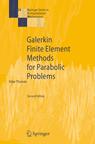 Series: Springer Series in Computational Mathematics , Vol. 25
2006, XII, 370 p., Hardcover
ISBN: 3-540-33121-2
About this book
This book provides insight in the mathematics of Galerkin finite
element method as applied to parabolic equations. The approach is
based on first discretizing in the spatial variables by
Galerkin's method, using piecewise polynomial trial functions,
and then applying some single step or multistep time stepping
method. The concern is stability and error analysis of
approximate solutions in various norms, and under various
regularity assumptions on the exact solution. The book gives an
excellent insight in the present ideas and methods of analysis.
The second edition has been influenced by recent progress in
application of semigroup theory to stability and error analysis,
particulatly in maximum-norm. Two new chapters have also been
added, dealing with problems in polygonal, particularly noncovex,
spatial domains, and with time discretization based on using
Laplace transformation and quadrature.
Zhilin Li and Kazufumi Ito
The Immersed Interface Method:
Numerical Solutions of PDEs Involving Interfaces and Irregular
Domains
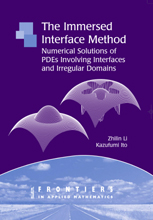 Frontiers in Applied Mathematics 33
"Most everything ever published on the topic is described・
tour de force on immersed interface methods."
・Loyce Adams, Department of Applied Mathematics, University of
Washington.
Interface problems arise when there are two different materials,
such as water and oil, or the same material at different states,
such as water and ice. If partial or ordinary differential
equations are used to model these applications, the parameters in
the governing equations are typically discontinuous across the
interface separating the two materials or states, and the source
terms are often singular to re?ect source/sink distributions
along codimensional interfaces. Because of these irregularities,
the solutions to the differential equations are typically
nonsmooth or even discontinuous. As a result, many standard
numerical methods based on the assumption of smoothness of
solutions do not work or work poorly for interface problems.
The Immersed Interface Method: Numerical Solutions of PDEs
Involving Interfaces and Irregular Domains provides an
introduction to the immersed interface method (IIM), a powerful
numerical method for solving interface problems and problems
defined on irregular domains for which analytic solutions are
rarely available. This book gives a complete description of the
IIM, discusses recent progress in the area, and describes
numerical methods for a number of classic interface problems. It
also contains many numerical examples that can be used as
benchmark problems for numerical methods designed for interface
problems on irregular domains.
The IIM is a sharp interface method that has been coupled with
evolution schemes such as the level set and front tracking
methods and has been used in both finite difference and finite
element formulations to solve several moving interface and free
boundary problems. In particular, the authors discuss the IIM
applications to Stefan problems and unstable crystal growth,
incompressible Stokes and Navier亡tokes flows with moving
interfaces, an inverse problem identifying unknown shapes in a
region, a nonlinear interface problem of magnetorheological ?uids
containing iron particles, and other problems. The book also
contains several applications of free boundary and moving
interface problems, including examples from physics,
computational fluid mechanics, mathematical biology, material
science, and other fields.
The IIM, which is based on uniform or adaptive Cartesian/polar/spherical
grids or triangulations, is simple enough to be implemented by
researchers and graduate students with a reasonable background in
differential equations and numerical analysis yet powerful enough
to solve complicated problems with high-order accuracy. Since
interfaces or irregular boundaries are one dimension lower than
solution domains, the extra costs in dealing with interfaces or
irregular boundaries are generally insigni?cant, and many
software packages based on uniform Cartesian/polar/spherical
grids, such as the FFT and fast Poisson solvers, can be applied
easily with the IIM. The most recent IIM computer codes and
packages are available online.
Audience: This book will be a useful resource for mathematicians,
numerical analysts, engineers, graduate students, and anyone who
uses numerical methods to solve computational problems,
particularly problems with fixed and moving interfaces, free
boundary problems, and problems on irregular domains.
Contents: Preface; Chapter 1: Introduction; Chapter 2: The IIM
for One-Dimensional Elliptic Interface Problems; Chapter 3: The
IIM for Two-Dimensional Elliptic Interface Problems; Chapter 4:
The IIM for Three-Dimensional Elliptic Interface Problems;
Chapter 5: Removing Source Singularities for Certain Interface
Problems; Chapter 6: Augmented Strategies; Chapter 7: The Fourth-Order
IIM; Chapter 8: The Immersed Finite Element Methods; Chapter 9:
The IIM for Parabolic Interface Problems; Chapter 10: The IIM for
Stokes and Navier?Stokes Equations; Chapter 11: Some Applications
of the IIM; Bibliography; Index.
About the Authors: Zhilin Li is a Professor in the Department of
Mathematics and Center for Research in Scientific Computing at
North Carolina State University. Kazufumi Ito is a Professor in
the Department of Mathematics and Center for Research in
Scientific Computing at North Carolina State University.
2006 / xvi + 332 pages / Softcover
ISBN-10: 0-89871-609-8 / ISBN-13: 978-0-898716-09-2
Claus Gerhardt, University of Heidelberg, Germany
Analysis II
 Hardcover
ISBN-10: 1-57146-160-4
ISBN-13: 978-1-57146-160-5
Year Published: 2006
Pages: 395 pages
Binding: Hardcover
Description:
Analysis II is the second and last part of an introduction to
analysis which is based on the author's undergraduate course,
Analysis I-III, and the more advanced course, Tensoranalysis, at
Heidelberg. It comprises of materials for a four-semester course,
and can be used as a textbook.
The book covers "Elements of functional analysis,
differentiation in Banach spaces, the fundamental existence
theorems in analysis, ordinary differential equations, Lebesgue's
theory of integration, tensor analysis, and the theory of
submanifolds in semi-Riemannian spaces."
This book is intended for graduate students or for very motivated
undergraduates who want to pursue studies in the fields of Math
or Physics.
Table of Contents (chapters):
Elements of functional analysis
Differentiation in Banach spaces
Existence theorems
Ordinary differential equations
Lebesgue's Theory of Integration
Tensor analysis
Theory of submanifolds