Guy D. Coughlan / James E. Dodd / Ben Gripaios
University of Oxford
The Ideas of Particle Physics, 3rd Edition
An Introduction for Scientists
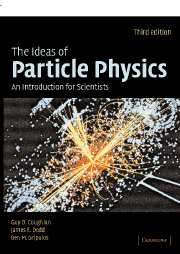 Paperback (ISBN-13: 9780521677752 | ISBN-10: 0521677750)
The third edition of this well-received book is a readable
introduction to the world of particle physics. It bridges the gap
between traditional textbooks on the subject and popular accounts
that assume little or no background knowledge. Carefully revised
and updated, this new edition covers all of the important
concepts in our modern understanding of particle physics. The
theoretical development of the subject is traced from the
foundations of quantum mechanics and relativity through to the
most recent particle discoveries and the formulation of modern
string theory. It includes a full description of the prospects
for the Large Hadron Collider at CERN, which will allow many key
ideas to be tested. The book is intended for anyone with a
background in the physical sciences who wishes to learn more
about particle physics. It is also valuable to students of
physics wishing to gain an introductory overview of the subject.
* Third edition of a well-reviewed treatment of the modern
theories of matter, energy and the structure of the universe
* Includes description of most recent particle experiments and
discoveries and the formulation of string theory
* Will be of particular interest in preparation for the operation
of the Large Hadron Collider at CERN due in 2007
Contents
Introduction; 1. Basic particle physics; 2. Strong interaction
physics; 3. Weak interaction physics I; 4. Weak interaction
physics II; 5. Gauge theory of the weak interactions; 6. Deep
inelastic scattering; 7. Quantum chromodynamics - the theory of
quarks; 8. Electron-positron collisions; 9. The Standard Model
and beyond; Appendices.
D. R. Cox
Nuffield College, Oxford
Principles of Statistical Inference
 Hardback (ISBN-13: 9780521866736 | ISBN-10: 0521866731)
Paperback (ISBN-13: 9780521685672 | ISBN-10: 0521685672)
In this definitive book, D. R. Cox gives a comprehensive and
balanced appraisal of statistical inference. He develops the key
concepts, describing and comparing the main ideas and
controversies over foundational issues that have been keenly
argued for more than two-hundred years. Continuing a sixty-year
career of major contributions to statistical thought, no one is
better placed to give this much-needed account of the field. An
appendix gives a more personal assessment of the merits of
different ideas. The content ranges from the traditional to the
contemporary. While specific applications are not treated, the
book is strongly motivated by applications across the sciences
and associated technologies. The mathematics is kept as
elementary as feasible, though previous knowledge of statistics
is assumed. The book will be valued by every user or student of
statistics who is serious about understanding the uncertainty
inherent in conclusions from statistical analyses.
* Authoritative: D. R. Cox is the pre-eminent statistician - both
theoretical and applied - unrivalled in scope and experience
* Balanced: Careful comparison of frequentist and Bayesian
approaches allows readers to form their own opinion of advantages
and disadvantages
* Compact: Concise, conceptual explanations use mathematics but
avoid technicalities
Contents
Preface; 1. Preliminaries; 2. Some concepts and simple
applications; 3. Significance tests; 4. More complicated
situations; 5. Some interpretational issues; 6. Asymptotic
theory; 7. Further aspects of maximum likelihood; 8. Additional
objectives; 9. Randomization-based analysis; Appendix A. A brief
history; Appendix B. A personal view; References; Author index;
Index.
James C. McWilliams
University of California, Los Angeles
Fundamentals of Geophysical Fluid Dynamics
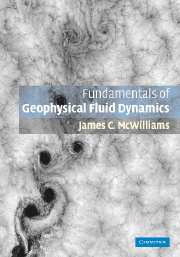 Hardback (ISBN-13: 9780521856379 | ISBN-10: 052185637X)
Earth's atmosphere and oceans exhibit complex patterns of fluid
motion over a vast range of space and time scales. These patterns
combine to establish the climate in response to solar radiation
that is inhomogeneously absorbed by the materials comprising air,
water, and land. Spontaneous, energetic variability arises from
instabilities in the planetary-scale circulations, appearing in
many different forms such as waves, jets, vortices, boundary
layers, and turbulence. Geophysical fluid dynamics (GFD) is the
science of all these types of fluid motion. This textbook is a
concise and accessible introduction to GFD for intermediate to
advanced students of the physics, chemistry, and/or biology of
Earth's fluid environment. The book was developed from the
author's many years of teaching a first-year graduate course at
the University of California, Los Angeles. Readers are expected
to be familiar with physics and mathematics at the level of
general dynamics (mechanics) and partial differential equations.
* Covers the essential GFD required for atmospheric science and
oceanography courses
* Mathematically rigorous, concise coverage of basic theory and
applications to both oceans and atmospheres
* Author is a world expert; this book is based on the course he
has taught for many years
* Exercises are included, with solutions available to instructors
from solutions@cambridge.org
Contents
Preface; List of symbols; 1. Purposes and value of geophysical
fluid dynamics; 2. Fundamental dynamics; 3. Barotropic and vortex
dynamics; 4. Rotating shallow-water and wave dynamics; 5.
Baroclinic and jet dynamics; 6. Boundary-layer and wind-gyre
dynamics; Afterword; Exercises; Bibliography; Index.
Jose Wudka
University of California, Riverside
Space-Time, Relativity, and Cosmology
 Hardback (ISBN-13: 9780521822800 | ISBN-10: 0521822807)
Space-Time, Relativity and Cosmology provides a historical
introduction to modern relativistic cosmology and traces its
historical roots and evolution from antiquity to Einstein. The
topics are presented in a non-mathematical manner, with the
emphasis on the ideas that underlie each theory rather than their
detailed quantitative consequences. A significant part of the
book focuses on the Special and General theories of relativity.
The tests and experimental evidence supporting the theories are
explained together with their predictions and their confirmation.
Other topics include a discussion of modern relativistic
cosmology, the consequences of Hubble's observations leading to
the Big Bang hypothesis, and an overview of the most exciting
research topics in relativistic cosmology. This textbook is
intended for introductory undergraduate courses on the
foundations of modern physics. It is also accessible to advanced
high school students, as well as non-science majors who are
concerned with science issues.
* Uses a historical perspective to describe the evolution of
modern ideas about space and time
* The main arguments are described using a completely non-mathematical
approach
* Ideal for physics undergraduates and high-school students, non-science
majors and general readers
Contents
1. The scientific method; 2. From antiquity to Aristotle; 3. From
the Middle Ages to Heliocentrism; 4. Galileo and Newton; 5. The
clouds gather; 6. The special theory of relativity; 7. The
general theory of relativity; 8. The relativistic universe; 9.
The lives of a star; Bibliography; Index.
Wei-Chau Xie
University of Waterloo, Ontario
Dynamic Stability of Structures
 Hardback (ISBN-13: 9780521852661 | ISBN-10: 0521852668)
This book presents a systematic introduction to the theory of
parametric stability of structures under both deterministic and
stochastic loadings. A comprehensive range of theories are
presented and various application problems are formulated and
solved, often using more than one approach. Investigation of an
elastic system’s dynamic stability frequently leads to the
study of dynamic behavior of the solutions of parametrically
excited systems. Parametric instability or resonance is more
dangerous than ordinary resonance as it is characterized by
exponential growth of the response amplitudes even in the
presence of damping. The emphasis in this book is on the
applications and various analytical and numerical methods for
solving engineering problems. The materials presented are as self-contained
as possible, with all of the important steps of analysis provided
in order to make the book suitable as a graduate level textbook
and especially for self-study.
* Has wide ranging theories and practical solutions
* Is particularly useful with respect to its main subject:
dynamic stability of structures
* This is a textbook with extended usefulness as a reference
Contents
1. Introduction; Part I. Dynamic Stability of Structures under
Deterministic Loadings: 2. Linear differential equations with
periodic coefficients; 3. Approximate methods; 4. Nonlinear
systems under Periodic excitations; Part II. Dynamic Stability of
Structures under Stochastic Loadings: 5. Random processes and
stochastic differential equations; 6. Almost-sure stability of
systems under ergodic excitations; 7. Moment stability of
stochastic systems; 8. Lyapunov exponents; 9. Moment Lyapunov
exponents; Appendix A. Maple programs; Bibliography.