William T. Shaw / King's College London
Complex Analysis with MATHEMATICA R
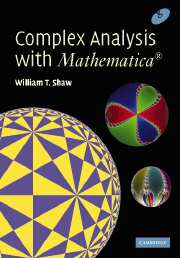 Hardback (ISBN-13: 9780521836265 | ISBN-10: 0521836263)
Complex Analysis with Mathematica offers a new way of learning
and teaching a subject that lies at the heart of many areas of
pure and applied mathematics, physics, engineering and even art.
This book offers teachers and students an opportunity to learn
about complex numbers in a state-of-the-art computational
environment. The innovative approach also offers insights into
many areas too often neglected in a student treatment, including
complex chaos and mathematical art. Thus readers can also use the
book for self-study and for enrichment. The use of Mathematica
enables the author to cover several topics that are often absent
from a traditional treatment. Students are also led, optionally,
into cubic or quartic equations, investigations of symmetric
chaos and advanced conformal mapping. A CD is included which
contains a live version of the book: in particular all the
Mathematica code enables the user to run computer experiments.
* Integration of a course on complex variables with the symbolic
computation system Mathematica
* An introduction to twistor methods and the use of complex
variables for 3 and 4 dimensional problems.
* Integration of a course on complex variables with Mathematica
software, supported by the accompanying CD
Contents
Preface; 1. Why you need complex numbers; 2. Complex algebra and
geometry; 3. Cubics, quartics and visualization of complex roots;
4. Newton-Raphson iteration and complex fractals; 5. A complex
view of the real logistic map; 6. The Mandelbrot set; 7.
Symmetric chaos in the complex plane; 8. Complex functions; 9.
Sequences, series and power series; 10. Complex differentiation;
11. Paths and complex integration; 12. Cauchy's theorem; 13.
Cauchy's integral formula and its remarkable consequences; 14.
Laurent series, zeroes, singularities and residues; 15. Residue
calculus: integration, summation and the augment principle; 16.
Conformal mapping I: simple mappings and Mobius transforms; 17.
Fourier transforms; 18. Laplace transforms; 19. Elementary
applications to two-dimensional physics; 20. Numerical transform
techniques; 21. Conformal mapping II: the Schwarz-Christoffel
transformation; 22. Tiling the Euclidean and hyperbolic planes;
23. Physics in three and four dimensions I; 24. Physics in three
and four dimensions II; Index.
Richard L. Epstein
With contributions by Leslaw W. Szczerba
Classical Mathematical Logic:
The Semantic Foundations of Logic
 Cloth | 2006 | ISBN: 0-691-12300-4
544 pp. | 7 x 10 | 20 line illus.
In Classical Mathematical Logic, Richard L. Epstein relates the
systems of mathematical logic to their original motivations to
formalize reasoning in mathematics. The book also shows how
mathematical logic can be used to formalize particular systems of
mathematics. It sets out the formalization not only of
arithmetic, but also of group theory, field theory, and linear
orderings. These lead to the formalization of the real numbers
and Euclidean plane geometry. The scope and limitations of modern
logic are made clear in these formalizations.
The book provides detailed explanations of all proofs and the
insights behind the proofs, as well as detailed and nontrivial
examples and problems. The book has more than 550 exercises. It
can be used in advanced undergraduate or graduate courses and for
self-study and reference.
Classical Mathematical Logic presents a unified treatment of
material that until now has been available only by consulting
many different books and research articles, written with various
notation systems and axiomatizations.
Richard L. Epstein received his doctorate in mathematics from the
University of California, Berkeley. He is the author of eleven
books, including two others in the series The Semantic
Foundations of Logic (Propositional Logics and Predicate Logic),
Five Ways of Saying "Therefore," Critical Thinking,
and, with Walter Carnielli, Computability. He is head of the
Advanced Reasoning Forum in Socorro, New Mexico.
Hoang Pham (Rutgers University, USA)
RELIABILITY MODELING, ANALYSIS AND OPTIMIZATION
 As our modern information-age society grows in complexity both in terms of embedded systems and applications, the problems and challenges in reliability become ever more complex. Bringing together many of the leading experts in the field, this volume presents a broad picture of current research on system modeling and optimization in reliability and its applications.
The book comprises twenty-three chapters organized into four
parts: Reliability Modeling, Software Quality Engineering,
Software Reliability, and Maintenance and Inspection Policies.
These sections cover a wide range of important topics, including
system reliability modeling, optimization, software reliability
and quality, maintenance theory and inspection, reliability
failure analysis, sampling plans and schemes, software
development processes and improvement, stochastic process
modeling, statistical distributions and analysis, fault-tolerant
performance, software measurements and cost effectiveness,
queueing theory and applications, system availability,
reliability of repairable systems, testing sampling inspection,
software capability maturity model, accelerated life modeling,
statistical control, and HALT testing.
Contents:
Reliability Modeling:
Optimal Checkpointing Interval for Task Duplication with Spare
Processing (S Nakagawa et al.)
Optimal Interval of CRL Issue in PKI Architecture (M Arafuka et
al.)
Applying Accelerated Life Models to HALT Testing (F Guerin et al.)
Software Quality Engineering:
Measurement of Object-Oriented Software Understandability Using
Spatial Complexity (J K Chhabra et al.)
An Approach to Quantifying Process Cost and Quality (G Twaites
& C Hoffman)
Software Process Improvement Activities Based on CMM (T Fujiwara
& S Yamada)
Software Reliability Modeling:
A Two-Level Continuous Sampling Plan for Software Systems (S
Hwang & H Pham)
An Extended Delayed S-Shaped Software Reliability Growth Model
Based on Infinite Server Queueing Theory (S Inoue & S Yamada)
Disappointment Probability Based on the Number of Debuggings for
Operational Software Availability Measurement (Y Saitoh et al.)
Maintenance and Inspection Policies:
Optimal Random and Periodic Inspection Policies (T Sugiura et al.)
Screening Scheme for High Performance Products (W-T Cheong &
L-C Tang)
Age-Dependent Failure Interaction (Q Zhao et al.)
and other papers
Readership: Serves as a reference for researchers and
practitioners in reliability and maintenance engineering,
software and information engineering, and safety and systems
engineering; may also be used as an advanced textbook for
graduate and post-graduate students engaged in reliability
research.
508pp Pub. date: Jun 2006
ISBN 981-256-388-1
************************************************