Terry Gannon
University of Alberta
Moonshine beyond the Monster
The Bridge Connecting Algebra, Modular Forms and Physics
 Series: Cambridge Monographs on Mathematical Physics
Hardback (ISBN-13: 9780521835312 | ISBN-10: 0521835313)
Moonshine forms a way of explaining the mysterious connection
between the monster finite group and modular functions from
classical number theory. The theory has evolved to describe the
relationship between finite groups, modular forms and vertex
operator algebras. Moonshine Beyond the Monster, the first book
of its kind, describes the general theory of Moonshine and its
underlying concepts, emphasising the interconnections between
modern mathematics and mathematical physics. Written in a clear
and pedagogical style, this book is ideal for graduate students
and researchers working in areas such as conformal field theory,
string theory, algebra, number theory, geometry, and functional
analysis. Containing over a hundred exercises, it is also a
suitable textbook for graduate courses on Moonshine and as
supplementary reading for courses on conformal field theory and
string theory.
* This is the first authored book on Moonshine and it will have
wide appeal
* A burgeoning research area, showing the connectedness of a
variety of topics
* Written in a clear and pedagogical style, emphasising the
fundamental ideas and interesting examples
Contents
Introduction: glimpses of the theory beneath Monstrous moonshine;
1. Classical algebra; 2. Modular stuff; 3. Gold and brass: Affine
algebras and generalisations; 4. Conformal field theory: The
physics of Moonshine; 5. Vertex operator algebras; 6. Modular
group representations throughout the realm; 7. Monstrous
Moonshine; Epilogue; References.
S. G. Hoggar
University of Glasgow
Mathematics of Digital Images
Creation, Compression, Restoration, Recognition
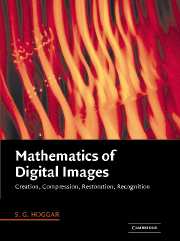 Hardback (ISBN-13: 9780521780292 | ISBN-10: 0521780292)
Compression, restoration and recognition are three of the key
components of digital imaging. The mathematics needed to
understand and carry out all these components are explained here
in a style that is at once rigorous and practical with many
worked examples, exercises with solutions, pseudocode, and sample
calculations on images. The introduction lists fast tracks to
special topics such as Principal Component Analysis, and ways
into and through the book, which abounds with illustrations. The
first part describes plane geometry and pattern-generating
symmetries, along with some on 3D rotation and reflection
matrices. Subsequent chapters cover vectors, matrices and
probability. These are applied to simulation, Bayesian methods,
Shannon's information theory, compression, filtering and
tomography. The book will be suited for advanced courses or for
self-study. It will appeal to all those working in biomedical
imaging and diagnosis, computer graphics, machine vision, remote
sensing, image processing and information theory and its
applications.
* Written to be understood not only by engineers but by all
concerned with digital image issues
* Builds up the required probability and information theory from
scratch
* Draws on material from author's successful earlier book
Contents
Introduction; 1. Isometries; 2. How isometries combine; 3. The
braid patterns; 4. Plane patterns and symmetries; 5. The 17 plane
patterns; 6. More plane truth; 7. Vectors and matrices; 8. Matrix
algebra; 9. Probability; 10. Random vectors; 11. Sampling and
inference; 12. Entropy and coding; 13. Information and error-correction;
14. The Fourier transform; 15. Transforming images; 16. Scaling;
17. B-spline wavelets; 18. Further methods; References; Symbols;
Selected answers; Index.